Moving Linguistic Borders
From a geographical point of view, linguistic displacement can also take place in different ways. For example, when an incoming new elite takes the ruling power of the region, a possible pattern may be the apparition of several language shift sources —e.g., near government, education or religious emplacements.
On the other hand, when the language shift mechanism implies population displacement (due to immigration and a subsequent rapid growth), there will be a moving linguistic border between the two languages that will understandably progress with the incoming population; usually such situation can be seen as an advancing front driven by the population growth and thus can be easily described through wave-of-advance models. However we can also have a moving linguistic frontier without the need of an immigrant population front. This is the case when the new language is introduced from a neighbouring region.We can mathematically model the progress of a linguistic frontier over time and space, when the displacement mechanism is due to language acquisition rather than population substitution, with a reaction-diffusion model similar the wave-of-advance models; that is, a model where the population dynamics is simplified to short-range migration (e.g., due to marriage), and the increase or decrease in the population number is due to factors such as population growth or conversion into another population group. However, as opposed to the classic wave-of-advance model (Ammerman and Cavalli-Sforza 1973), now the main driver will be the language shift (conversion into another linguistic group) rather than the population growth.
A general reaction-diffusion model to describe the dynamics of two linguistic groups, where a language A is gaining speaker in detriment of language B, may be

Note that the equations now do not deal with fractions of speakers (pA and pB) but with population densities (nA and nB).
These equations estimate the evolution over time of the density of speakers of each language at every position and time instant in terms of three processes: diffusion, population growth and conversion. The first term on the right-hand side of the equations is the diffusion term, which is related to short-range migrations without colonizing intent. This diffusion is characterized by a diffusion coefficient D. The second term is related to the population growth. Population growth is often described by a logistic function where populations with low densities grow exponentially, with a growth rate a, but the process is self-limiting when the population density nears a saturating density defined as the carrying capacity K. In the equation above, Eq. 7.3, the growth is limited by the densities of both populations, since they all share the same land and resources (Isern and Fort 2010). In addition, since we assume that they all have, in principle, similar ways of live, the parameters D, a and K are the same for both linguistic groups. Finally, the last term corresponds to the conversion of speakers from language B to language A, with the shift rate depending on the densities of speakers of each language at every location. As in the previous Eqs. 7.1 and 7.2, the opposed sign in this last term of Eq. 7.3 means that the speakers lost by language B become speakers of language A.However, since the introduction of the new language does not yield, in this case, the assimilation of new technologies leading to a rapid population growth, we may assume that the total population number will vary slowly over time, especially in comparison with the language shift rate. Therefore, as a first approximation, the growth term in Eq. 7.3 (second term on the right-hand side) can be dropped. Such approximation simplifies the described dynamics, since now we only have to deal with population diffusion and language shift, but it also allows us to rewrite Eq. 7.3 in terms of the population fraction, thus enabling us to replace the generic conversion term by the language displacement model introduced in the previous section, Eq.
7.2. The model is then expressed as follows (Isern and Fort 2014),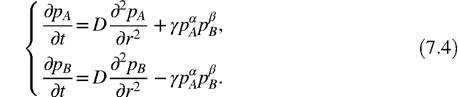
This simplified system describes, for every point in the region, the evolution over time of the fraction of speakers of each language within a population that is not experimenting substantial changes in the total population number. This evolution depends on short-range migrations of the population and the language shift process, according to which the indigenous population acquires a new language that they see as more advantageous socially or economically.
Since we are assuming that the new language is introduced from an adjacent region, the language shift will happen initially near the border, and then the new language will be progressively introduced further into the territory. From the model above, described by Eq. 7.4, we can measure the speed of the linguistic frontier by resolving the equation numerically (that is, with a computational simulation). It is also possible to derive mathematical expressions from which we can obtain a range within which lies the real speed, without having to resort to computational simulations. This is possible by assuming that the moving frontier is mostly planar
(which is realistic if the language shift “source” is a political border) and through variational analysis of Eq. 7.4 (Benguria and Depassier 1994, 1998), which leads to the following expression for the upper bound (Isern and Fort 2014)

and the following one for the lower bound (Isern and Fort 2014)

where the gamma function is defined by the following integral
r(x) = J0°° tx — 1 e — ‘dt, for x >0 (Murray and Liu 1999).
The values of the bounds are obtained from the previous Eqs. 7.5 and 7.6 by searching for the maximum result of the right-hand side expression for values of S in the range (0, 1) for the lower bound, and for values of pA in the range (0, 1) for the upper bound.
7.5
More on the topic Moving Linguistic Borders:
- In chapter 5,1 argued against linguistic accounts of vagueness on the grounds that if it is true that we cannot know whether Harry is bald, then this is not because of the way the English sentence ‘Harry is bald' happens to be used. Whether a belief that Harry is bald constitutes knowledge or not, I suggested, is just not sensitive to facts about your linguistic environment.
- Is Vagueness Linguistic?
- Borders and Population Changes
- FROM PRODUCER TO SUPPLIER AND MOVING TO A NEW SINGULARITY
- The linguistic turn
- Nutrients in streams and rivers cycle while moving downstream
- Cossacks and Borders
- Managing Borders
- Critical Theory and the Linguistic Turn
- CHAPTER NINE Moving toward Caveat Venditor
- Linguistic Assessment of Legal Normativity
- The shifting borders of modern Europe?