CHAPTER NINE Moving toward Caveat Venditor
Shortly after Franklin Delano Roosevelt’s inauguration in March 1933, he sent a special message to Congress that called for federal regulation of the securities markets. Taking note of the “severe losses” that investors had incurred “through practices neither ethical nor honest on the part of many persons and corporations selling securities,” the new president asked for legislation that would require comprehensive disclosures by marketers of stocks and bonds.
The enormity of the Great Depression, he argued, demanded new standards for communication by public corporations, investment bankers, and other players in financial markets. In order to restore “public confidence” in mechanisms of capital allocation, Congress had to place “the burden of telling the whole truth on the seller.” Without oversight that ensured candor by the vendors of investments, Roosevelt proclaimed, stock exchanges and the bond markets would remain moribund, as shell-shocked investors shunned public securities.1Roosevelt’s plea represented a turning point in the policing of business fraud in the United States. After some wrangling over details, Congress acceded to his request, creating a powerful agency to supervise America’s capital markets, the Securities and Exchange Commission (SEC). Along with the 1938 Wheeler-Lea Act, which extended the FTC’s jurisdiction over duplicitous marketing, the creation of the SEC vastly expanded federal responsibility for regulating the truthfulness of economic speech. During the New Deal, the nation’s elected officials pledged to redress informational asymmetries within America’s industrialized, continental economy. They chose to act through robust bureaucracies that would monitor national marketplaces and combat deceptive business practices. These developments ushered in a half-century of intensive public action to constrain economic duplicity.
Congress, statehouses, and city councils passed legislation that attacked such deceit, both in general and with respect to specific markets such as retail trade, franchising, and consumer credit. From the late 1950s through the 1970s, states and municipalities also launched new agencies charged with combating business fraud.One must be careful not to overstate the degree of change associated with post-New Deal antideception regulation. Legislators and other policymakers had many earlier experiments upon which to build, and the fraud-fighting endeavors of the mid-twentieth century retained key features of those precursors. The waxing insistence that sellers face stricter standards at no point meant forsaking the assumption that economic actors had to be able to fend for themselves. Roosevelt explained that his call for tighter securities regulation did not absolve buyers from the duty to keep a sharp lookout. Rather, the proposal “adds to the ancient rule of caveat emptor [‘Let the buyer beware'] the further doctrine: ‘Let the seller also beware' [caveat venditor]” The crafting and implementation of New Deal securities legislation adhered to this formulation. Indeed, almost all of the antifraud policies enacted by American legislatures and regulatory agencies between 1933 and the 1970s were premised on due diligence by economic actors. Those policies also reflected abiding anxieties about extending too much power to administrative bureaucracies, whether through overgenerous budgetary allocations or the granting of undue discretionary authority. As a result, even at the height of the more expansive mid-twentiethcentury American state, nongovernmental and self-regulatory organizations continued to play key roles in the antifraud regulatory environment.
The Roosevelt administration's embrace of caveat venditor nonetheless signaled a shift in political discourse and policy. For the following four decades, American legislators and regulators from both political parties gave less credence to assertions of economic freedom, and worried more about preserving popular confidence in markets or treating economic actors fairly.
They also framed antifraud policies in terms of consumer and investor protection. Indeed, only with the New Deal did those phrases come into common currency.2The next three chapters survey American fraud policing from the New Deal through the 1970s. This chapter considers antifraud efforts into the early 1960s, focusing on federal regulation of the financial markets and retail marketing, as well as related undertakings by Better Business Bureaus. Chapters Ten and Eleven grapple with the impact of consumerism on antifraud regulation from the late 1950s through the late 1970s. Together, these three chapters document wide-ranging attacks on commercial deception through legislative statutes, administrative rule-making, and, in some contexts, judicial interpretation. They also chart the bipartisan construction of a much denser and more integrated network of antifraud institutions, both public and outside the state. Despite enduring constraints on the reach and effectiveness of antifraud regulation, all of this activity circumscribed the scale, scope, and impact of marketplace deceptions.
Institutional Designs and Intellectual Foundations
New Deal antifraud regulation was born out of anxieties about the securities markets, which focused on decades-long patterns of self-dealing, manipulation, and misrepresentation, given new intensity by the post-World War I boom and subsequent stock market crash. During the dramatic run-up in stock prices from 1920 to 1929, Wall Street depended on a wider base of shareholders. Having become accustomed to investment through the World War I Liberty Bond campaign, and bombarded by the hard-sell techniques of fastgrowing brokerages such as Merrill Lynch, several million middle-class Americans joined the investing class.3 These newcomers purchased not just the securities of established sectors such as banking, insurance, transportation, and mining, but also shares in manufacturing, retail firms, and investment trusts, as well as foreign bonds.
The mix of strong demand, unsophisticated purchasers, and weak regulatory constraints generated powerful incentives for deceit.As Chapter Five demonstrated, mail fraud enforcement had targeted stock and bond swindlers since the late 1870s, and interstate investment fraud became a more substantial priority for the Post Office Department in the 1910s and 1920s, resulting in scores of prosecutions and convictions. During World War I, the Treasury Department's Capital Issues Committee received the authority to scrutinize proposed initial public offerings and to disallow the marketing of any issues deemed to be inconsistent with the war effort. Far more substantial regulatory legislation occurred at the state level, with the outpouring of blue-sky laws.
Rather than truly discriminating filters, however, state regulatory schemes proved to be at once porous and overly restrictive. The former problem resulted from legislative exemptions, either for sectors such as utilities and banking, or for companies with listed securities. The Investment Bankers of America (IBA), founded in 1913 to fend off the threat posed by blue-sky laws, worked hard to establish safe harbors for stocks and bonds sold on exchanges. Woeful bureaucratic limitations further hampered state regulation. Legislative appropriations often allowed only cursory enforcement, and even the best- funded agencies did not constrain the tip sheets and telephone boiler rooms that drove interstate sales. At the same time, promoters inveighed against bluesky licensing requirements. To these apostles of enterprise, the new rules created legal “shackles” that only reinforced the power of established stock exchanges and investment banks, while placing a “strait jacket [on] industrial development.”4
Even New York's far-reaching attempts to curb securities fraud through the 1921 Martin Act and the creation of a dedicated Bureau for the Prevention of Fraudulent Securities (BPFS) faced important limits.
From 1925 onward, it distributed compulsory questionnaires to promoters and stock brokerages, so that it might learn about questionable practices even without specific complaints from investors.5 BPFS attorneys initiated thousands of fraud investigations during the 1920s and 1930s, pursued hundreds of injunctive proceedings to force firms out of business, and brought scores of criminal prosecutions. Its success rate in the courts, moreover, represented a distinctive break from the hapless record of nineteenth-century state antifraud enforcement actions. As with requests for mail fraud orders, most BPFS motions for injunctions and the appointment of receiverships went uncontested; the Bureau usually prevailed when promoters or brokerages opposed it in court, and its criminal fraud prosecutions, while far less common than injunctive proceedings, typically resulted in convictions.6 BPFS could and did point to successful enforcement actions against large-scale investment frauds. Attorneys general and their deputies took every opportunity to crow about their fearless takedowns of the New York's Consolidated Stock Exchange during the mid-1920s, George Graham Rice's promotion of the Idaho Copper Mine, Charles Bob's looting of a mining investment trust, and many other financial frauds. Officials also stressed that the Bureau's impact extended beyond putting investment swindlers out of business or in jail, because initial inquiries from staff attorneys often convinced securities firms to reform their marketing practices.7Despite official breast-beating, contemporaries questioned how much enforcement of the Martin Act curbed the hawking of fraudulent investments. There were too many dodgy promoters for a few dozen investigators, attorneys, and clerks to track down, leading to laments from attorneys general about stingy appropriations and an impossible workload. Too often, critics such as the Progressive lawyer Samuel Untermeyer argued that enforcement under the Martin Act would merely “lock the stable door on these promotion frauds after the stock had been distributed and the thieves had bolted with their swag.” Furthermore, court orders to dissolve fraudulent securities firms, again like mail fraud orders, did not prevent seasoned operators from relaunching scams through new firms.
And Martin Act investigations targeted fringe operators—outsiders who dealt in unlisted stocks. Like the investigators of the Better Business Bureaus, the BPFS rarely scrutinized national financial elites.8Amid the prosperity unleashed by World War I, as well as a heightened pace of technological diffusion and a rapid expansion of consumer credit, shady practices became endemic in Wall Street. Large public corporations such as the Insull utilities’ holding companies took advantage of permissive accounting standards to inflate income statements, thereby facilitating the marketing of new securities.9 Corporate insiders and the managers of stock pools relied on a corrupt press corps to disseminate news favorable to their trades and manipulated prices directly through wash or matched sales—transactions in which they arranged to have confederates purchase shares to create the appearance of intensifying demand and increasing prices. Floor traders and specialists at the NYSE took advantage of knowledge about pending orders to engage in “frontrunning.” As these insiders received large orders that would affect prices, they first placed trades on their own account that would appropriate some of the economic value from those price movements.10 The investment trusts that sprang up during the 1920s created a culture of secrecy that abetted misrepresentation. Although fund managers claimed to have adopted sophisticated portfolio strategies that minimized risks, they often used investor funds to prop up struggling companies that they controlled, skimmed profits through undisclosed management and underwriting fees, and amplified risks by purchasing securities on margin.11
Investment banks and stock brokerages indulged in both conflicts of interest and deceptive practices. When underwriting initial public offerings of stock, investment bankers underpriced shares and reserved placements for corporate insiders and other favored clients, including members of the nation’s political and legal elite.12 In marketing the sovereign debt of struggling Latin American countries such as Peru, banking syndicates characterized the securities as low- risk, despite internal reports that warned of parlous fiscal situations.13 Banks and brokerage firms that sold securities to the broad middle class, such as National City, adopted several practices of the boiler room brigade. In addition to training salesmen in high-pressure tactics and implementing commissionbased remuneration policies that encouraged stretching of the truth, they trimmed the firms’ losses on poorly performing stocks in their portfolios by instructing sales personnel to push those securities on retail customers.14
On the eve of the Great Depression, New York Attorney General Hamilton Ward conceded that prevailing regulations, including his own state’s Martin Act, did little to prevent the most barefaced securities frauds. “The Martin Act,” Ward observed, “is no protection against the common thief who claims to be a broker or salesman and deals in worthless securities. From the petty grafter to the gang of high-pressure salesmen with plenty of money who open a big office, there is a large field in which the remedies provided by the Martin Act help but little.” Amid the wreckage strewn about the post-1929 financial landscape, the most ambitious forms of state antifraud legislation appeared even more insufficient.15
Malfeasance in the financial sector attracted public critiques before the New Deal, whether through the tell-all memoirs of stock operators Thomas Lawson, George Graham Rice, and Jesse Livermore, the analyses of academics such as economist William Z. Ripley, or the coverage of muckraking journalists such as John T. Flynn.16 But only with the Senate Banking Committee’s hearings on the securities markets did many Americans learn about the seamier side of the 1920s stock boom. These hearings, which began in the spring of 1932 and picked up momentum after Roosevelt’s election and the selection of Ferdinand Pecora as lead counsel, received saturation press coverage. The evidence presented by Pecora demonstrated the questionable ethics and behavior of vaunted firms, including National City Bank and J. P. Morgan. The hearings undercut Wall Street’s image, set off a political furor, and laid the groundwork for the Securities Act of 1933 and the Securities and Exchange Act of 1934.17
This pair of statutes remolded the marketing of securities. Although some Roosevelt administration officials and congressmen wished to create a federal “blue-sky” law, the chief drafters of the legislation, including Harvard law professors Felix Frankfurter and James Landis, viewed state regulatory approaches as failures. Instead of vesting the federal government with the obligation to certify new stock issues as reasonable propositions, Frankfurter and Landis joined two separate strategies of regulatory governance. The first involved bans on insider trading, market manipulations, and deceptions in initial public offerings and the secondary shares market. Here the architects of reform emulated the approach of the Martin Act, as well as state false pretenses laws and the federal mail fraud statute: they presumed that vigorous criminal prosecutions would deter outlawed behavior. The second strategy followed the longstanding logic of British financial regulation, which emphasized transparency in accounting and truthful marketing claims. The New Deal securities laws imposed rigorous disclosure requirements on public corporations, investment banks, and stock brokerages. But American legislators also extended the British approach. Across the Atlantic, the government depended on investors to identify wayward companies and promoters. Congress instead created an administrative regime to oversee provision of financial information, lodged in a new oversight body, the SEC.
Before investment banks could sell new securities to investors, they had to register proposed offerings (first with the FTC and, starting in 1934, with the SEC) and then wait twenty days before making sales. Registration documents had to furnish information about past performance, future strategy and prospects, assets and capital structure, and underwriting fees and sales commissions. If questions arose about veracity or completeness, firms could amend statements during the waiting period. If the SEC judged the information to be incomplete or untruthful, it could issue an administrative stop order that blocked offerings. Public companies further had to submit quarterly and annual statements about earnings and financial conditions, audited by independent accountants and consistent with accounting standards approved by the SEC in conjunction with the American Accounting Institute. The legislation furnished exemptions for small-scale stock offerings, closely-held companies with fewer than one thousand shareholders, and corporations with only instate investors; but it reached most stocks and bonds owned by American investors.18
Three later pieces of legislation completed the New Deal architecture of securities regulation, each designed in light of SEC investigations and hearings. The 1938 Maloney Act mandated the creation of quasi-public regulatory organizations to oversee America's hundreds of brokerages as well as the “over-the- counter” (OTC) market, which took place through telephone trades based on privately circulated price sheets, and which handled secondary bond transactions, stock purchases by large institutional investors, and trading in shares of unlisted companies. The new quasi-public associations would have authority to license brokers. They would further set training standards and rules of practice, monitor compliance with these rules, hear complaints from customers, and penalize brokers and firms that misled or mistreated investors. The SEC retained supervisory authority over self-regulatory institutions, as well as its own direct powers of rule-making, monitoring, and enforcement. After the passage of the Maloney Act, the industry settled on a single self-regulatory organization (SRO) to fulfill these roles, with the IBA reconstituting itself to become the National Association of Securities Dealers (NASD).19
Two years later, Congress enacted the Investment Companies Act and the Investment Advisers Act, which established regulatory oversight of investment trusts and the new fields of investment counselors and portfolio managers that had emerged after World War I. The first of these two statutes prohibited self-dealing in the selling and investment practices of mutual funds. It also barred individuals who had been sanctioned for securities fraud from serving as investment company directors or officers, required investment companies to register with the SEC, and mandated that those corporations provide investors with detailed updates about holdings, financial structure, and strategy. The second statute required advisers to register with the SEC and disqualified individuals who had participated in securities fraud; it further forbade material misrepresentations and mandated disclosure of potential conflicts of interest.20
On occasion, the SEC extended rules against deceptive practices, as in 1942, when it adopted Rule 10b-5. This regulation clarified the 1933 Securities Act's prohibition of fraud in securities transactions, declaring that it covered purchases as well as sales, omissions of material facts that made claims misleading, and any other kind of deceitful “device, scheme, or artifice.” For almost two decades, Rule 10b-5 remained a minor element of securities regulation, ignored by SEC enforcement staff and securities lawyers. But in 1961, more aggressive officials adopted an interpretative opinion that this rule prohibited stock trading by corporate officers who were taking advantage of nonpublic information, as well as the provision of such information to others who then traded on it.21
All of this legislative and administrative action was premised on the use of regulatory power to reshape the business environment. The central goal of disclosure requirements on corporations and investment banks, like the licensing mechanisms for stock brokerages, stock dealers, and investment advisers, was to remake the structure and culture of the financial markets. Toward this end, legislative framers, along with SEC staff, enlisted the help of financial professionals. Policymakers concentrated on private gatekeepers such as corporate attorneys, who had the responsibility to oversee compliance with the new requirements, and public accountants, whom the legislation anointed as monitors of corporate financial statements. This strategy of administrative prevention retained punitive features. Failure to abide by disclosure requirements made corporations subject to civil and criminal penalties, as did adoption of deceptive or fraudulent marketing practices. The Securities Acts also gave investors standing to sue for damages if corporations had made false claims or withheld material information, and if investors had suffered losses due to reliance on false or incomplete representations. But their central aim was to construct a new set of norms and practices about communicating truthful financial information.22 The apex of regulatory power in this system lay with the SEC and its hundreds of government lawyers, economists, and bureaucrats. Nonetheless, its designers remained leery of gumming up the securities markets with excessive red tape. As a result, they delegated extensive responsibility for regulatory compliance to the long-established stock exchanges, the newly created NASD, and the legal and accounting professions.23
As with securities law, post-1933 regulation of duplicitous retailing built on institutional forerunners and involved more robust activity by the national government. The most important federal agency in this policy arena remained the FTC. During the 1910s and 1920s, FTC lawyers had investigated thousands of businesses to determine whether they had violated Section 5 of the FTC Act, which outlawed “unfair methods of competition.” Its inquiries generated hundreds of “cease and desist” enforcement actions, as well as many more stipula- tions—written pledges to discontinue objectionable business practices. At no point, however, did the FTC enunciate the marketing transgressions that would trigger investigations. FTC administrative law judges and commissioners rather laid out principles piecemeal in case opinions.
Through this common law-like accretion, the pre-New Deal FTC identified clusters of disfavored marketing deceptions. Misleading claims about the quantity, quality, or newness of goods raised the eyebrows of FTC officials, as did false assertions about place of origin, the nature of ingredients/compo- nents, and the seller's status within the business community. Other enforcement triggers included unjustified disparagement of competing firms; deceptive claims about prices, such as fake “going out of business” sales and the touting of big discounts from fictitious high list prices; and phony testimonials. The trade practice conferences of the 1920s and early 1930s, which hammered out voluntary codes of fair competition, applied these broad principles to the specific contexts of individual industries.24
From the onset of the New Deal through the 1960s, the FTC took a very dim view of these marketing tactics. As its investigators, hearings' officers, and commissioners evaluated allegations of commercial misrepresentations, they used a much lower evidentiary standard than that required for criminal fraud allegations. The issue of fraudulent intent did not factor into FTC assessments, at least as they substantiated cease and desist proceedings in court; nor did the question of whether purchases had been influenced by deceptive claims. Instead, as the Supreme Court ruled in the 1919 case of Sears Roebuck v. FTC, the Commission only had to find that advertising or other aspects of marketing “had a capacity or tendency to injure competitors directly or through deception of purchasers.”25
Later action by the courts and Congress expanded the reach of FTC regulation. Just a few months after President Roosevelt decisively shifted the Supreme Court's political balance through the appointment of Justice Hugo Black, that tribunal further lowered evidentiary requirements in FTC deception proceedings. The pivotal case was FTC v. Standard Education Society (1937), an appeal from an FTC cease and desist order against an encyclopedia distributor. According to the FTC, the firm's army of door-to-door salesmen falsely claimed that prominent figures had either contributed to or endorsed the encyclopedias; they told prospective purchasers that they wished to give them a set of volumes as a gift in order to gain access to their homes, before explaining that they would also have to pay for a ten-year subscription to monthly supplements; and they mischaracterized the regular purchase price as a steep discount. To argue its case in the federal courts, the Standard Education Society retained Henry Ward Beer, the fervent and long-time critic of expansive FTC administrative action. A federal appeals court vacated several elements of the FTC's order, resting its judgment on the logic of caveat emptor laid out by Beer. “We cannot,” the lower court argued, “take too seriously the suggestion that a man who is buying a set of books and a ten years' ‘extension service' will be fatuous enough to be misled by the mere statement that the first are given away, and that he is paying only for the second.” This opinion echoed the nineteenth-century jurists and editors who marveled at the stupidity of some Americans. On this view, if hopeless rubes insisted on ignoring telltale signs of imposition, courts had no business protecting them. After the FTC took the case to the Supreme Court, Justice Black rejected this contempt for the credulous sucker. “The fact that a false statement may be obviously false to those who are trained and experienced,” Black reasoned,
does not change its character, nor take away its power to deceive others less experienced. There is no duty resting upon a citizen to suspect the honesty of those with whom he transacts business. Laws are made to protect the trusting as well as the suspicious. The best element of business has long since decided that honesty should govern competitive enterprises, and that the rule of caveat emptor should not be relied upon to reward fraud and deception.
Black's opinion for the Court accordingly upheld the FTC order in its entirety.26 Like the post-1937 federal judiciary, Congress enlarged the FTC's fraud beat. During the 1920s, the Supreme Court had ruled that the FTC only possessed jurisdiction over duplicitous sales practices if it could show that they constituted “unfair methods of competition” that brought harm to other businesses. The 1938 Wheeler-Lea Act removed this limitation, prohibiting “deceptive practices” in interstate commerce regardless of losses incurred by other firms, and enhancing the FTC's powers to act against deceptively marketed food, drugs, and cosmetics.27
Buoyed by these moves by the Supreme Court and Congress, FTC hearing officers and commissioners pushed out the boundaries of illegal deception. From the 1940s through the mid-1960s, they continued to convene trade practice conferences, encouraging firms and trade associations to hammer out sectoral codes of fair competition. In the late 1950s, the Commission conducted economywide campaigns against fictitious pricing, bait and switch advertising, and deceptive guarantees. After distilling the broad principles that had underpinned cease and desist orders in these areas, it disseminated official guides and made them investigative priorities.28
These endeavors received deferential treatment from the federal courts. Midcentury appellate judges shied away from overturning FTC assessments in deceptive practices cases, even without evidence that customers had been deceived or that anyone had suffered quantifiable monetary harm. Members of the federal bench presumed that FTC experts could be trusted to look out for the “careless” and “least sophisticated” readers of advertising, identifying the tricky or ambiguous claims that would trip up easy marks. If those public servants found that descriptions of hair dye as “permanent” went beyond the legal pale, because the dye would not impact new growth, the courts would not upend their judgment. Nor would they overrule FTC findings that a company's “buy one, get one free” promotional campaign was deceptive, on the grounds that the firm had never sold the item at the stipulated price; or its rejection of a television shaving-cream advertisement that claimed the product could soften sandpaper, because the ad relied on “camera tricks” and a “simulated prop” made of Plexiglas covered in sand.29 As the eminent federal judge Learned Hand summed up the FTC's discretion in deception cases, it had the authority to require “a form of advertising clear enough so that, in the words of the prophet Isaiah, ‘wayfaring men, though fools, shall not err therein.'” FTC staff well understood the leeway that they enjoyed. The Commission's 1966 Manual for Attorneys described its mission as protecting the “most ignorant and unsuspecting purchaser.” This objective required that investigators assess the “general impression” of ads and promotional materials, but did not hinge on showings of intent and gave investigators flexibility in building cases, because establishing deceptiveness was not amenable to “any general or allpurpose rule of investigative procedure.”30 This paternalistic vision represented a stark reversal from the presumptions that defined transactions a century, or even a half-century, earlier.
With America's entry into World War II, the national government refocused antifraud policy on military contracting and the regime of consumer price controls. As manufacturers retooled factories to meet the insatiable demand for weapons, munitions, tanks, and planes, reports surfaced of overbilling and other abusive practices. Federal officials responded by scrutinizing the work and billing practices of contractors and subcontractors. The armed services adopted stringent rules about quality control and cost structures, and backed them up with thousands of civilian inspectors and auditors who spent most of their time within factories. Congressional committees held a series of hearings to keep administration officials attentive to the task of keeping contractors honest. This oversight encouraged jawboning over charges and contract renegotiations. Where such informal pressure did not generate satisfactory outcomes, the Defense Department initiated dozens of high-profile prosecutions, which in most cases led to convictions.31
The crucial arbiter of the wartime retail economy was the Office of Price Administration (OPA), which had the task of enforcing rationing systems and price controls on consumer goods. In Washington, OPA economists and scientists set price ceilings and quality standards for a bewildering variety of consumer goods, and then constructed rationing regulations for crucial items such as gasoline and meat. Across the nation, local OPA officials, many of them former BBB leaders, enlisted hundreds of volunteer advisory groups and tens of thousands of local board members to assist with the formulation and implementation of regulations. A companion army of volunteer “price assistants,” mostly housewives, monitored compliance with price and quantity controls in retail outlets.32 Fraud enforcement represented only a minor aim for this gargantuan bureaucracy, which remained focused on tamping down inflation and ensuring the fair distribution of essential goods. But the organization nonetheless spearheaded hundreds of investigations across the country into ration-coupon counterfeiting, as well as the fraudulent sale of highly indemand rebuilt radio sets and used cars, leading to scores of arrests and trials.33
In the decade and a half after World War II, Congress passed a series of other statutes that targeted specific forms of commercial deceit, including the 1951 Wool Act and Fur Products Labeling Act, the 1958 Textile Fiber Products Identification Act, and the 1958 Automobile Information Disclosure Act. These statutes embraced the central regulatory strategy that animated New Deal securities law: information provision. Each specified several types of truthful information that businesses had to provide to their customers and defined standards for presenting that information. Together, they solidified the federal government’s commitment to acting against misleading and fraudulent forms of commercial speech, while also signaling an ongoing preference for enhancing the capacity of individuals to look after themselves.34
Post-World War II national policymakers exerted analogous efforts to rein in fraudulent educational institutions. Such concern reached back into the 1910s, when Better Business Bureaus, state prosecutors, and federal postal inspectors all began to wage battles against diploma mills. The creation of national higher-education grants and guaranteed loans through the GI Bill, however, gave the problem of educational fraud new salience. Now the issue was not just protecting the credulous or safeguarding the value of legitimate degrees and the standing of reputable educational institutions, but also preventing raids on the Treasury. After the 1944 passage of the GI Bill, there were periodic scandals involving fly-by-night vocational schools and more respectable institutions that misled prospective students about instructional quality or graduates’ career trajectories. The federal government’s primary regulatory response, heralded first in the 1952 Veterans’ Readjustment Assistance Act, depended on state and regional accrediting agencies. These nongovernmental organizations took on the role of certifying that universities, colleges, and proprietary vocational schools furnished bona fide educational programs, and so deserved eligibility for federal loans and grants. As with oversight stock brokerages, which relied on NASD scrutiny, attempts to combat fraud in higher education delegated key regulatory functions to quasi-public entities.35
Companion antifraud efforts occurred outside Washington, DC, as state and local governments added their own statutes and ordinances targeting consumer fraud. During the 1940s and 1950s, much of this legislative barrage singled out problems in specific economic sectors, such as marketing practices in the insurance industry (which was not subject to federal regulation, with the contested exception of advertising in national publications), or licensing and bonding regimes for occupations. The number of states that made instances of false advertising subject to prosecution as a misdemeanor also grew. By 1956, forty-three states had enacted such laws, with thirty-one mandating that prosecutors did not need to establish either knowledge or intent to obtain convictions.36
In one longstanding arena of antideception regulation—mail fraud enforcement—the judiciary did prune federal power. In a pair of cases, the Supreme Court ruled that the Post Office had to demonstrate fraudulent intent to justify the issuance of fraud orders, and that postal officials had to take greater care in framing the scope of such orders, so that they reached only activities shown to be fraudulent.37 These rulings, however, were premised on concurrent expansion of FTC authority, which gave the federal government an alternative administrative sanction for deceptive marketing practices—the FTC cease and desist order. The Post Office also retained authority to investigate allegations of mail fraud, initiating criminal prosecutions where appropriate.38 Thus, from the onset of the New Deal into the 1960s, tighter antifraud regulation represented a consistent feature of the American political economy.
There was no epochal event such as the 1929 stock market crash to serve as a generational touchstone for regulatory moves against duplicitous retail marketing. At no point did the specter of consumer fraud seem daunting enough to crash the entire economy. On occasion, smaller-scale incidents galvanized national concern over the willingness of businesses to shade the truth. In 1958, revelations that the major television networks had scripted popular game shows such as Twenty One and The $64,000 Question shocked elite commentators and ordinary viewers alike. A few years later, public disclosures that music companies showered DJs with inducements (“payola”) to play their records on radio programs produced similar reactions. These episodes generated high- profile congressional hearings, sparked some policy shifts, such as a federal law criminalizing payola, and encouraged the FTC to embrace a more aggressive posture toward deceptive business practices.39
In the absence of scandals, Americans continued to learn about the ongoing problem of consumer and financial fraud from commercial watchdogs. At no point did metropolitan newspapers cease to cover fraud prosecutions. As early as the 1930s, columnists such as the New York Post’s Sylvia Porter guided investors through the maze of modern capitalism, including advice on how to avoid financial swindles. The midcentury embrace of long-term investigative reporting produced numerous series on prevailing cheats, such as Jim Foree's five- part June 1957 expose for the Chicago Defender on sleazy automobile sales practices. Mid-twentieth-century national magazines also emulated their predecessors. Publications as various as Better Homes and Gardens, Reader’s Digest, Nations Business, the Saturday Evening Post, and Changing Times ran compendiums of business scams and recycled general cautions about the telltale signs of fraudulent marketing.40 A number of these journalists, such as Ralph Lee Smith, Frank Gibney, and Sidney Margolius, reached national audiences through books on frauds and rackets that drew on their careers covering consumer issues.41
Antifraud sentinels in the press continued to have allies in the nation's network of Better Business Bureaus, which became even more entrenched during the postwar decades. The BBBs retained a focus on public education, as indicated by a massive campaign at the end of World War II to warn Americans about a flurry of investment frauds (Figure 9.1). By the 1950s, though, the BBBs put more effort into combating consumer fraud, a reflection of the deepening institutional framework of securities regulation. As Americans moved to the suburbs, BBBs followed right along, opening up offices in fast-growing new communities. By 1962, there were bureaus in 122 American cities and towns. They distributed a torrent of consumer guides to suburbanites, explaining how to look after their interests when dealing with a landscaping company, ordering television repairs, or purchasing an appliance on credit. In several cities, they produced radio and television segments that highlighted enduring problems of consumer fraud—three thousand radio and television episodes and forty thousand shorter public-service advertisements a year.42 In Chicago, for example, the long-running radio programs Hello Sucker and It’s Your Money ran weekly in the 1950s, warning listeners about frauds in automobile showrooms, among door-to-door salesmen, and through the marketing of franchising opportunities and residential developments.43 These campaigns rivaled the scale of BBB efforts in the 1920s.
National consumer organizations founded during the Great Depression, such as Consumer Research and Consumers Union, also monitored deceptive business practices as part of efforts to educate the parents of baby boomers and other postwar adults about how best to spend. As these organizations evalu-
Moving toward Caveat Venditor • 259
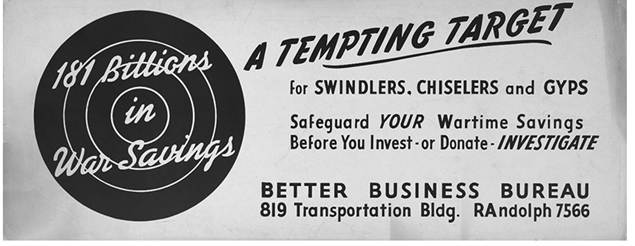
Figure 9.1: A BBB poster beseeching investors to remain vigilant in the face of post-World War II investment and charity frauds. W Dan Bell Papers, Denver Public Library, Western History Collection. Reproduced with permission.
ated product quality, they remained alert to marketing that pressed at the boundaries of acceptable puffery. Their newsletters and magazines then informed subscribers about products, services, and companies that flattered to deceive.44
Some of the most insistent post-World War II pleas for combating business fraud came from middle-class women, who took advantage of the growing tendency of economic discourse to feminize “the consumer” by picturing this abstract individual as a middle-class housewife. Cultural linkage of American household consumption to female decision-making had longstanding origins. The nineteenth-century birth of consumer education was bound up with the invention of home economics, a highly gendered undertaking. Mail-order houses, early department stores, and advertising agencies all directed marketing to potential female purchasers.45 But the equation of women with consumption decisions became even more common after World War II, as the figure of “Mrs. Consumer” became a common stand-in for the spending public, addressed in ads, referenced in the business pages, and depicted in antifraud literature, such as an early 1950s BBB poster that showed a skeptical housewife deflating the confidence of a door-to-door salesman by invoking the need to check out his firm with the local Bureau (Figure 9.2). “Mrs. Consumer” took on the gloss of the capitalist economy's true sovereign, the maker or breaker of corporate profitability. Through mounting consumer complaints to businesses, BBBs, and government officials, middle-class women deployed this rhetoric with regard to numerous consumer issues, including deceptive marketing. They organized as well, joining myriad neighborhood organizations that lent popular heft to consumerism.46
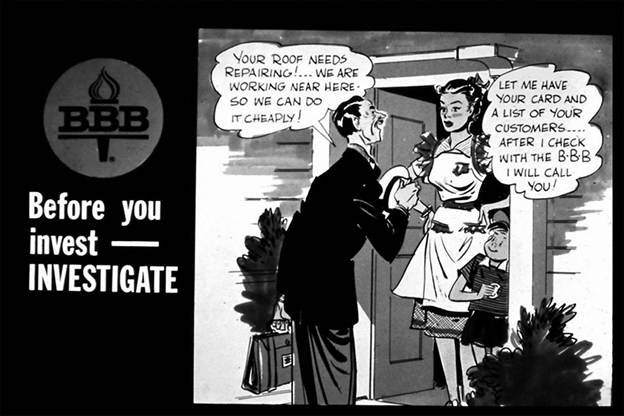
Figure 9.2: A skeptical Mrs. Consumer in a 1950s Better Business Bureau cartoon. Illustrated by Wilson Cutler as part of a series of educational slides commissioned by the Better Business Bureau.
Heightened expectations by consumers and investors encouraged diffuse support for antifraud regulation. Ongoing media coverage raised awareness of commercial deception and at least sometimes fostered public outrage over economic injustices. A steady increase in the number, kind, and reach of NGOs dedicated to fighting business fraud broadened the chorus of voices calling for antifraud measures, as well as the research base about marketing practices and consumer behavior. These developments swelled popular pressures for government action against commercial deceit and enlarged the stock of ideas about how to execute such regulatory campaigns. But the adoption of antifraud regulations between 1945 and the early 1960s rarely reflected vigorous grassroots mobilization.
During these years, regulatory action against misrepresentation was pushed by business interests, much as had been the case in nineteenth-century debates over fertilizer adulteration or the early twentieth-century campaign against false advertising. Adoption of more stringent labeling regimes for furs and textiles in the 1950s, for example, came at the behest of fur raisers, wool and cotton growers, and upscale manufacturers and retailers. Other than officials from regulatory agencies, representatives from these sectors were the only witnesses who testified before congressional committees considering labeling reforms. These groups alleged that discount sellers were engaging in rampant mislabeling that undercut public confidence in higher-quality goods; they also contended that many consumers were duped by such tactics, and needed protection that only strong public regulation could provide.47 Similarly, major record labels instigated the late 1950s payola investigations in the hopes of beating back inroads by independent producers. The latter had turned to payola as one way to introduce R&B, rock music, and African American artists to a wider public, focusing on new local radio stations that coveted young listeners. Even though the established music distributors also furnished DJs with gifts and favors, they calculated correctly that investigations into the industry’s endemic bribery and kickbacks would hamstring independents such as BMI and Ace Records.48
Advocacy for postwar antifraud regulation, however, did not always equate to regulatory capture, in which corporate puppeteers lay behind more stringent regulatory action, pulling the strings of public officials in order to fend off competitive threats.49 With some initiatives, such as moves against bait advertising and misleading pricing practices, antifraud professionals within the business establishment—BBB careerists, aided by counterparts at national advertising trade associations—stood out as the key figures driving regulatory agendas. From the 1930s onward, local BBBs and the National BBB identified such marketing practices as deserving of priority attention. During hundreds of trade practice conferences, BBB leaders hammered out detailed specifications about what constituted bait and switch tactics, false comparisons with competing retailers, and fake assertions about sale discounts. By the early 1950s, the Bureaus had developed comprehensive standards in these areas, whether for consumer goods such as vacuum cleaners and automobiles, or for services provided by home improvement companies and insurance companies. These codes served as templates for the FTC’s regulatory rule-making and enforcement priorities, which targeted bait advertising in late 1958, deceptive pricing in 1959, and deceptive advertising of guarantees in 1960.50
Postwar BBB officials, moreover, articulated an expansive antifraud philosophy that reflected an institutional mission distinct from that of their corporate funders. C. W. Dessart, a trade practice consultant specializing in the regulation of car marketing, articulated this stance in a sharply worded 1957 letter to a Texas auto dealer who had opposed more stringent antifraud rules for the industry. “As a dedicated automobile man, and as a Better Business Bureau Trade Practice Consultant,” Dessart explained to the dealer,
we admit to a kind of bias. For we are biased against the petty thief who filches pennies from a blind man’s cup; we are biased against the “shopper” who lies about what the “other dealer allowed him” for his old “heap” and the merchant whose business ethics and “law” is that of the shady business jungle, and whose theme song is “CAVEAT EMPTOR”—“let the buyer beware;” we are most decidedly biased against the merchant in any line—including automobiles—whose technique is to trade upon and exploit human ignorance and credulity, and who as an automobile “Medicine Man” pitches his “snake oil” by mass advertising to today's Mortimer Snerds, instead of to the yokels from the tail-gate of a horse drawn wagon as in the earlier days.51
For Dessart, sharp practices in retailing had no place in modern America. This mindset percolated throughout the national network of long-s erving BBB professionals.
The voices raised up against American business fraud during the Great Depression, World War II, and the immediate postwar period, then, reflected important continuity. As was the case during the Progressive era, some business interests continued to see deceptive sales cultures either as a short-term competitive threat or a longer-term menace to consumer confidence. And a cadre of antifraud professionals often took the lead in formulating legal reforms and setting enforcement priorities. Indeed, Presidents Truman and Eisenhower refrained from the full-throated critique of caveat emptor that had framed New Deal securities regulation.
To be sure, Harry Truman treated consumer welfare and the equitable distribution of America’s economic bounty as policy lodestars for his “Fair Deal.” These broad goals shaped his thinking about using fiscal policy to tame the business cycle and extending prosperity to a wider circle of Americans through national health insurance, expansion of Social Security, stronger protections for labor unions, federal aid for education and housing, stricter antitrust enforcement, and civil rights legislation. But at no point did Truman make consumer protection a centerpiece of his domestic agenda.52 While in office, Dwight Eisenhower signaled concern that American businesses faced too much heavy-handed governmental oversight. “The great economic strength of our democracy,” he proclaimed in his first message to Congress, “has developed in an atmosphere of freedom. The character of our people resists artificial and arbitrary controls of any kind.” This philosophy guided Eisenhower’s legislative priorities and appointments to regulatory agencies such as the SEC and FTC.53 Thus, it should come as little surprise that the pace of major federal antifraud initiatives slowed in the decade and a half after World War II, or that antifraud legislation adopted by Congress in this time period, such as the Textile Fiber Identification Act, came at the behest of business interests.
Toward the end of Eisenhower’s time in office, however, the television quiz show and payola scandals elicited a few presidential echoes of FDR’s rhetorical shots against unscrupulous stock promoters. Ike denounced the quiz show frauds “as a terrible thing to do to the American public” and described payola as an affront to “public morality.” In both cases he called for investigations and prevention of reoccurrences, which nudged Congress to pass legislation criminalizing fakery over the airwaves.54 These responses presaged more sustained presidential engagement with deceitful marketing and business fraud as national problems.
Challenges of Enforcement
New Deal and post-World War II antifraud statutes, of course, did not immediately transform legal culture and day-to-day economic relations any more than the formal legal reforms of the previous century. Policy innovations do not magically elicit adequate enforcement. Once again, we need to consider law in action—the meanings of all the new statutory requirements and administrative rules to aggrieved consumers, embattled firms, and consumer watchdogs; the legal system’s mediation of fraud-related disputes; and the impact of new legal norms on the beliefs and values that influence economic behavior. With the pivot toward the legal principle of caveat venditor, American policymakers filled in the latticework of a modern antifraud state. By 1960, thousands of individuals worked for antifraud institutions, deepening organizational capacity, constructing enforcement networks across jurisdictions and agencies, and encouraging professionalization of antifraud regulators. In some arenas, such as securities regulation, these endeavors achieved significant improvements in the trustworthiness of commercial speech. Wrestling with the flim-flam man, however, continued to require constant monitoring, patient investigation, shrewd deployment of resources, and unwavering vigilance, and the wrestlers did not always live up to these exacting requirements.
Mid-twentieth century antifraud enforcement efforts confronted numerous obstacles that had deep historical roots. Echoes of longstanding popular attitudes toward hucksterism represented one complication. Despite the shifts away from the premises of caveat emptor in American law, many corners of society retained contempt for the sucker and grudging admiration for those who took advantage of them. Post-World War II overviews of prevalent consumer and investor scams often marveled at the wondrous gullibility of those “suckers” who bit on the truly “preposterous,” “incredible,” “astonishing,” “fantastic swindles” lurking about the American marketplace. Accounts of specific fraud scandals, such as the 1948 implosion of Arthur Knetzers Ponzi-like car deposit scheme in southern Illinois, or the 1961 collapse of David Farrell's guaranteed trust deed investments in southern California, elicited analogous amazement at just how “eager” and “naive” investors and consumers could be.55 American linguistic practices also still communicated a disfavored status for those taken in by bait and switch advertising or investment scams. Even when seeking to warn consumers and investors about the need for skeptical appraisal of puffery, mid-twentieth-century commentators tagged those who lacked such habits with unflattering monikers. One list included “come-on, flyflat, John, juggins, or pigeon”; another “apple, bates, boob, chump, clown, easy mark, addle-cove, addict, egg, fink, lily, mooch, mug, pushover, top, [and] sweet pea.”56 Such turns of phrase did not imply abiding concern or respect.
The picaresque confidence man also continued to receive frequent billing in popular culture. W. C. Fields's 1939 film You Can’t Cheat an Honest Man became a mainstay of postwar television, repeating the message that those preyed on by financial bilkers had only their own greed to blame. It was joined by such hits as A Day at the Races (1937), The Rainmaker (1955), and The Music Man (1962). These productions offered sympathetic characterizations of grifters who relied on their wits to navigate unforgiving worlds. As one writer observed about the ongoing cultural status of the confidence man, he remained “an eccentric, a source of anecdote, a joke quickly told.” Even within the consumer movement, more conservative spokespersons such as Frederick Schlink of Consumers Research opposed stringent antifraud regulation, repeating the argument that it was impossible to hornswoggle “an honest man,” and worrying that regulatory paternalism would render consumers unthinking “wards of the state.”57
These undercurrents of mockery toward fraud victims and approbation for tricksters were not as powerful as in the nineteenth or early twentieth century. Most post-World War II discussions of swindles and commercial impositions stressed the psychological vulnerability of consumers and investors to well- constructed deceptions. A 1960 article in Changing Times, a personal finance magazine aligned with moderate Republicanism, conveys this common interpretive stance. The author of this catalogue of prevalent swindles and marketing trickery declared that “No one is safe” from commercial and financial fak- ery; that “[a]nybody can be a victim”; that “fraud operators can strike anywhere and anyone.” 58 By the same token, perpetrators of business frauds received scorn as “heartless” criminals.59
Still, wonderment at the credulity of American consumers and investors remained a feature of public discourse and private attitudes, as did some ambivalence about the “golden fleecers” who so artfully separated them from their savings. Such sentiments could hinder antifraud prosecutions. Amid lingering norms that harkened back to the age of caveat emptor, the psychology of embarrassment or denial still led many shorn Americans to keep quiet. According to Nathaniel Goldstein, New York attorney general in the mid-1950s, the vast majority of defrauded investors fell into this category, letting “pride keep them from filing complaints against the sharpers.”60 Even when victims were not dissuaded from making public complaints, there might be considerable delay between the moment of deception and its recognition by the consumer or investor, complicating any investigation. As in previous eras, the tiny stakes of many scams constituted a further barrier to action. Because many consumer frauds filched only small sums from individual purchasers, most victims did not chase after satisfaction.61
In both financial and consumer fraud cases, moreover, key actors in the American justice system viewed allegations of marketplace deceptions with jaundiced eyes. Outside the ranks of specialized antifraud agencies and divisions, the legal fraternity often retained personal standards that hewed closely to those of W. C. Fields, or even P. T. Barnum. In the decades before the emergence of public-interest law firms and a plaintiff’s bar that specialized in classaction suits, American attorneys were more accustomed to the perspective of business interests than that of consumers or investors, and so tended to sympathize with that viewpoint. Thus, if disgruntled consumers or investors sought out legal advice about how to handle some allegedly deceptive transaction, they were likely to be counseled against pursuing criminal complaints. For similar reasons, many mid-twentieth-century prosecutors were disinclined to bring fraud-related charges against businessmen. Moving in the same social and political circles as retailers and real-estate developers, and often contemplating returns to private practice, they had incentives to avoid antagonizing future clients.62
Prosecutors also knew that criminal fraud cases were often hard to win, for the same reasons as in earlier periods. The artful dodging of duplicitous businessmen, so vexing to late nineteenth-century postal inspectors and early twentieth-century BBB managers, continued to trouble antifraud enforcers. Pitchmen of mid-twentieth-century get-rich-quick schemes proved no less capable than their predecessors of moving boiler rooms from location to location, or of seeking out friendly jurisdictions from which to operate. Improvements in communications even expanded their geographic options. After the creation of the SEC, Canadian cities became popular bases for peddling penny stocks to American investors over the phone.63
The wide expanses of the United States also still offered escape routes for the purveyors of consumer frauds, as was made clear by the decades-long predation by a clan of several hundred petty swindlers known as “The Travelers” or “The Terrible Williamsons.” This set of related Scottish families maintained a nomadic lifestyle, moving from town to town pitching “bogus goods and services,” such as the cheapest textiles passed off as fine imports, shoddy driveway resurfacing, or ineffective roof sealing. The Williamsons took care to “stop in one location just long enough to bilk the local citizenry out of as many hard earned dollars as possible” before a chorus of complaints raised the alarm with local police. In those unusual circumstances in which members of the clan stuck around long enough to face arrests and criminal charges, they had little compunction about skipping bail. As a result, postwar BBBs officials and journalists issued repeated public warnings about their exploits.64
When victims were willing to file complaints and testify in court, and law enforcement officials were able to corral alleged perpetrators, prosecutors still had to weigh the drain on resources that fraud cases often entailed. Although the post-1945 judiciary accommodated antifraud reforms that lowered evidentiary burdens in administrative enforcement actions, the legal requirements for criminal fraud convictions remained steep. Just as in the previous century, much investigative legwork was necessary to substantiate fraud prosecutions. Establishing the false claims that underpinned marketing deceptions, as well as reliance on those falsehoods by victims and the fraudulent intent of defendants, often required interviews with far-flung witnesses and, in financial cases, expert accounting analysis. Prosecutors might have needed weeks to present such evidence before grand juries or in court, which meant that fraud cases clogged criminal dockets. The nature of the evidence at issue further gave well-prepared defense counsel opportunities to slow matters down with procedural challenges. These considerations shaped case selection even among prosecutors who made fraud cases a priority.65
Mid-twentieth-century criminal fraud prosecutions also ran into difficulties with juries and trial judges. The former could struggle to keep track of complex evidence about obscure financial transactions, manifest skepticism about the extent to which defendants had meant to deceive their counterparties, or demonstrate reluctance “to stigmatize a man as a criminal” because sales pitches had taken a few liberties with the truth. The latter often refused to see fraud charges as meriting the degree of concern shown to instances of violent crime, or went out of their way in jury instructions to emphasize that fraud convictions required a showing of fraudulent intent beyond a reasonable doubt.66 These stubborn dimensions of the legal system meant that some criminal sanctions against hucksterism went unused. Despite the steady passage of statutes criminalizing false advertising, prosecutions almost never occurred, because prosecutors viewed indictments as disproportionate responses to deceptive marketing.67
In addition, charismatic businessmen accused of fraud retained their penchant for avoiding criminal penalties, even after business failures that resulted in losses to investors, employees, and creditors. The 1949-50 trials of automobile impresario Preston Tucker suggests how the best defense attorneys had a knack for leading judges and juries to see their clients as sympathetic if flawed entrepreneurs. After World War II, the Tucker Corporation developed a new motor car, the Torpedo, in the hopes of cashing in on voracious demand created by rising household incomes and a wartime production ban. This vehicle possessed several technological innovations, but was beset by cost overruns and the gargantuan capital requirements of launching a new automobile firm. To raise cash, Tucker sold hundreds of dealerships to local businessmen and thousands of purchase options to consumers, while regaling potential investors with his company's prospects. After national magazine stories raised questions about corporate financial practices and a series of engineering difficulties, the firm spiraled into bankruptcy.
At this juncture, officials at the SEC, Post Office, and FBI became convinced that Tucker was emulating several fraudulent interwar carmakers, such as the Pan Motor Company of St. Cloud, Minnesota, which built factories and prototypes as part of elaborate schemes to bilk investors. As a result, they charged Tucker and seven other corporate officers with mail and securities fraud. Two high-profile trials led first to a mistrial and then acquittals. In the second trial, the judge instructed jurors about the high legal bar for fraud cases, informing them that they could convict only if they found that the defendants had made false statements and promises out of “a purpose and design to cheat.” Jurors rejected the prosecutor's argument that a mix of unrealistic projections, aggressive salesmanship, and generous executive compensation met such an exacting standard.68 Versions of this script recurred through the Cold War decades, as judges and juries declined to follow the lead of prosecutors in fraud cases brought against flamboyant leaders of failed corporations.69
Even when prosecutors won fraud cases, they often despaired over continuing judicial leniency. Whether fraud convictions came under state false pretense laws, the federal mail fraud statute, or prohibitions against securities fraud, defendants received minimal sentences. More often than not, unsavory characters who had filched large sums received only “wrist slaps”: probation, suspended sentences, or jail terms of a few months.70 The disinclination of judges to “rap their knuckles a little harder” when staring down at individuals convicted of business fraud had ramifications for plea bargaining. Because defense lawyers knew the score, plea deals rarely imposed jail time and often mandated only consent decrees that accepted findings of legal violations without admission of guilt.71
In earlier decades, frustrations with criminal fraud prosecutions had encouraged innovations such as the postal-fraud order and informal pressure on publications to reject advertising from offending firms. These tactics had elicited howls about creeping despotism, prompting adoption of procedural protections, which, in turn, had limited the effectiveness of administrative remedies. Proceduralism became even more deeply ingrained after World War II. Within the criminal courts, the dominant trend, driven by a Supreme Court concerned about civil liberties, was to give defendants greater access to legal representation and to ensure observance of procedural safeguards. Tougher appellate scrutiny of criminal convictions sometimes meant the overturning of fraud convictions on procedural grounds.72 That possibility expanded the tactics employed by defense attorneys in business fraud cases, because trial judges operated in the shadow of the appellate bench.
Heightened concern for procedure also cramped administrative enforcement. Here, the legal terrain was reshaped by the 1946 Administrative Procedure Act, which mandated extensive opportunities for public comment as part of the rule-making process and required that administrative actions mimic criminal process. Parties facing enforcement actions had to receive ample notice of specific allegations; they enjoyed rights to legal representation, access to incriminating evidence, and reasonable accommodation in preparing defenses; they could expect that hearing officers, investigators, and prosecutors would all be separate individuals, and that hearing officers would explain the legal basis of findings to them. Such protections, embraced as well by state Administrative Procedure Acts, extended the time and resources needed to pursue administrative orders against firms accused of deceitful marketing.73
Given sufficient bureaucratic capacity, the extensions of American commitment to the rule of law need not have presented insuperable enforcement problems. Some antifraud agencies, moreover, were able to build sizable organizations. The SEC began the post-World War II era with a budget of $4.6 million, which enabled it to maintain a staff of nearly 1,200, including more than three hundred employees in regional offices. But even at the most well- funded agencies, antifraud officials often still felt hard-pressed to meet their responsibilities in light of the growing population and economic activity. The SEC's budget did not keep pace with the explosive growth in securities origination and trading in the fifteen years after World War II, and budget cuts under Eisenhower forced the Commission to slash its staff by a quarter. Appropriations for the FTC's regulation of antideceptive practices did increase at a rate comparable to that of economic growth between 1945 and 1965. But its deceptive-practices unit struggled to handle thousands of annual complaints about false advertising and misleading sales techniques.74
Even more so than in the 1920s, administration action at the postwar FTC became notorious for its languid pace. Investigations often took months or years and then had to go through secondary reviews by staff attorneys.75 Consideration of formal cases by hearing officers and then the full commission took even longer, as high-level staff evaluated the analyses and conclusions of investigators and prevailing rules encouraged continuances. Every few years, an FTC chairman would declare war on internal delays and preside over speed- ups that would reduce bottlenecks. But a “dilatory and over-legalistic” institutional culture would then reassert itself. Although the courts mostly upheld FTC findings, appeals tacked on more time. In one convoluted case brought against Carter's Little Liver Pills for dubious health claims, the interval between the first investigation and the last court challenge was sixteen years. More often, three to five years elapsed before the conclusion of all appeals, far longer than the typical length of advertising campaigns. In addition, once FTC cease and desist orders became final, the agency allocated minimal resources to check on compliance. The agency developed a reputation for “snail-like procedures” and a “comatose spirit,” becoming known to the capital's chauvinistic wags as the “old lady of Pennsylvania Avenue.”76
The regulatory odyssey of Michigan's Holland Furnace Company suggests the capacity of some larger corporations to exploit these bureaucratic shortcomings. Holland Furnace had franchises in most states. Working door-to- door, its sales agents would create the impression that they were either government safety inspectors or private heating engineers, and ask to see the furnace. If homeowners agreed, agents would disassemble it and then spin grave tales of impending disaster via cataclysmic explosion, asphyxiating fumes, or engulfing conflagration. Next would come high-pressure pitches for replacement models, along with refusals to reassemble the old unit on the grounds that salesmen would not be “accessories to murder.” Holland managers gave salesmen extensive training in these tactics; the company also structured compensation incentives to encourage the hard sell.77
Holland executives pushed this selling scheme beginning in the mid-1930s. Scores of consumer complaints led the FTC to issue a cease and desist order against the firm in 1936. But the sales force ignored it. Years of additional complaints prompted another FTC investigation in 1954, which after four grinding years of procedural challenges culminated in a second cease and desist order. Holland personnel gave this order and a subsequent court decree the same short shrift. The firm continued to advertise for branch sales agents, whom it promised to “teach our business,” enabling them to make “above average wages while you learn and higher wages once you are experienced” Holland management also scoffed at fraud investigations by state and local agencies, raising every conceivable legal objection. Only in 1965, when a federal judge found the corporation in criminal contempt of the court decree, sentenced the former company president to a short prison term, and levied a fine of $100,000, did the firm take meaningful steps to root out abusive practices.78
Daunting practical realities confronted mid-twentieth-century enforcers of laws against business fraud: reticence among the fleeced; migratory swindlers; echoes of the world of caveat emptor that ricocheted around some corners of the criminal justice system; hyper-legalism; budgetary allocations that failed to match legislative aspirations. But regulatory officials were not without their own resources in coping with such challenges. Just as the history of American business fraud foreshadowed these problems, it also suggested regulatory rejoinders. Every facet of early twentieth-century American campaigns against business fraud reappeared in post-World War II initiatives, at a greater scale and intensity.
Fortifying the Antifraud State
Aware of their limitations, postwar antifraud organizations looked to maximize monitoring capacity and efficiently deploy resources for enforcement. One priority was to improve coordination and information-sharing among the agencies with jurisdiction over business frauds—an echo of the American Agriculturist’s network of correspondents, the NACM's “rogue's gallery” and the compendiums of quackery and quacks put together by the AMA's Bureau of Investigation. As soon as the SEC opened its doors, officials forged close relationships with federal postal inspectors, state securities regulators, and criminal investigators and prosecutors. Within months, the SEC collected sufficient data to construct a comprehensive set of “securities violation records” This “central index and clearing house” maintained details on about fifteen thousand Americans and Canadians who had faced allegations of securities fraud. In addition to keeping the index up to date, the SEC sent out a “monthly confidential bulletin” to its bureaucratic partners and contacted them about thousands of individual cases. By 1950, the fraud register comprised details on over fifty-three thousand stock promoters, brokers, and salesmen. SEC staff also analyzed the records to spot “overall pattern[s]," and always made the files
Moving toward Caveat Venditor
271
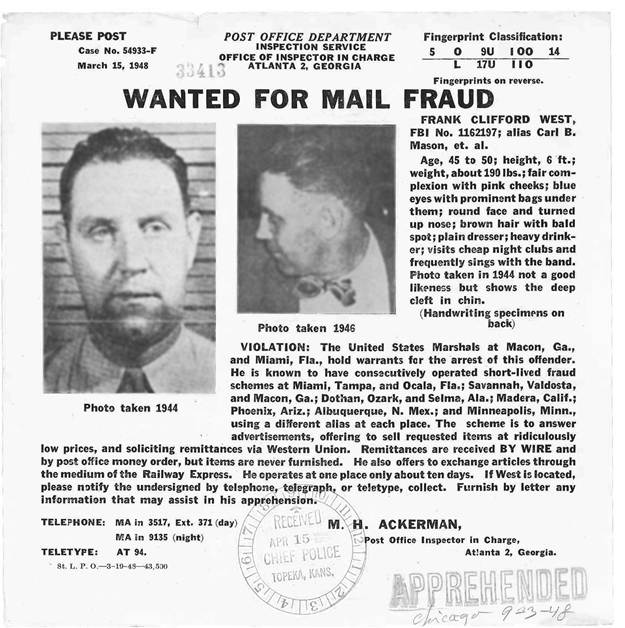
Figure 9.3: A Post Office “Wanted” poster, detailing the degree of information collected, and hinting at its national distribution (with receipt by the Topeka, Kansas, police, and a notation of the suspect being apprehended in Chicago). Author's collection.
available to state and local officials to assist with “current enforcement problems.”79 The postal inspectorate developed analogous information systems, as well as national distribution of “wanted” posters. The latter, such as a 1948 bulletin for Frank Clifford West, “alias Carl B. Mason” (Figure 9.3), included not only photographs, but also capsule biographies (in West’s case, consumer fraud schemes in seven separate states), fingerprints, and even handwriting samples. These national information systems facilitated the tracking down of even the most migratory swindlers.
Postwar antifraud agencies extended their reach through heavy reliance on self-regulatory organizations. New Deal securities regulation incorporated pri
vate regulatory gatekeepers from the start. The SEC leaned not only on securities exchanges and the NASD, but also on corporate accountants and attorneys. Exchange staff closely monitored transactions for indications of market manipulation. The NASD's inspectors visited brokerages far more often than their SEC counterparts, and its officials could levy punishments on individuals and firms that unfairly treated investors, including fines, suspension, and expulsion. Accountants and attorneys had professional obligations to keep corporations attuned to the new set of regulatory rules.80
As investor confidence returned during and after World War II, cooperation from self-regulatory institutions and professional gatekeepers became ever more crucial. By the late 1950s, the annual value of shares traded on registered exchanges eclipsed that of the 1930s by more than 300 percent. Investors could buy more than 7,500 stock issues on those exchanges or over the counter, while the number of brokerages approached five thousand, accompanied by nearly 1,500 firms that offered investment advice.81 Faced with the enormity of the American financial markets, SEC officials presumed that prevention of securities fraud would have to rest on a solid foundation of “selfregulation,” “self-discipline in the brokerage community,” and a commitment among lawyers and accountants to foster “compliance with the law.” The relentless circulation of capital threatened to overwhelm centralized regulatory oversight.82
Outside of finance, trade associations for broadcasters, news publications, and advertising agencies took on responsibilities for keeping deception out of major marketing channels.83 But the most important NGOs involved in antifraud enforcement remained the Better Business Bureaus. The post-World War II BBBs continued to encourage consumers with grievances against businesses to contact them. Millions of Americans internalized these pleas, bombarding BBB offices with letters and phone calls that raised questions or concerns. Although most complaints did not allege fraud, a significant fraction did so. A steady stream of BBB members complained about advertising and marketing tactics by competitors. These two streams of accusations prompted over thirty thousand annual investigations nationwide. In addition, BBB officials scanned newspaper and magazine advertisements and then sent out a corps of several hundred professional shoppers to discover whether enterprises lived up to their marketing promises. This ongoing policy of “shopping the ads” triggered additional inquiries. BBB activities amplified the monitoring activities of state agencies such as the FTC, which could only invest limited resources in surveillance of broadcast and print advertising.84
In hundreds of civil and criminal cases at every jurisdictional level, BBB officials coordinated with government investigators and prosecutors. BBB offices further responded to regular requests from governmental officials for assistance with enforcement efforts. During the early years of the New Deal, for instance, the Missouri commissioner of securities, resident in Jefferson City with no budget for investigative staff, pleaded with the St. Louis, Kansas City, and Springfield BBBs to forward intelligence about firms dealing in securities without licenses, or about “duly licensed dealers and brokers who may be adopting shady or questionable methods in the distribution of securities.” After World War II, the Federal Housing Authority asked for BBB assistance in policing the submission of “completion certificates” by construction and home improvement companies, which were required for homeowners to receive FHA mortgages. The FHA's deputy commissioner went so far as to ask every office to “establish a working relationship with the local” BBB, because such “close cooperation... will serve as one means of maintaining a close watch over... operations in your area.”85
The post-World War II BBB network never enjoyed statutorily sanctioned authority like that of the NASD in securities regulation, though BBB leaders sometimes hoped for such formal delegation. As the head of Denver's BBB mused in an early 1960 memo, “Maybe we could dare to propose that BBBs be set up like Eric Johnston's operation in the movie industry; or NASD's operation in the securities business, the Commissioner of Baseball, etc.”86 Such tentativeness suggests minimal confidence in achieving official grants of power. Nonetheless, the BBBs' post-1945 activities meant that the line between public and private business regulation continued to blur, as efforts by public and private agencies shaded into one another, even without explicit legislative delegation.
By the 1950s, the more established antifraud organizations, whether inside or outside the state, boasted numerous long-serving career professionals. These individuals had familiarity with marketplace deceptions, kept abreast of new variations, and knew how to conduct fraud investigations. The best of these careerists appreciated the challenges of navigating criminal and administrative enforcement actions and grasped the importance of sensible prosecutorial discretion, given limited institutional resources. They also enjoyed strong personal relations with their peers in other agencies.
Long tenure as a fraud fighter by itself did not guarantee legal savvy or implementation of effective enforcement techniques. The FTC developed a reputation for having bureaucratic “deadwood,” with timid staff attorneys cowed by the tendency of the pre-New Deal judiciary to overrule more expansive FTC actions. From the 1930s onward, many of its most powerful career attorneys owed appointment and promotion to connections with members of Congress serving on oversight committees. Dubbed “cronies” by critics, these civil servants perfected the art of the drawn-out investigation, demanded procedural meticulousness, and often set agendas more on the basis of how much competitors groused about a business’s advertising than on sustained analysis of harm to consumers. Tellingly, the 1966 FTC Manualfor Attorneys furnished detailed instructions about how to handle complaints from competing enterprises, because staff “not infrequently” learned about “alleged violations” from those quarters. By this point, the FTC had developed a reputation for fecklessness, inertia, and leniency toward powerful corporations.87
By contrast, at the SEC, within the postal inspectorate, and among the ranks of federal prosecutors, appointments and promotions more often reflected talent and performance. A few biographical sketches suggest the ability of veteran antifraud enforcers in these agencies to cultivate high standing among policy elites and the wider public. Irving Pollack typified the SEC’s dedicated corps of lawyers who hewed to meritocratic norms. Arriving at the SEC in 1946 a few years after graduation from Brooklyn Law School, Pollack was one of the few staff lawyers who had not attended an Ivy League university. Over more than three decades, he participated in almost every aspect of fraud regulation, from monitoring new issue registration statements to fraud prosecutions. As he moved into managerial positions, he created an indexing system of SEC cases to streamline the process of linking evidentiary findings to prosecutorial arguments. Because of his breadth of experience, Pollack took on a key role in conceptualizing the early 1960s Special Study of Securities Markets, a mammoth assessment of regulatory policy amid rapid changes on Wall Street. Throughout the Cold War era, the reputation established by high-ranking SEC officials such as Pollack helped the organization attract the nation’s sharpest law school graduates.88
At the Post Office and Justice Departments, the careers of Nathaniel Kos- sack and Henry Montague illustrate the accrual of expertise in fraud cases. Kossack joined the fraud division in 1952 as a prosecutor after serving as an FBI agent known for excelling in the “painstaking research” and “patient detective work which fraud cases require.” He became divisional chief in 1953 and then deputy assistant attorney general in 1965. These positions afforded opportunities to plan and carry out nationwide antifraud campaigns, which required coordination of personnel from multiple jurisdictions and agencies.89 Originally a postal clerk in Poughkeepsie, New York, Montague lacked the professional education of fraud prosecutors. But after becoming a postal inspector during World War II, he received an extended tutorial on how to locate perpetrators of business frauds. After a decade of fieldwork, he became head New York inspector in 1951 and then chief postal inspector a decade later, a position that he occupied until his retirement in 1969. Montague’s office was
an early adopter of computer processing to improve investigators’ access to mail fraud complaints and invested in forensic laboratories to speed analysis of handwriting and typewritten evidence. Throughout his tenure, he forged deep networks with other federal agencies and US attorneys.90 By the time he left his post, exacting hiring standards and rigorous professional training had allowed the postal inspectorate to cultivate a reputation as “among the most effective of all federal investigators.”91
Self-regulatory organizations depended on an analogous accumulation of professional experience. Most of the key figures in the postwar BBBs were careerists. Men such as W Dan Bell came of age in the 1920s or the Great Depression, found a niche in the early bureaus, and stayed on for the bulk of their working lives. Beginning his BBB work by monitoring Chicago auto ads for compliance with NRA regulations, Bell worked as an automobile marketing specialist for the Cleveland BBB in the late 1930s, managed first the Peoria and then the Buffalo BBB during World War II, and took over the revived Denver Bureau in 1951, presiding over it until he retired in the mid-1970s. At the national level, bureau leaders such Kenneth Willson and Victor Nyborg spent most of their adult lives with the organization. Scores of BBB officials who served during the mid-twentieth century had similar resumes.92
The professional identities of BBB leaders were based not only on the status hierarchies of a continental network of local organizations and national umbrella institutions, but also on fidelity to its mission of fostering honesty in communication with consumers and other firms. High-level BBB staff viewed themselves as deputized by the business establishment to serve as arbiters of fair competition. Kenneth Barnard summed up this self-perception in a March 1960 letter to Clyde Kemery, then the manager of the Oklahoma City BBB. Granting that “Better Business Bureaus are the creation of the business community,” Barnard refused to “concede they are its vassals. Indeed, the record shows that businesses created them as the umpires of business advertising.”93 The story was much the same at other self-regulatory bodies, such as the AMA’s Department of Investigations, with the partial exception of the NASD, which into the early 1960s relied on volunteers from member firms to fulfill enforcement functions.94
This generation of antifraud specialists was influenced strongly by the Great Depression and World War II. The majority came of age during this fifteen- year stretch; some served in the military. Manifesting allegiance to public service, they valued antifraud work as a lifelong calling. Despite close links to the business establishment, they viewed themselves as resolute defenders of the trust that underpinned capitalist marketplaces, and so “the integrity and strength” of the American economy.95 If they hungered after distinction, it was for the esteem of peers in the growing fraternity of antifraud investigators, prosecutors, and regulators.
Like their predecessors in the “truth in advertising” movement, postwar antifraud regulators placed a high priority on refashioning and reinforcing social mores about manipulative and deceptive marketing. This impulse drove the many trade-practice conferences convened into the 1960s by BBBs and the FTC. Republican regulators favored this mode of antifraud regulation, because it involved minimal public expense and placed the onus for regulatory action on business. As with so many other features of the antifraud state, the goal of trade codes was to improve the quality of information that structured purchasing decisions. With manufacturers incorporating so many new materials, novel production processes, and other technological innovations, opportunities for misrepresentations in selling emerged all the time. The fashioning of complex service products and complicated credit terms created further avenues to mislead purchasers. Trade practice conferences gave communities of businessmen the chance to hammer out principles of fair competition that would make miscommunication, misdirection, and deception less common.
The often tedious business of code-making laid out exhaustive standards for information provision. Rules articulated by the Chicago BBB in 1965 for the local advertising of plastic slipcovers convey the impulse. The slipcover code not only prohibited bait tactics, price quotes excluding labor, porous guarantees, misleading claims of low overhead, and use of asterisks or excessively small print; it also set out complex definitions for quality (at least 8 grade clear plastic, with no Poly or Poly-plastic), and specified norms for the allowable size of furniture to be covered (“tight back, loose cushioned sofas up to 90 inches, sections to 65 inches and chairs approximately 34 inches in width”), unless firms described variations in their ads.96
The thousands of marketing codes drafted from the 1940s through the mid- 1960s had important implications for regulatory enforcement actions. Codes often clarified the specific nature of alleged misrepresentations. They also offered touchstones as enforcers engaged in moral suasion, because firms had participated in code formulation and had consented to the rules. The tone of BBB bulletins, for example, mixed communal boosterism with ministerial preaching that called wayward congregants back to the straight and narrow path. A 1957 bulletin from the Pittsburgh BBB to its members typified this rhetorical style. As part of a national campaign against deceptive car marketing, it had convinced over one hundred area car dealerships to sign a new code of conduct. The report on this “Campaign for Integrity in Auto Advertising” applauded firms that had shown a “VAST IMPROVEMENT” in the candor of their advertising copy and reminded dealers that they had agreed that it was “more desirable to compete in a clean competitive environment” It also contrasted the admirable dealer who “didn't hem and haw” when a BBB official pointed out questionable advertising claims, who was “a man” and so quickly agreed to run a correction, from the backsliding dealer who continued to push exaggerated price claims—“the other kind of bird” who “tries to talk around you instead of to you, and is most interested of all in comparing himself to advantage with the dregs of other advertisers.”97 With such messages, Bureaus staked out ground as independent arbiters of best commercial practice, called on businessmen to live up to professed ideals of commercial morality, and infused those ideals with an ethos of manliness.
Implicit in this framework of self-regulation was a faith in voluntary fulfillment of regulatory directives. The facilitators of trade practice conferences hoped that deliberation about the boundaries of legitimate marketing would lead participating firms to embrace the resulting standards and embed those rules in commercial routines. Insofar as the detailed rules of codes became general practice, one did not need to worry so much about compliance. Earl Kintner, a Republican FTC commissioner appointed by President Eisenhower in the late 1950s, elaborated on this approach in speeches to Chambers of Commerce, trade groups, advertising conventions, and BBB meetings. “By every means at its disposal,” Kintner explained, “the Commission is attempting to fan the coals of conscience into a fire hot enough to burn the impurities out of ads.” Advertising agencies had to find the “courage” and “pride” to prefer “professionalism” to “short-t ermism” and “the rat race,” demonstrating that they had “the guts to put these principles over billings.” Media outlets should not “be blinded by short-sighted visions of shady profits.” Such pronouncements tinged self-regulatory endeavors with Protestant evangelism, harkening back to the nineteenth-century pleas of H. H. Boardman and the moralism of Progressive-era “truth in advertising” acolytes. Kintner presumed that the Bible belonged not only in the modern counting house, but also the marketing department and advertising agency.98
This approach to antifraud regulation could reconfigure competitive environments, as the FTC's moves against deceptive claims by mail-order health insurance firms illustrate. The private health insurance industry mushroomed after World War II, stimulated by wartime tax policies that made employee benefits tax-deductible, the failure of Truman's plan for public insurance, advances in medicine, and rising household incomes. Amid this surge, dozens of insurance companies looked to sell policies through the mail. By the mid- 1950s, these firms provided coverage for three million Americans, bringing in nearly $70 million a year in premiums. Competition was fierce, encouraging expansive promises in promotional materials about benefits, which skirted exelusions, coverage limits, and policy termination triggers (though the actual policies mentioned these contractual features in fine print). As early as 1949, several larger companies had asked the FTC to sponsor a trade practice conference to root out misleading advertising tactics. The resulting meeting produced a sectoral code of conduct, but many firms refused to abide by it. Then, after a mammoth ten-month nationwide investigation in 1954 that belied its reputation for timidity, the FTC charged forty-one companies with false and deceptive advertising, including several leading insurers.99
Through the 1945 McCarran-Ferguson Act, Congress had vested insurance regulation with the states unless they had abdicated oversight. The charged corporations used this statutory provision to challenge FTC jurisdiction in the courts. Aware that the companies had a strong case, the FTC convened a second conference to forge a revised set of industry standards, inviting not only insurers and the Health Insurance Association of America (HIAA), but also state regulators and the National Association of Insurance Commissioners, which had developed its own statement of best practices for mail-order ads. The United States Senate also began to consider legislation to tighten federal regulation of mail-order insurance marketing, as did individual states. Faced with these pressures, more established companies subscribed to a code of ethics and pledged that they would help to “eliminate the ‘bad apples' in their industry.” To sustain HIAA membership, companies now had to eschew misleading ad copy. Over the next several years, cut-rate mail-order insurance firms continued to pop up. But they had a harder time placing advertisements, as regulators circulated lists of licensed insurers to publishers, convincing many to accept ads only from these companies.100
Coordinated action by BBBs could result in similar reforms. Early in the Eisenhower administration, Bureaus in Los Angeles and Chicago spearheaded an initiative to clean up marketing by large discount-car dealerships, which had adopted abusive sales practices such as “bushing” (increasing prices after an initial oral agreement) and “packing” (including overpriced “extras” in packaged car deals).101 In the late 1950s, nationwide cooperation among BBBs exposed systematic misrepresentation and overcharging by auto collision insurers, which in turn prompted multi-million-dollar refunds.102
Despite these demonstrations of the potential to reshape commercial norms through self-regulation, most postwar antifraud officials recognized that there would always be a population of dissemblers and swindlers who would prey on gullible Americans. As a result, every antifraud bureaucracy responded to budgetary constraints and procedural gauntlets by constructing internal filters to guide prosecutorial discretion. Veteran enforcement officials at the SEC and the Post Office acquired a fine-grained sense of the circumstances that facilitated successful prosecutions. Unless prosecutors saw evidence of callous deceit that would raise the hackles of judges and juries, they declined to seek indictments. The vast majority of complaints or referrals did not generate docketed investigations, while investigations leading to criminal prosecutions tended to hover at around 1 percent. Civil enforcement actions were more common, but still represented a small fraction of official inquiries.103 Prosecutorial selectivity, in combination with accumulated savvy in presenting fraud cases, resulted in impressive conviction rates. From World War II through the 1960s, US attorneys won criminal cases referred by the SEC more than 80 percent of the time. Mail fraud cases were even more likely to result in guilty verdicts: the postal inspectorate’s meticulousness helped federal prosecutors to convict nineteen out of twenty defendants.104 Such outcomes represented even greater prosecutorial successes than during the early twentieth-century campaigns against business fraud.
Furthermore, when circumstances brought wider public attention to nodes of commercial chicanery, antifraud agencies had the capacity to mount coordinated campaigns with bite. In the mid-1950s, officials at the SEC and Justice Department became alarmed by boiler rooms that floated sham mining and high-tech stocks amid a booming market, as well as mutual-fund managers who unloaded worthless securities on their investors. Federal regulators ramped up securities fraud investigations, with annual indictments and convictions between 1959 and 1965 increasing 400 percent as compared to the previous fifteen years.105 Many of these cases targeted peddlers of dodgy Canadian uranium mines or corporate shells masquerading as producers of the latest electronics wizardry. But federal prosecutors also went after more sophisticated promoters, including Walter Tellier, Lowell Birrell, and Alexander Guterma. These individuals organized complex multi-million-dollar frauds involving mergers, acquisitions, and the burgeoning corporate strategy of conglomeration.106
One can point to numerous enforcement drives against other arenas of business fraud. Toward the end of the 1950s, several members of Congress were alerted by constituents to an upsurge in interstate advance-fee schemes, which dangled alluring franchising opportunities, promises to find buyers for those wishing to sell small businesses or residential properties, or offers to arrange loans for small-business owners in need of capital. The resulting congressional hearings triggered multiyear investigations mounted by the Department of Justice’s Fraud Division and the postal inspectorate, generating dozens of successful prosecutions.107 During the early 1960s, officials at the Federal Communications Commission cooperated with their counterparts at the DOJ and the Post Office to clamp down on US mail-order scams that ran ads on high-powered Mexican radio stations.108 Throughout the 1960s, Federal agencies also launched extended campaigns against credit fraud rings, interstate real-estate scams, and a spate of managerial frauds at Savings and Loans.109
Even the most gung-ho enforcers, however, had to be mindful of resource constraints. Ever-present budgetary and staffing limitations allowed only so many expensive, time-consuming investigations and interagency campaigns. As a result, post-World War II antifraud cops, just like their interwar predecessors, relied heavily on negotiated settlements. When evidence seemed serious enough to warrant official attention, the first option was always to enter into informal discussions with a firm whose business practices were skirting the lines that separated puffery or aggressive reliance on informational advantages from fraud.
Enforcement strategies at postwar BBBs typified reliance on a graduated system of sanctions. Bureau officials encouraged disgruntled purchasers to seek out resolutions such as partial refunds that would allow both sides to avoid implications of impropriety. If BBB staffers judged ads or sales techniques to violate standards of fair dealing, they would request revisions, turning to sterner measures only when businesses rebuffed these interventions. For firms that did not follow through on promises to clean up their marketing, the next stage involved drawing up formal stipulations. In April 1952, the Logan Appliance and Furniture Mart signed off on a typical “voluntary” agreement with the Chicago BBB, pledging to foreswear advertising “which has the tendency... to mislead” and all “bait practices.” They also agreed to furnish fuller information than they had about credit terms.110 Such declarations, like the act of signing on to an industry code, committed firms to the moral force of BBB standards and the legitimacy of ongoing BBB oversight. BBBs further asked some firms to run corrective advertisements that apologized for past deceptions.
If firms rejected overtures for quiet adjustments or signed stipulations only to violate their terms, BBBs again turned to the weapon of publicity. Every local branch published newsletters calling out firms that had strayed too far from BBB principles. A still more pointed step was to give local media outlets details about a firm's repeated violations and intransigence in the face of requests for reform, and to proclaim that “further advertising by this source is not in the public interest.” Although not every publisher or broadcaster abided by such “NIPI” declarations, many, including leading publications such as the Chicago Tribune and the Los Angeles Times, did. Radio and television stations, which had to worry about FCC license renewals, also abided by Bureau directives. “NIPI” declarations functioned like postal fraud orders, cutting lines of communication between businesses and customers. The most common outcome of such proclamations was a toning down of marketing, which led the BBB to lift its objections. According to the Chicago BBB’s automotive trade consultant, Carl Dalke, NIPIs were much “more effective than to haul someone into the local state attorney’s office for a hearing. What we do is not only a lot tougher, but it’s faster, and it works.”111 As a result of Bureau jawboning, firms ran corrections to thousands of ads (150 in Chicago alone during 1957), and adjusted thousands more. In 1962, businesses complied with requests from the National BBB for such adjustments 93 percent of the time.112 In addition, BBB investigations could, and did, help authorities send fraudulent businessmen to jail.113
At the same time, BBBs emulated public antifraud agencies through greater concern for procedural rights. Although pushed by the consumers and competitors who complained to them, Bureau officials remained representatives of the business community, eager “to protect the business man.” They further had to worry about retaining membership. As a result, BBB officials extended the benefit of the doubt to established firms. The always present threat of civil suits for conspiracy and libel fortified this inclination. From the 1930s through the mid-1960s, local BBBs faced more than a hundred such lawsuits, which reinforced a preference for “quiet investigation and patient persuasion.”114 Concerns about due process eventually led BBBs to revisit the idea of an appeals process, with several local Bureaus forming advertising review boards. Before a NIPI directive went into effect in these markets, an affected enterprise could ask for a hearing before a tribunal of prominent BBB members. After sustained debate within national BBB structures, the organization endorsed such forums in late 1952. By the end of 1960, twenty-six BBBs had one, with a further sixteen in the works.115
The extension of proceduralism into self-regulation created openings for business cheats in much the same fashion as had the punctiliousness of FTC cease and desist hearings. Consider the saga of Fritzel Television Repair. For almost two decades, owners of televisions and radios complained to the Chicago local BBB about Fritzel, alleging unauthorized, unnecessary, and faked repairs, shoddy work, overcharges, and rank coercion, as employees refused to return radio or television sets until bills were paid in full, regardless of pending complaints. Fritzel customers pleaded with the BBB to make the firm accountable for its abuses and to warn others about it. “I keep wondering,” a (Mrs.) Andre Chervence wrote in June 1954, “how many other people are being ‘done in’ as I was I don’t like to feel that such dishonesty can go unchecked.” Into
the 1960s, Bureau staff regularly contacted the company to mediate on behalf of consumers like this North Side housewife. Fritzel accommodated BBB overtures, reaching numerous settlements with disgruntled customers, but not changing its business practices.116 Only after the Illinois Bureau of Consumer Fraud began a 1964 investigation did the BBB go after the firm, assisting with a sting operation that demonstrated a pattern of fake repairs, in which Fritzel technicians replaced working components with second-rate or even faulty ones.117 Here was another Holland Furnace Company, operating on a local scale.
Cases like Fritzel recur throughout the Chicago BBB files. Although complaint mediation frequently happened within days, BBBs often took years to adopt tougher measures, especially when businesses did not make the mistake of brushing off BBB staff. Even a steady stream of mediated compromises, ad corrections, and stipulations might not lead to less deceptive marketing. As with FTC disciplinary action, a far-sighted marketing department could easily cope with BBB finger-wagging. By the time that a BBB staffer objected to an ad, firms could cheerfully comply, because they were about to roll out a different, though analogous pitch. BBB methods did not necessarily work better than those of the administrative state.118
Beginning in the late 1950s, some BBBs tried a more preventive tack by offering advance assessments of advertising campaigns. The vetting of proposed ads allowed businesses to receive clearer signals about the interpretive boundaries of BBB and media codes of conduct. This “opportunity to iron out wrinkles before the fact,” Bureau officials insisted, did not constitute “precensorship”; it was merely a sensible mechanism to ward off deceptive pitches before they “reach[ed] the public's ears and eyes.”119
On occasion, persistent preaching led to conversion. The postwar Chicago BBB could point to numerous examples in which years of jawboning persuaded an aggressive discount house to clean up its advertising. Bargaintown, U.S.A., for instance, tussled with the head of the Bureau's Home Furnishings Division for nearly five years in the late 1950s and early 1960s. On several occasions, BBB officials demanded ad corrections by this local toy store chain; three times, they issued three NIPI directives because of disputed comparative price claims. Bargaintown treated BBB officials with deference and complied with these requests. Eventually, its owner-managers also agreed to cease making claims about markdowns from manufacturers' suggested list prices, on the grounds that the ongoing revolution in American distribution had so intensified price competition as to render them “meaningless and confusing,” producing “a lack of confidence by the consumer in ourselves as merchants and in the toy industry in general.” BBB officials could not hope for a clearer recitation of the “truth in advertising” catechism.120
From the 1920s up to the late 1960s, the FTC, SEC, and Post Office disposed of its fraud-related caseload in similar fashion. If inquiries convinced FTC lawyers that a firm's marketing promotions had the capacity to mislead, they looked to negotiate pledges to stop the offending practices.121 In order to encourage compromises, the FTC in 1951 stopped requiring that businesses agree to findings of illegal marketing as a condition of stipulations. Beginning in 1962, it followed the BBB's lead and set up an advisory service to dispense guidance about the legitimacy of new marketing strategies.122 SEC and postal regulators likewise looked to give firms the chance to correct problems before initiating the creaky wheels of formal legal process. If registration documents for an initial public offering lacked important details or included misleading text, SEC officials would send a “deficiency letter” that laid out the problematic features and asked for revisions. After “a process of give and take by conferences, telegraph messages, telephone conversations, or correspondence,” the commission would draft a voluntary agreement setting out necessary amendments. SEC staffers also issued advisory opinions to corporate lawyers who asked for guidance about the legality of promotional materials. Within the Post Office, most fraud investigations led not to fraud orders or indictments, but rather stipulations in which firms promised to discontinue objectionable marketing.123
This posture reflected realities that confront all regulatory bureaucracies. But for BBBs and many officials at federal antifraud agencies, they also represented deeper philosophical commitments amid the era's epochal conflicts with Soviet communism. BBB leaders remained dedicated to an ideology of business self-regulation, in which regulators, ideally, handled marketing deceptions outside the glare of publicity. This style also suited the leadership of the postwar FTC and SEC. Convinced that most businessmen were trustworthy and well-meaning, these officials gave reputable firms considerable leeway. There would be, Earl Kintner and later Democratic FTC chair Paul Rand Dixon agreed, no “commercial Gestapo” as the United States engaged in the “battle” between “individual freedom and state slavery.”124
****
The sentiments expressed by these two FTC commissioners spoke to broader impulses that underpinned antifraud policies from the early New Deal through the first years of the Kennedy administration. During these three decades, most new antifraud regulations and enforcement campaigns were pushed either by business interests or policy entrepreneurs within antifraud agencies. Corporate interests, such as textile manufacturers, worked to root out what they saw as unfair competition. Policymakers sometimes worried about systemic threats that fraud posed to capitalist markets, nowhere more so than in securities regulation, as the Great Depression left an enduring imprint. In other contexts, such as the post-World War II moves against diploma mills, legislators and regulators looked to protect the government itself, much as the Reconstruction-era Post Office had moved against mail fraud to safeguard its own reputation. These efforts were often inflected by deeper faith in the value of candor in commercial speech; they always depended on dense networks that linked national and state governments with self-regulatory organizations. In all of these contexts, antifraud regulators stressed the importance of looking out for consumers and investors who lacked the information or sophistication to sidestep misleading and fraudulent pitches.
But before the 1960s, consumer perspectives rarely drove either antifraud politics or policy. In the 1940s and 1950s, organizations such as Consumers Research and Consumers Union did help educate Americans about marketing deceptions, but they lacked the bureaucratic capacity, strategic vision, and standing to set regulatory agendas. Amid the heightened socioeconomic expectations that accompanied the postwar boom, however, a resurgent consumer movement would increasingly bring its own analyses of business fraud to Washington, DC, state capitol buildings, and city council chambers. Buoyed by the more general political activism of the 1960s and greater awareness that specific demographic groups continued to be the victims of abusive marketing practices, advocates of consumerism would soon inject a new sense of urgency into public efforts to beat back the scourge of business fraud.
More on the topic CHAPTER NINE Moving toward Caveat Venditor:
- CHAPTER NINE Moving toward Caveat Venditor
- Institutional and contractual solutions for incomplete contracts
- THE GREAT REVERSAL
- Market actors: framing and ambiguity
- CHAPTER SIX Innovation, Moral Economy, and the Postmaster General’s Peace