CHAPTER EIGHT Quandaries of Procedural Justice
The modes of American fraud policing that emerged from the early 1870s through the 1920s augmented regulatory power. Both within and outside of the state, antifraud organizations developed an unprecedented capacity to monitor economic misrepresentations and sanction the individuals and firms responsible for them.
Ranging from chemical laboratories to nationwide information clearinghouses, the new regulatory infrastructures boasted pools of trained, experienced manpower, including scientists, inspectors, and detectives. These fraud-fighters did not sit back and wait for allegations of fraud to come to them. They randomly tested the composition of agricultural inputs, impersonated customers to amass evidence against sham mail-order firms, and sent shoppers to see if marketing practices lived up to the promises of advertising copy. In order to overcome the collective action problems that so often stymied fraud prosecutions, they built investigative networks that matched the geographic range of sophisticated swindling rings and deceptive promoters. Finally, antifraud organizations developed far-reaching remedies for economic deception, imposing new quality standards, cutting off access to the mails, and limiting access to advertising channels.These new forms of bureaucratic power did not sit well with some Americans. Previous chapters have offered glimmers of this discontent. Through 1910 or so, the most vocal protests came from businesses who perceived themselves as unjustly treated by antifraud institutions, although Democratic newspapers and champions of civil liberties from both major parties sometimes chimed in. By the advent of the Wilson administration, anxieties over antifraud tactics were increasingly expressed by a conservative faction within the legal profession, who viewed discretionary administrative power with abiding suspicion.
One recurrent complaint emphasized a lack of consistency in regulatory determinations, as had occurred in response to variable fertilizer analyses or grain grading. A second and even more powerful objection targeted invasive investigative techniques and unaccountable methods of adjudication, which opponents of antifraud efforts portrayed as harmful to competition, undemocratic, and even un-American. These latter grievances arose particularly in the contexts of administrative mail fraud enforcement between the 1880s and early 1900s, and the later enforcement activities of the Better Business Bureaus during the 1920s and early 1930s. Postal officials and BBB leaders vociferously defended themselves against their detractors, but eventually modified internal procedures to assuage critics, chiefly through more formal protections for due process.The resulting adjustments anticipated a broader mid-twentieth-century effort to accommodate evolving administrative institutions to the longstanding formalities and values of American legal culture. In the federal government, this process culminated in the passage of the Administrative Procedure Act of 1946, which compelled federal regulatory institutions to adhere to exacting procedural standards in both rule-making and enforcement actions. But it was evident as well in the early history of the Federal Trade Commission (created in 1914), which from its first decades embraced modes of proceeding that hewed much more closely to common-law protections than had the Post Office Department before 1913. Procedural reform in antifraud efforts thus served as a prologue to more general administrative law reform.
Insofar as late nineteenth- and early twentieth-century antifraud initiatives achieved their aims, success often depended on the power to act quickly and with discretion. One key virtue of postal fraud orders and informal agreements to exclude advertisers from leading publications was that officials could implement them rapidly, before fraudulent firms reached many victims.
In addition, threats to rely on these remedies persuaded numerous firms that had used marginally deceptive tactics to discontinue them. These advantages were hallmarks of effective regulatory governance. But when both the Post Office and the BBBs eventually agreed to reshape their methods of handling disputes, they reduced their disciplinary impact. Such adjustments testify to the enduring force of America's common-law legal culture, even as the United States came to terms with the pressures of modern capitalism.Anti-Comstockery
The first broadsides directed at the Post Office arrived almost as soon as it began to enforce the 1872 Postal Reform Act's provisions targeting objectionable materials in the mails. Opponents of Anthony Comstock's moral crusade complained that his techniques violated American norms of fair play. By adopting fictitious personas to gain evidence against the senders of illicit mail, critics charged, Comstock embraced means that were as immoral as his antagonists' businesses. One Democratic editor insisted at various points in the mid-1870s that the New York City postal inspector stooped to “lies and forgeries” by sending his decoy letters in search of illegal goods; he made “his living by lying, swindling, and deceiving the people in the name of the God and morality party”; against “all true law and manly decency,” he systematically relied on the same sort of “false pretences” as his far-flung suspects.1
Comstock’s campaigns against distributors of pornography provoked the loudest condemnations of his enforcement practices, though few voices defended the rights of publishers to disseminate literature with sexual content. But many New Englanders, including a number of nonevangelical ministers and avowed free-thinkers, objected to the vice reformer’s aggressive investigations in much the same fashion as the Chicago newspaperman. A New York City minister objected to “the whole system of spies and the lying thereby enacted” by the use of decoy letters, while a Boston intellectual argued that “a lie or fraud perpetrated in behalf of morality or religion is just as truly a lie or a fraud as is one prompted by the Father of lies.” One New York City publisher whom Comstock arrested for selling pamphlets that contradicted Christian revelation and discussed sexual reproduction, D.
M. Bennett, compared his mode of operation to that of the Spanish Inquisition. To Bennett, the postal inspectors had embarked on a “nefarious business” founded on “falsehood, deception, traps, and pitfalls for the unwary.” This approach might furnish evidence against many ne’er-do-wells, but at the cost of ensnaring innocent individuals as well. Such critiques persuaded over seventy thousand Americans to petition Congress in the late 1870s to repeal the obscenity portions of the Postal Reform Law.2Qualms about Comstock’s practices paralleled concerns about the surveillance instituted by private credit reporting agencies in the mid-nineteenth century. Credit reporters did not engage in such subterfuges. Instead, the agents for R. G. Dun, Bradstreet’s, and other such businesses compiled financial details about individuals, as well as prevailing opinions about their creditworthiness and character. Yet the creation of a nationwide system of surveillance over commercial debtors struck many Americans as a disreputable “spy system” that intruded into private lives. Other commentators objected to the “secret service manner” in which commercial agencies did their business, because the identity of credit reporters remained a mystery, as did the process by which they formulated their judgments.3
Nineteenth-century credit reporters and postal inspectors attracted reproach for similar reasons. Both worked for national organizations that wielded potentially crippling power over individuals and firms. Both pursued investigations in secret and made decisions without fear of legal accountability. Underlying the uneasiness with credit reporting and mail fraud enforcement lay ambivalence about the way that the creation of an integrated national econ-
omy tended to bring about concentrations of power, minimally constrained by legal or democratic oversight. As Philadelphia economics writer Edward Freedley articulated the concern in 1853, mercantile agencies were “in the hands of a few men, self-constituted umpires,...
subject to the errors of ignorance and mistakes of carelessness, with no guaranteed exemption from the influence of malice, favouritism, bribery, or corruption.”4 Cautions such as Freedleys embodied suspicions of unchecked authority that had animated American politics since the Revolution.5Credit reporting firms and the postal inspectorate mostly parried the thrusts of their adversaries. The former emphasized their role in preventing reckless speculators and unsavory characters from gaining access to established channels of credit, as well as their facilitation of such access to reputable firms. Mercantile agencies further insisted that the pressures of an intertwined national credit system necessarily limited the privacy rights of would-be debt- ors.6 Postal officials stressed the difficulty of building evidentiary cases against proprietors of illicit businesses operating across state lines, which justified some tactical deceptions. “Officers who deal with corrupt men,” the Reverend Henry Ward Beecher argued at the 1885 annual meeting of the New York Society for the Suppression of Vice, “must adapt themselves to the finesse, the courage, and the trickery of their game.” As Anthony Comstock stressed, those who complained about the postal laws primarily had run afoul of those prohibitions; they were not “the merchant, banker, or business man engaged in open, legal traffic.” Comstock further emphasized that there were strict limits to the inspectorate’s “finesse” and “trickery.” At no point did they violate the “sacred seal” of mail in transit. They simply ordered and purchased goods from firms identified by suspicious advertisements, extraordinary postal volume, or specific complaints from members of the public. In doing so, they used “test” letters, not “decoys.” Official duplicity extended only to the fabrication of identities for the purpose of initiating orders.7
Many Republicans and evangelicals, including key figures within the nation’s commercial elite, joined the defense of virtuous creditor reporters and heroic soldiers against vice.
Organs of the business establishment, such as Hunt’s Merchants’ Magazine and Bankers’ Magazine, offered early and full-throated support to nascent credit-reporting firms. Once they became established in the 1840s and 1850s, metropolitan business leaders and social commentators portrayed them as a pillar of the country’s economic infrastructure. The mercantile agency system, Bankers’ Magazine concluded in 1858, safeguarded honest businessmen from “the ruinous competition of the inexperienced, the incompetent and the fraudulent,” while redressing “many evils incident to the credit system.” According to the Philadelphia Inquirer, credit reporters labored “not only for the benefit of the general commerce of the country, but for the benefit of their neighbors and friends.” By the 1880s, the role of credit reporting in “protecting merchants and manufacturers against fraud and imposition” had become commonplace among leading businessmen.8This elite consensus helped commercial agencies fend off libel lawsuits from the 1850s through the 1880s, as well as regulatory proposals in several states. Legal actions were initiated by businessmen who alleged that false credit reports had occasioned commercial losses. In the federal courts and Northeastern state courts, judges consistently held that when credit reporters provided information to customers on a confidential basis, they were not liable for damages resulting from inaccuracies made in good faith. Elsewhere, Dun lawyers sought to frustrate libel litigants through procedural objections and delaying motions, pressure on mercantile witnesses not to testify, and enticements to plaintiffs’ lawyers to drop suits. If strongarm tactics proved insufficient, the agency settled cases to avoid adverse judicial opinions. During the 1870s and 1880s, especially after financial crises that led to widespread bankruptcies, state legislators throughout the nation proposed tough regulations on credit reporting. The most common bills either made intentional dissemination of a false credit report a crime, or required commercial agencies to post heavy bonds as checks against losses resulting from false reports. Outside of South Dakota, which in 1890 passed a bond requirement, credit reporting firms found sufficient legislative allies to keep such ideas from becoming law.9
The Northeastern establishment similarly endorsed the Post Office’s attempts to regulate fraudulent marketing and the trade in obscene literature. Comstock’s Fraud Exposed, explicitly written to counter attacks on mail fraud and obscenity enforcement, received laudatory reviews in the religious, commercial, and Republican press. The Boston Advertiser typically characterized Comstock’s “ruses” as the “only way yet discovered to track and convict the scoundrels” who defrauded Americans through the mails. 10 Publication of annual reports from the country’s urban antivice societies, which tallied arrests and other enforcement actions, prompted similar commentary. The objectives of the flagship New York organization, the Christian Advocate explained, were “of the highest value to every Christian community and every family home,” while its “indefatigable... Secretary, Mr. Anthony Comstock,” was “doing a work of real Christian heroism” by battling “the mercenary fiends who are preying upon the morals of the body politic.”11 Persuaded by Comstock and his backers, the nation’s business and political leaders brushed off periodic calls for Congress to prune back the regulatory powers of postal authorities, or for the postmaster general to muzzle his eager special agents. Comstock also sidestepped an attempt on his life in 1874, as well as legal actions for libel and false arrest.12
Although attacks on Anthony Comstock and his fellow inspectors did little to change investigative practices in mail fraud cases, a quarter-century's worth of complaints about administrative adjudication of mail fraud allegations encouraged procedural adjustments. The assault on the Post Office's internal legal process was spearheaded by relatively deep-pocketed businessmen who faced fraud order proceedings. The first effort along these lines, undertaken in 1879 by the extremely well-resourced Louisiana Lottery, challenged the fraud order's constitutionality. After a federal court rejected this gambit, attention turned to the specifics of how officials evaluated evidence collected by postal inspectors and then made determinations to bar individuals or firms from receiving mail.
The 1872 Postal Reform Law furnished few guides about such matters. Until the mid-1890s, the department's practice was to have a postal inspector or special agent write up a report on a case, which he would then send to the assistant attorney general for the Post Office. After reading the report and any supporting documents, that official would make a recommendation to the postmaster general, who almost always followed his advice. This approach meant that very few subjects under investigation received the benefit of a hearing prior to the issuance of a fraud order. Indeed, from 1872 through 1896, very few individuals even received notice that the Post Office was considering action against them. Like Richard Sears, fraud order recipients usually learned about the Post Office's concerns only once they were barred from the mails. Although most subjects of fraud orders responded with flight, those on the entrepreneurial margin often, again like Richard Sears, appealed for revocations. The Post Office generally granted hearings in these circumstances, and, as we have seen, demonstrated a willingness to revoke fraud orders if lawyers could show that their clients had the backing of significant local elites and would discontinue any problematic marketing practices. After the issuance of fraud orders, however, the legal burden rested on recipients to show why the Post Office should rescind them. During the 1890s, the government agreed to as many as sixty-four revocations a year.13
That same decade, attorneys for the bond investment companies hit with fraud orders excoriated the Post Office's disregard for basic principles of due process. Thus J. T. Hanna, an attorney representing Illinois' State Mutual Life Insurance Company, wrote to the acting postmaster general in July 1894 to express shock at the Post Office's treatment of his clients. The Department, Hanna maintained, “has seen fit to ‘brand' the business of this company as ‘fraudulent,’ upon information secretly transmitted to you, without giving it any notice thereof, or an opportunity to meet the charges.” Adding insult to injury, it then refused to explain the basis for its action. The lowest criminal, the attorney observed, received more substantial procedural respect. Such treatment occasioned stinging rebukes from the trade press of the advertising industry. To the editor of the Advertisers’ Guide, the “underlings of the Post Office” had set themselves up as “petty tyrants” who were every bit “as autocratic” as “the Czar of Russia or the Sultan of Turkey.” Rendering the US Constitution “a dead letter,” they had instituted “a star chamber tribunal,” in which the system “hangs men first and tries them after.”14
Late in 1896, members of the federal judiciary joined the chorus condemning the slipshod legal process within the Post Office Department, prompted by legal actions that bond investment firms and brokerages brought to challenge fraud orders. That September, several Chicago brokerages received fraud orders on the grounds that they were bucket shops. One firm challenged the action in federal court, arguing that it had received no prior notice and had no chance to defend itself. At the resulting hearing, District Judge Peter Grosscup took pains to emphasize that the postmaster general’s authority to issue fraud orders was settled law. But he voiced disapproval of the one-sided nature of the department’s investigative sifting of facts. “I do not think,” Grosscup explained from the bench, “that an ex parte statement of some postal inspector should be the basis of an order that might destroy a man’s business.” A week later, the judge refused to grant an injunction against the Chicago postmaster, though not without remarking that the “great” authority vested in the postmaster general “ought to be restricted.”15
Officials in Washington could pay little heed to the yelps of dodgy mailorder businesses or the screeds of advertising journals that profited from deceptive ads. After all, the late nineteenth-century American legal system tolerated many summary processes in which defendants possessed few of the procedural rights enshrined in the state and federal constitutions. The handling of vagrancy charges by urban and Southern rural courts stood out in this regard, as did federal hearings to consider the exclusion of would-be immi- grants.16 But a sharp lecture from an esteemed federal judge who had a track record of ratifying the Post Office’s regulatory efforts was not so easy to ignore. After the Republicans had regained the White House and control over federal appointments in the 1896 election, the new assistant attorney general for the Post Office, James Tyner, revised fraud order policy. Henceforth, postal officials would conduct hearings in Washington before issuing fraud orders. Legal process would remain far more informal than civil suits or criminal trials, and defendants would not necessarily receive access to evidence against them. But postal officials would no longer act against businesses on the basis of allegations made by “one aggrieved person,” and they would furnish a “memorandum of the charges” to assist the mounting of a legal defense.17
These procedural concessions ushered in a six-year period in which the Post Office issued fraud orders far less frequently, in some years barring fewer than fifty individuals or firms from the mails. Officials publicly explained the reduction as a reflection of more careful vetting of cases, along with a disinclination to issue fraud orders in doubtful cases. The new standard led the Department to revoke a number of fraud orders, including several that targeted bond investment companies, on the grounds that federal courts had not adjudged their operations to be so deceptive as to constitute fraud.18
By expanding the zone of legal ambiguity surrounding the fraud order, the McKinley administration heightened opportunities for corruption with the office of the assistant attorney general for the Post Office. As a subsequent two- year internal investigation documented, James Tyner's deputy and nephew, Harrison Barrett, along with another departmental lawyer, Daniel Miller, used the new procedures to operate a de facto protection racket. After notifying firms that they were under investigation, Barrett and Miller intimated that the owners could deflect legal action by amending their business practices. The key step, they then explained in letters to corporate attorneys, was to retain outside legal counsel who possessed the expertise to guide them. Through the close of 1900, Barrett directed mail-order firms to a Baltimore lawyer with whom he had close relations; he then resigned his position and entered into a partnership with that attorney. Thereafter, Miller suggested that businesses that needed to revise marketing literature to meet postal standards hire Barrett. Tyner subsequently lost his job, and both he and Barrett faced a 1904 criminal trial for conspiracy to defraud the government, which resulted in an acquittal attributed chiefly to Tyner's advanced age and poor health.19
Such influence-peddling extended beyond the confines of the Post Office Department, reaching as far as Congress. A few months before the Tyner- Barrett trial, Senator Joseph Burton of Kansas was convicted on a bribery charge stemming from his efforts to forestall a fraud order against a St. Louis investment firm. In exchange for a $500 monthly retainer, Burton agreed to act as the investment firm's attorney, using his influence to intercede with postal authorities. The senator made no attempt to deny this arrangement. Instead, he argued that his legal services constituted a more formal version of the good word that members of Congress regularly communicated to the Post Office Department on behalf of constituents under suspicion. Burton's trial, in conjunction with the Tyner-Barrett revelations, suggested that irregularities had become commonplace within mail-order proceedings.20
These scandals gave adversaries of the fraud order additional ammunition, and they wasted little time in using it. As in the 1890s, the leading dissenters were high-profile businessmen who faced postal scrutiny. Led by oilman H. H. Tucker and publisher and banker E. G. Lewis, these critics sharpened the arguments against the Post Office's allegedly autocratic practices and disseminated them to a national audience. They simultaneously cultivated influential new allies among civil libertarians and members of Congress.
Tucker, one of the colorful early twentieth-century stock promoters who invoked a language of democratic capitalism, sought to cash in on a succession of oil booms in Kansas, Oklahoma, and Texas through the Uncle Sam Oil Company. Attracting thousands of investors through puffing newspaper advertisements and prospectuses, Tucker promised not only to develop wells in emerging fields, but also to build refineries and a transport network. The oilman initially cultivated investor loyalty by depicting his enterprise as an inveterate opponent of the Standard Oil monopoly. He then cemented attachment to Uncle Sam by explaining any legal setbacks, including a 1907 mail fraud prosecution and 1908 fraud order, as the result of dirty work by Standard Oil's political and legal errand boys. Insisting that the Post Office was persecuting him at the behest of the oil giant, Tucker avoided a guilty verdict in 1907 and then took his attacks to Congress, President Theodore Roosevelt, and the press. At every point, he lambasted postal officials, and especially R. P. Godwin, Tyner's successor as assistant attorney general. Godwin, Tucker's company argued in a 1908 petition to Congress, had maliciously disregarded evidence presented by Uncle Sam at its fraud order hearing, and then authored a report on the case that was “untrue and incorrect and wholly unsupported.” In addition to asking for relief from the fraud order, Tucker called for a congressional investigation into postal regulation that would expose “the outrages and injustices as have been perpetrated upon this company,” create a basis for the punishment of “misconduct in office,” and formulate legislative reforms that would “prevent such injustices in the future.”21
Lewis, the St. Louis-based mail-order entrepreneur who mixed an eye for innovative business opportunities with an elastic conception of truthful marketing, responded even more vigorously to the Post Office's regulatory tactics. He excoriated the department in his magazines' editorial pages, then, through his publishing company, distributed two books that fleshed out his critiques. He cooperated in the production of a third volume about his travails, authored by a former high-ranking postal official who dissented from the department's treatment of Lewis. Through his political connections, he also pushed legislation to establish a legal mechanism to appeal fraud orders in the federal courts.
Like Tucker, Lewis alleged malfeasance, claiming that the postal protection racket had continued after Tyner's firing and was now run by Leonard Goodwin, a Chicago attorney specializing in mail fraud cases and the brother of the new assistant attorney general. Lewis alleged that Goodwin had promised to make his troubles with the federal government disappear. For the right retainer, he would show the publisher how to word his marketing materials so as to meet any objections from the Post Office.22 Such machinations were possible, Lewis argued, because every step of the fraud order process remained shrouded in secrecy. Even when accorded a hearing, defendants had no access to the evidence, inspectors' reports, or legal justifications that underpinned fraud orders. “If a man uses the mails,” Lewis defiantly pronounced in 1905, “he has no right of any sort that a Post Office Inspector has to respect.” The publisher and banker portrayed himself as a victim of “secret Russian methods,” a man who had been “crucified from coast to coast as a fraud and swindler.”23
On their own, the transparently self-interested views from shifty entrepreneurs on the margins of American capitalism were unlikely to influence the direction of postal regulation. But the arguments put forward by H. H. Tucker, E. G. Lewis, and other mail-order businessmen received amplification from the occasional trade journal affiliated with the sector. They also resonated with a collection of writers, lawyers, and politicians who either worried about individual civil liberties or opposed waxing centralization of federal authority, as well as some conservative Republicans who winced at their party's flirtation with paternalistic regulation. The periodical Health, which catered to a sector that attracted numerous fraud orders in the 1900s, encapsulated the key arguments against Post Office legal culture in a 1909 editorial. Fraud order proceedings, Health's editor fulminated, were “arbitrary,” a “gross travesty of justice,” even “un-American.” The assistant attorney general for the Post Office had become “a veritable Pooh Bah” who took on the roles of “prosecutor, judge, and sheriff.” This official decided whether the initial evidence collected by postal inspectors warranted a hearing, oversaw that proceeding, and then determined whether to recommend a fraud order. This mixing of legal functions, the editor proclaimed, violated basic Anglo-American norms about justice and the rule of law.24
An eclectic group of public intellectuals picked up on similar themes. The anti-imperialist editor Louis Post saw fraud orders as a type of “persecution,” given that they occurred “without trial or accusation, upon the mere ipse dixit of a postal clerk at Washington.” Such power harnessed “autocratic” impulses on a par with the extension of American political control over territories recently wrested from Spain. Franklin Pierce, a prominent New York City attorney and Democratic legal reformer, identified the lack of due process in mail fraud deliberations as a prime example of “federal usurpation” also evident in growing reliance on appointed commissions and the summary conduct of immigration cases. Even with the procedural reforms initiated in 1897, the Post Office retained authority to institute temporary bans on mail service pending hearings. Such action, Pierce maintained, shared much in common with lynching, as the postmaster general first went about “destroying a man's business” and then gave him the courtesy of “a hearing [to] ascertain whether he is guilty,” in front of the same official who judged the case as meriting action. For Edward Frederick Browne, a conservative Republican author, the Post Office's antifraud “system of paternalism” had put “even the Empires... of Europe into a second class,” portending an ominous illustration of “the present socialistic tendency to build up the executive power.”25
With such varied opponents of a vigorous national government training their sights on the fraud order, Lewis, Tucker, and other similarly situated businessmen had little difficulty finding congressional advocates for curbs on the Post Office's antifraud powers. The leading champions of reform included Edward Crumpacker, a former Indiana judge and House Republican, and William A. Ashbrook, an Ohio Democrat. An ardent opponent of racial disenfranchisement, lynching, and the treatment of African Americans by the Southern legal system, Crumpacker viewed the fraud order through the prism of procedural fairness. The Postal Department, he explained to the House of Representatives in 1906, ran “a system of... espionage” in which hundreds of “secret emissaries” used “dark lantern methods” to produce “secret reports,” which then became the basis for “blasting forever” the “business reputation” of firms. Such proceedings, he argued, were “absolutely inconsistent with the spirit of free institutions.” From 1905 through the early 1910s, he pushed legislation that would have allowed the recipients of provisional fraud orders to appeal in federal district court. The Post Office would then have fifteen days to make its case before a federal judge and jury, whose assent would be required for any appealed fraud order to go into effect. In federal court, common-law procedural protections would be in effect, allowing accused business owners to see investigative reports and to present and cross-examine witnesses.26 After the Democrats' 1910 electoral victory placed Ashbrook in the chairmanship of the House Committee on Post Office Expenditures, he convened hearings on the department's treatment of E. G. Lewis and the Uncle Sam Oil Company. Taking place over several months, the Lewis hearings furnished the publisher with ample opportunity to air his version of events to a national audience, placing an official spotlight on the implementation of antifraud policies.27
As in the late nineteenth century, leading figures within the Post Office mounted a robust public relations campaign to counter attacks on their handling of fraud orders. The department’s annual reports insisted that postal officials exercised “great care” in assessing firms alleged to be violating the mail fraud law. No firm or individual lost access to the mails without a “thorough review” of the relevant evidence by both the assistant attorney general and the postmaster general. Whenever “legitimate enterprises” disseminated “misleading advertisements” without a clear intent to deceive, the department afforded them the chance to discontinue misrepresentations, clean up ad copy, and “adjust” any outstanding complaints from customers. In pamphlets and magazine articles, officials such as Postmaster General George Cortelyou further pointed out that only one in eighty recipients of fraud orders challenged them. They also insisted that the loudest calls for constraining Post Office discretion emanated from “those who have been hampered in nefarious undertakings through the issuance of fraud orders,” men who naturally saw the mail fraud law as “autocratic and tyrannical.” Above all else, postal officials stressed the indispensability of “promptness” in fraud order proceedings. Delay “for any appreciable time” meant that a “scheme could run its fraudulent course or transfer its affairs to other names and destinations before it could be obstructed by official interference.” By contrast, the existence of a “summary” process protected the public from “hordes of rascals” whose transgressions, because of the evidentiary challenges that had bedeviled prosecutors for decades, defied criminal prosecution.28 The establishment press, including trade periodicals, professional journals, mass-market magazines, and leading metropolitan newspapers, echoed the Post Office’s stance on these issues.29
Whether or not federal judges paid attention to the controversies over the fraud order, they mostly continued to defer to bureaucratic judgments about which marketing practices were sufficiently deceptive to justify this remedy. In 1902, the Supreme Court did chip away at postal regulation of medical treatments. In American Magnetic School of Healing v. McAnnulty, the tribunal directed a lower federal court to grant a temporary injunction against a fraud order, and to entertain legal arguments about whether the school’s claims about its capacity to heal patients through the use of magnetism actually constituted mail fraud. Writing for the majority, Justice Rufus Peckham ruled that assertions about the efficacy of healing methods involved matters of opinion rather than fact, and so did not easily fit within the legal framework of fraud. But in another case two years later, the Supreme Court reiterated that the fraud order was a Constitutional exercise of power, and that the judiciary would not second-guess the postmaster general’s findings absent clear indications of legal improprieties.30 The lower federal courts, moreover, continued to reject almost all requests for injunctions against fraud orders, finding that the identification of “fraudulent schemes” was a factual matter, and that Congress had authorized postal officials to assess such facts. Even when a federal judge indicated that he would have ruled differently in a fraud order proceeding, as Circuit Court judge Learned Hand did in one 1909 case, this disagreement was not enough to overturn postal authority. So long as “there be any evidence at all” sustaining the postmaster general's position, Hand concluded, that officer's decision was “final” and unreviewable. For the courts to void a fraud order, it would have to be “a clear case of error” in which “no one can reasonably conclude anything else.”31 Such a high legal standard meant that reform would have to occur through the political branches.
The legislative high-water mark of efforts to subject fraud orders to judicial review came in January 1907, when the House of Representatives passed the Crumpacker Bill on a voice vote. But intensive lobbying from George Cortel- you, along with a veto threat from President Roosevelt, doomed the proposal in the Senate.32 Despite this legislative outcome, the tirades against postal autocracy eventually nudged the Post Office to adjust its policies. In 1910, a new postmaster general, Frank Hitchcock, decided to deemphasize the fraud order in favor of criminal prosecutions. The stated rationale for this shift was that fraud orders did little to hamstring the savviest swindlers, as “a man who was put out of business by such a fraud order might very easily move across the street into another office building and begin his work over again under the name of another bogus company.” To take down such adaptive promoters, Hitchcock explained, the Post Office had to invest the time and resources to build cases that could withstand the rigors of criminal trials. The continual comparisons of postal officials to secret police, czars, and sultans surely helped to convince him to take this step.33
The Post Office Department's new tack dramatically increased the number of individuals whom it arrested, prosecuted, convicted, and sent to prison for mail fraud. Before 1910, the department did not keep comprehensive statistics on its criminal fraud cases; it likely did not prosecute more than fifty a year. But from that year through the end of the Taft administration, the tempo of prosecutorial activity quickened, as Table 8.1 suggests. Over these three years, postal authorities sent well over a thousand mail fraud cases into the federal courts, including several high-profile prosecutions of New York City brokerage firms that floated fraudulent stocks, such as Continental Wireless, a corporation that falsely promised to create a nationwide network of wireless telegraphy stations (a vision of what would eventually become radio).34
To facilitate more intensive enforcement, Hitchcock reorganized the postal inspectorate. In addition to placing the inspector corps under the “immediate
Table 8.1: Criminal Mail Fraud Cases Handled by the Post Office Department, July 1910 to June 1913
| Indictments | Convictions | Cases Nolle Prosequied | Acquittals | |
| 1910-11 | 529 | 184 | 36 | 12 |
| 1911-12 | 537 | 263 | 85 | 51 |
| 1912-13 | 554 | 304 | 100 | 36 |
(From Post Office Annual Reports, 1911-13)
supervision” of his office, he created an elite unit of investigators to handle complicated cases, demanded more coordination among regional offices, and instituted a policy of geographic rotation. This last innovation attacked the parochialism of many senior inspectors, who had developed inappropriately “cozy” relationships with businessmen in their cities, including some individuals who had displayed a penchant for deceptive marketing. Hitchcock further deepened cooperation with other federal agencies with an antifraud mission, such as the Agricultural Department’s Bureau of Chemistry, which enforced the Pure Food and Drug Act.35 These initiatives enabled the Post Office to bring off a high percentage of mail fraud convictions. From July 1910 through June 1913, the ratio of convictions to acquittals was better than seven to one, a much greater prosecutorial success rate than had been the norm in nineteenthcentury state fraud cases.
And yet, “Mr. Hitchcock’s War on Swindlers,” as The Independent dubbed it, soon bogged down amid investigative fatigue and the obstinate realities of the criminal justice system. By the fall of 1912, the Post Office Department was groaning under the strain of over four thousand fraud investigations, leading to a formal request that Congress move responsibility for such inquiries to the Justice Department.36 Even though only about one out of every eight investigations led to indictments, and roughly one-fourth of indictments resulted in trials, mail fraud cases also began to clog the federal courts. The reorganized and reinvigorated postal inspectorate could now more readily grapple with the sophisticated strategies of deception and misrepresentation employed by large- scale mail-order businesses. But as the relevant evidence became more voluminous and intricate, and as a wealthier class of defendants hired specialized legal counsel, mail fraud trials became ever more complicated. Turning on complex matters of fact and law, they often took months to complete. As Chief Postal Inspector Robert Sharp observed in 1912, mail fraud actions had “practically filled the dockets of the courts and exemplified the inadequacy of the present judicial machinery to promptly dispose of the various cases.” Once Postmaster
General Hitchcock directed his inspectors to aim for criminal convictions rather than administrative fraud orders, federal prosecutors complained that their offices could only handle the new fraud workload “to the exclusion of other matters of public importance.” Faced with lengthening backlogs, US attorneys called for state officials to take charge of these cases.37
Postal officials, moreover, soon expressed concern about judicial approaches to mail fraud trials, which tempered the impact of high conviction rates. “The discouraging feature to the department in its fraud crusade,” Chief Inspector Sharp lamented in 1912, was “the character of sentences imposed by the courts.” Individuals who defrauded thousands of Americans frequently avoided prison terms, getting off with “small fines, ranging from a few dollars to $3,000”; men who “robbed the people of millions of dollars” left courthouses with “sentences of only a few months.” According to Sharp, most judges did not appreciate the national implications of mail fraud, and so viewed the offense as meriting only “light court sentences.”38 The expense of these trials raised additional concerns, as journalists contrasted their tens of thousands of dollars in costs with the minimal jail terms and fines that they produced.39
Disquiet over the shortcomings of criminal prosecution prompted yet another redirection of enforcement policy. The Democratic postmaster general appointed by President Woodrow Wilson, Albert Burleson, articulated the need for fresh strategic thinking. His Republican predecessor’s single-minded focus on criminal prosecution, Burleson proclaimed, left too many Americans vulnerable to mail fraud. Characterized by continuances, lengthy trials, and appeals, fraud prosecutions were “necessarily slow” and their “execution of sentences had been deferred for long periods.” During this interval, which the flood of mail fraud cases had only exacerbated, many fraudulent companies “had continued to reap a harvest” from investors or customers. Even worse, light sentences created minimal deterrence; short jail terms and low-level fines barely disrupted the operations of many swindling enterprises. Predicating antifraud strategy solely on criminal prosecution, the Wilson administration’s new team contended, left the American public “at the mercy of swindlers.”40
Burleson maintained that the sensible response was to pursue both fraud orders and criminal prosecutions, because the former had immediate preventive impact. Even when firms went through the hassle of restarting their operations under newly created front companies, fraud orders reduced their profits and slowed the process of finding new customers or investors. Mindful, however, of the longstanding aspersions cast at fraud order proceedings, the new administration instituted yet another procedural overhaul. Henceforth, the assistant attorney general for the Post Office would no longer personally review the reports and recommendations made by postal inspectors, nor decide whether to pursue fraud orders, nor draw up formal “citation[s] of charges,” nor present cases at hearings. Instead, lawyers in his office would undertake that work on their own. The assistant attorney general would take on a judicial role, presiding over fraud order hearings, assessing all relevant evidence and argument, and preparing memoranda for the postmaster general's consideration. This new arrangement, postal leaders argued, addressed longstanding concerns about the unfairness of having the same person serve as prosecuting attorney and authoritative assessor of facts.41
Reconfiguring fraud order proceedings to look more like common-law trials did not eliminate public attacks, as the occasional author or lawyer still raised the hue and cry of governance by fiat.42 But the Post Office Department's moves defused politically salient critiques. Complaints about postal secret police and American Star Chambers no longer echoed from the House of Representatives nor reverberated across the telegraphic reports of the Associated Press. Indeed, the ramping up of nongovernmental antifraud organizations such as the NACM, the BBBs, and the AMA gave the Post Office influential and vocal supporters. These organizations lauded the department's endeavors and expanded its disciplinary scope, their private investigators cooperating closely with federal authorities.43 From 1913 into the 1920s and 1930s, postal inspectors and attorneys went about their business, while the solicitor of the Post Office Department (formerly the assistant attorney general) took on his new role of administrative judge.
Greater attention to legal formalities, however, brought costs. Fraud order hearings evolved into elaborate affairs, with motions, presentation of voluminous evidence, and punctilious production of official records. Departmental lawyers took increasing care to prepare for hearings, as did the Washington attorneys who specialized in mail fraud cases. By the late 1910s, fraud order hearings could take several weeks. This slower pace made it impossible for the department to handle the same number of formal hearings as it had under Postmaster General Cortelyou. The annual number of fraud orders accordingly declined, ranging between twenty-seven and seventy-six between July 1913 and June 1919, even as mail-order business boomed. These figures understated the reach of enforcement actions, as postal officials simultaneously negotiated a much larger number of stipulations that committed otherwise legitimate businesses to stop deceptive practices. The department also continued to prioritize criminal prosecutions, with annual cases approaching one thousand a year by America's entry into World War I. Nonetheless, by lengthening the administrative gauntlet for fraud orders, the new procedures encouraged a much finer internal filter for identifying commercial deceptions that merited action. In the 1919 fiscal year, tens of thousands of complaints and hundreds of investigations produced only sixty-one formal administrative hearings, with fewer than half leading to fraud orders.44 After its reforms, the Post Office no longer confronted noisy controversies about the legitimacy of its antifraud work. But the department became less nimble in its efforts to disrupt swindling through the mails, beset into the 1930s by a caseload that threatened to overwhelm an understaffed cohort of investigators and prosecutors.45
The “Clue Cliques Clan” of Commerce
The nation's network of Better Business Bureaus also encountered sharp public questioning of methods and motives. During the 1920s, and even more after the onset of the Great Depression, the Bureaus faced claims that they cared only about extending their influence and furthering their corporate funders' interests. According to their antagonists, the BBBs sometimes functioned like the protection racket allegedly run by Post Office lawyer James Tyner. The accusations were that the BBBs extorted subscriptions from businessmen, in some cases relying on solicitation agents who employed the same boiler room tactics that BBB leaders decried in the securities markets. If local concerns refused solicitations, critics argued, those firms found themselves subject to BBB investigations and then public shaming, which often caused irreparable commercial harm. Fearful of such treatment, many businessmen decided to “pay for immunity.”46
At other times, the BBBs' detractors maintained that they kept new firms from gaining footholds through sharp competition or inventive puffery, pointing to examples in the Denver dry-cleaning industry and the St. Louis personalloan market. Another complaint was that the BBBs ignored the unethical or even illegal commercial practices of the large corporations on which the organizations depended for much of their funding. Anti-BBB literature of the early 1930s noted repeatedly that the NYSE and the Investment Bankers of America had furnished tens of thousands of dollars in assistance to the Bureaus. A common allegation compared the Bureau network to the more sophisticated tip sheets of stock swindlers, which railed against all the fraudulent promotions clogging the nation's mailbags even as they flogged their own valueless schemes. To its critics, the antifraud network “served the purposes of the Stock Exchange by throwing suspicion outward, which served also... to prevent scrutiny inward.”47 An illustration in a 1931 expose of the antifraud organizations (Figure 8.1) encapsulated this latter contention, portraying BBBs as the exceedingly good “pal” of business elites. With these lines of attack, the antagonists of private antifraud organizations extended a libertarian critique of gov-
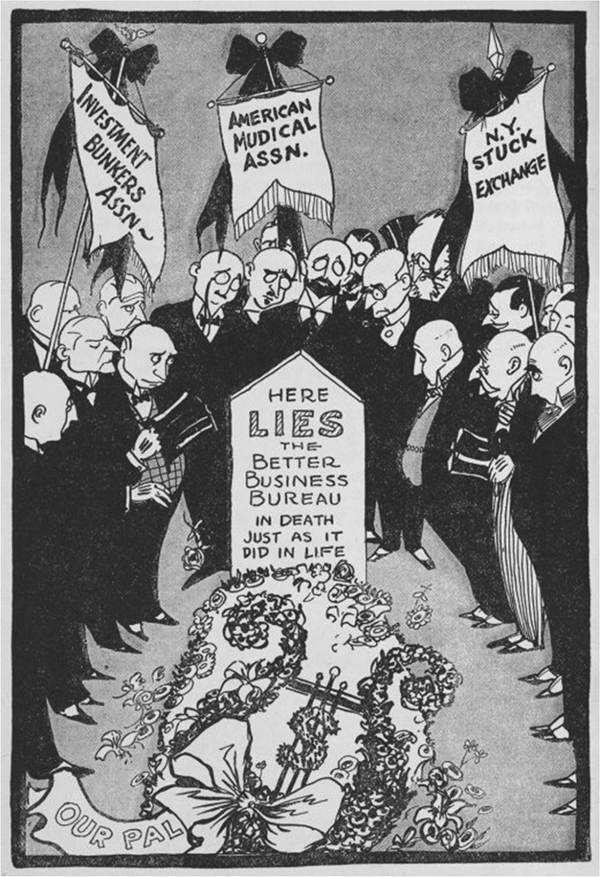
Figure 8.1: 'The Better Business Bureau as good friend of the Establishment. A cartoon from Edward Riegel’s 1931 anti-BBB pamphlet, “The Indictment of the Better Business Bureau Conspiracy.”
ernmental administrative regulation to the economic establishment’s preferred mechanisms of “home rule.” In either case, regulatory institutions turned out to be the pawns of entrenched businesses, and so created indefensible barriers to entry for would-be competitors.
Skeptics about the BBB network further condemned its pretensions to “quasi-public” status, calling it an “invisible government” without accountability or oversight. This strand of anti-BBB discourse echoed nineteenth-century attacks on credit reporting and the decades-long complaints about fraud orders. Like the foes of nineteenth-century commercial spy systems and secret postal investigations, the adversaries of interwar antifraud organizations rejected their vaunted surveillance networks and influence over prosecutors and the press. Such methods once again attracted the charge of being “unAmerican,” because they required a “system of espionage that is more vicious than the fraud it professes to suppress” and ignored principles of due process. As a longtime BBB adversary put this argument in 1933, the Bureaus had supplanted “the legitimate agencies of investigation, prosecution, and protection.” They had placed such powers in the hands of “unelected, irresponsible men, as well as unlicensed snoopers,” mostly “despicable” female “quasi-purchasers,” who “inject themselves into retail stores, to find, if possible, something derogatory to the merchant.” The BBB’s financial dependence on many of the businesses that they monitored elicited similar complaints.48
Even the name of the organization came under assault. The word “Bureau” was “a delusion and a snare,” falsely suggesting to ordinary Americans that it had official, public status, that it was even “a quasi-judicial body of our government.” “Vigilance Committee,” the institution’s original moniker, implicitly struck one antagonist, the iconoclastic social commentator Edwin C. Riegel, as more appropriate, because its extralegal mode of operation was reminiscent of the Ku Klux Klan. He dubbed the BBBs the “Clue Cliques Clan of Commerce.” Leaders of the Truth-in-Advertising movement had repeatedly invoked the language of “home rule,” portraying BBBs as institutions by which the business establishment could take the lead in policing candor in the marketplace. For Riegel, parallels between the antifraud campaign and the cause of white supremacy extended far beyond strategies of rhetoric.49
The National Businessmen’s Protective Council, a short-lived competitor to the BBBs, brought most of these charges together in a striking cartoon (Figure 8.2) that illustrated a promotional pamphlet. The cartoon’s central figure, a heavily muscled man symbolizing “Oppressed Business,” is bound by a clownish “Professional Snooper” and throttled by a venomous, two-armed snake, representing “Better Business Bureaus and Other Rackets.” Over the “Snooper’s” shoulders, a “Racketeer” whispers instructions. All the while, in the dis-
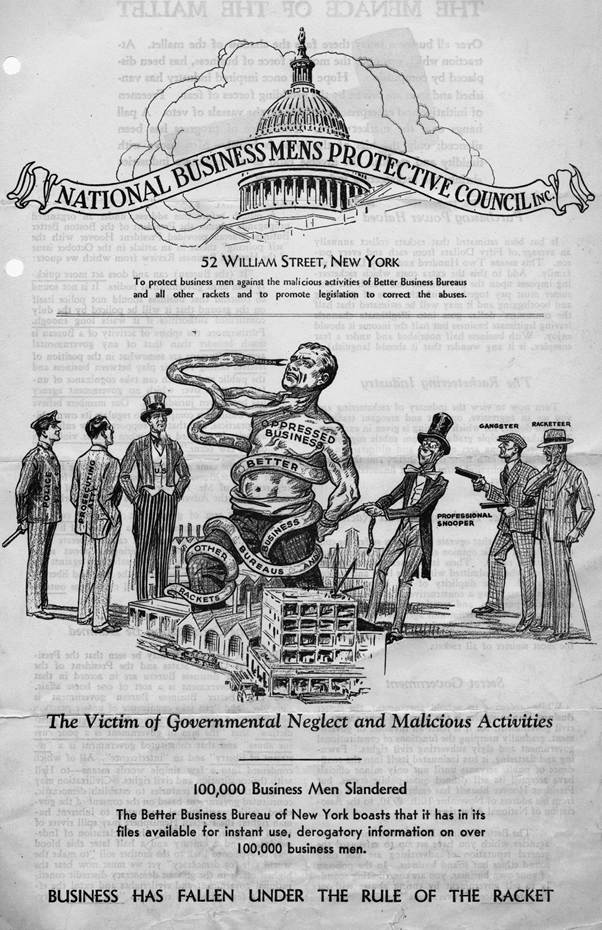
Figure 8.2: The Better Business Bureau as a two-armed poisonous snake. National Businessmen’s Protective Bureau pamphlet, 1931. Consumers’ Research Papers, Special Collections Library, Rutgers University.
tance, governmental officials either look away or glance bemusedly at the goings-on. Here was a vision of trade and industry “under the rule of the racket,” and of the BBBs as antithetical to American traditions of liberty, law, and free enterprise.
BBB officials responded to these various jibes in much the same way that credit reporting agencies and the Post Office had. In public commentary, they defended their methods as judicious institutional innovations that prevented economic duplicity. Both they and their political allies also attacked the credibility of their critics, whom Bureau defenders described as falling into one of three groups. The first comprised businessmen who pursued questionable marketing tactics and hoped to deflect attention from “their own malpractices.” This group included the stock promoter George Graham Rice, whose encounters with postal fraud allegations had led him to hone a populist rhetoric. In the wake of his first fraud order in 1904 and then his later mail fraud convictions, the inveterate promoter levied withering assaults on postal regulation, arguing that the country's financial elite, and especially the Guggenheim mining syndicate, used it as a means to crush their antagonists. In later years, his stock tip sheets denounced the Post Office, the New York Stock Exchange, and the nation's BBBs, all of which he characterized as doing the bidding of Wall Street.50
A second source of criticism, BBB leaders suggested, came from professional agitators and cranks such as Frank O'Sullivan and Edwin Riegel, who owed their livelihoods to windmill-tilting against the central institutions of modern American society, or from seemingly upstanding civic leaders who were hiding shady pasts, such as Logan Billingsley. A small-scale Chicago publisher and author, O'Sullivan specialized in florid detective literature and exposes of the criminal underworld. A self-taught libertarian economist, Riegel operated through an outfit known as the Consumers Guild of America, which was little more than a shell organization to dress up its president's periodic rants against both big business and big government. After a career in Seattle as a bootlegger, during which he faced allegations of involvement in two murders, Billingsley moved to New York City, where he dived into real-estate development. In the early years of the Great Depression, he gained control of the moribund Bronx Chamber of Commerce and Manhattan Board of Commerce, building up their public profiles by falsely claiming to have attracted prominent businesses as members. Like George Graham Rice, Billingsley sought to discredit the institutions of the “truth in advertising” movement after the BBBs exposed his own deceptions and evasions.51
Finally, antifraud organizations pointed out that they were occasionally targeted by populist politicians such as Iowa's Republican senator Smith W.
Brookhart. These politicos repeated the usual anti-BBB charges, seeing the issue as a chance to burnish their credentials as opponents of concentrated economic power. Given the sources of the complaints about BBB methods, its representatives advised that the public treat them as untrustworthy grumbling. Such gripes about the techniques of antifraud organizations were, the Columbus BBB explained in the early 1930s, nothing more than “the squealing of a stuck pig.”52
The squealing, however, sometimes contained an element of truth. Throughout the 1910s and the boom years of the 1920s, the BBBs had focused far more on identifying and publicizing the deceptions of fly-by-night firms than on the misrepresentations of large-scale retailers or leading investment banks. One exception to this generalization concerned price-related advertising by some metropolitan department stores, which BBB leaders highlighted as a further refutation of the claims made by its chief antagonists. The most prominent incident involved a public spat over the price claims of R. H. Macy & Co., which played out over the course of 1925 and 1926. This controversy would eventually push the BBBs, like the Post Office, to introduce procedural reforms.
For decades, Macy's had cultivated a reputation for low prices, boasting, as in one typical 1880 advertisement, that “OUR PRICES ARE BELOW COMPETITION.” By the 1920s, this claim had become far more precise. “Macy prices,” the store proclaimed in a 1925 ad, “are at least 6 percent less, every day of the year, on every article of merchandise,” including both regular and sale items. The department store could meet this promise, executives claimed, because Macy's purchased goods in large quantities for cash or extremely short credit terms, and sold only for cash, thus avoiding the bad debts and high return rates associated with credit sales. Prompted by a chorus of complaints from competitors, the New York City BBB's merchandising division sent its professional shoppers into Macy's over several months in 1925, in line with its policy of checking the advertising claims of all retailers, including member firms. The shoppers then compared the prices of identical items at other retailers, discovering dozens of items elsewhere that were the same price or even cheaper. Several meetings between BBB officials and Macy's executives ensued, as the Bureau pressed the company to redress the alleged inaccuracy in its core advertising message. But Macy's management rejected any suggestion that its ads were fundamentally “inaccurate,” characterizing the Bureau's demands as intrusive attempts to dictate marketing policies.53
The dispute between Macy's and the New York City BBB closely paralleled a key point of contention between the Post Office and Sears, Roebuck in the mid-1890s—how to interpret the significance of unfilled or wrongly filled orders. Sears had emphasized that his firm's enormous volume of business and large number of employees rendered some mistakes inevitable, and that the company had created an internal mechanism for identifying and correcting errors. Percy Straus, Macy's vice president, took a similar tack in responding to the BBB's allegations about his firm's ad copy. His department store, Straus pointed out, sold thousands of items, with prices for many changing regularly. In order to adhere to Macy's policy of selling below its competitors, the establishment maintained an internal “Comparison Bureau,” which sent out employees to other retailers to survey prices. Macy's also encouraged customers to bring lower prices to its attention, and charged its hundreds of sales clerks with “reporting] prices conflicting with our Policy” Whenever Macy's management became aware of a price differential, Straus insisted, they adjusted the store's prices downward. But in light of the enormous range of its offerings and the size of its workforce, some mistakes and oversights were inevitable. In many cases, moreover, thorny questions arose over whether particular goods were “really directly comparable or equivalent,” which required timeconsuming “technical analysis” and internal debate. Straus further explained that in all instances of ambiguity, Macy's erred toward “giving to our customers the benefit of the doubt.”54
Macy's and the New York BBB possessed very different understandings about what counted as an advertising “inaccuracy,” and who should have the authority to apply that standard and fashion remedies for violations. The department store's executives did not object to the BBB's shopping checks; indeed, they welcomed them and promised to adjust prices whenever the Bureau pointed out discrepancies. They also readily adjusted the wording of their advertising copy, including an explicit concession, adopted in early 1926, that “We are not infallible. Others may on occasion cut our price—may on occasion sell merchandise for one reason or another at prices lower than we, until we find it out.” But they refused to give ground on their central marketing claim—that they systematically offered the lowest prices in New York, and so were “the store of the thrifty—of those who pay as they go” To concede this point, Percy Straus insisted, would amount to tacit approval of the BBB's extending its jurisdiction far beyond the mission of combating fraud. The result of such a concession would be all manner of “dangerous meddling” in the delicate and difficult process of “competition in business” Rather than accept this diktat, Macy's resigned its membership in the New York City Bureau.55
The controversy over Macy's pricing policy simmered for several more years. BBB officials wished to demonstrate their willingness to stand up to a large corporation; they were fortified in that impulse by the encouragement of several Macy's competitors, such as Gimbels and Wanamaker's, which viewed their rival's claims of perennial underselling as misleading. For several years after Macy's resignation, BBB leaders looked upon the department store with suspicion. In the late fall of 1930, for example, the head of the Detroit BBB confidentially reported rumors that Macy's was bankrolling the activities of Logan Billingsley's Manhattan Board of Commerce, which had included attempts to place anti-BBB billboard ads in Detroit. At the national level, the BBB network forged standards for advertising copy that frowned on the use of universal claims of underselling such as those pushed by R. H. Macy & Co. In its 1932 Guidefor Retail Store Advertising, the Affiliated BBBs described such assertions as “impossible of fulfillment,” because no advertiser could “have complete and accurate knowledge of all prices in all other stores by all merchants at all times.”56
Nonetheless, Bureau officials felt compelled to handle its scrap with Macy's in a much less confrontational fashion than its response to the organizations and individuals who criticized its operations most vehemently. Percy Straus was no George Graham Rice. The Macy's vice president was a well-respected member of the nation's business elite who managed an iconic retail establishment, not a shifty promoter with a criminal record and a history of running businesses that, at best, pressed the bounds of propriety and honest marketing. In January 1926, at the height of the dispute over the “6 percent” claims, the New York City BBB offered to send the Macy's advertising case to an ad hoc review panel, appointed by the president of one of three organizations—the Merchants Association of New York, the New York State Chamber of Commerce, or the Bar Association of the City of New York. This approach, the BBB head Bayard Dominick suggested, would permit “the fullest possible determination of all the facts as to whether [Macy's] advertising slogans... are accurate as applied to your business, or whether they are misleading to the public and unfair to your competitors.”57 Dominick's proposal conceded that the Bureau's mode of enforcement was open to the same kind of objection so often lobbed at fraud order proceedings before the 1913 postal reforms—that the BBB vested the role of investigator, prosecutor, and judge in the same institution, and sometimes the same person.
Macy's declined to participate in arbitration relating to its advertising strategy, but the idea of instituting some type of appeal process to an impartial body remained alive within BBB circles. As the public attacks on its methods intensified amid the early years of the Great Depression, procedural reform of this sort became more attractive. An additional prod in this direction came from the increasing integration of the BBB network into the formal policymaking and enforcement activities of the federal government. During the late 1920s, the Federal Trade Commission had called upon the National BBB and the Affiliated BBBs to coordinate trade practice conferences to set standards in several industries, including one on national periodical advertising. This initiative culminated in the 1933 adoption of “Code of Advertising Practices,” which largely tracked the 1932 Guide to Retail Advertising.58
To fortify its case for the adoption of such codes, and perhaps to make them more palatable to its large corporate funders, the National BBB proposed the creation of “a Review Committee on Fair Business Practices” in 1931. Comprising representatives of advertisers, the advertising industry, and media, this board would furnish an appeal tribunal to advertisers who disagreed with NBBB findings. Although its jurisdiction would be informal, akin to voluntary arbitration, its procedures would mimic many legal conventions. After advertisers requested a hearing, the NBBB would furnish it with “a brief designating the alleged practices and setting forth the reasons why the practices are considered by the Bureau to be unfair to competition or detrimental to [the] public interest in advertising.” The appellant would next file a “written answer” within fifteen days, and the NBBB would set a date for a hearing. Although that proceeding would “be conducted in an informal manner,” the board would have the power to confine discussion to the precise dispute at issue, both sides would have the opportunity to introduce “expert testimony,” and each party could ask legal counsel to present arguments. Edward Greene, the NBBB's general manager, depicted this setup as “a sound application of quasi-judicial opinion applied to business conduct.” In combination with the surveillance and moral suasion furnished by the National BBB, Greene contended, the new tribunal would “provide a broad and equitable system of self-regulation by business.”59
With the incoming Roosevelt administration in view, Greene found sufficient support from the publishing, broadcast, and advertising industries to begin preparations for a review board in late 1932. Over the next several months, the NBBB persuaded trade associations representing these industries to appoint members to the board, and announced in late spring of 1933 that it would soon begin operations.60 This initiative quickly faded from public view, however, displaced by the chaotic activity of the National Recovery Administration (NRA). As part of the New Deal economic recovery strategy, the NRA asked industries, including advertising, to adopt and then enforce fair business practices. The codes that emerged for retail advertising followed the script laid down by the NBBB's work from the late 1920s and early 1930s. Throughout the country, moreover, the new federal agency turned to the BBB network for assistance in enforcement, borrowing several BBB officials to help run metropolitan compliance divisions, and drawing on a number of local BBBs to undertake the work of code monitoring and enforcement. Now, instead of the planned Advertising Review Committee, firms who chafed at a
BBB interpretation or decision could gain a formal hearing before an NRA Code Administrator.61
Unlike the Post Office Department, then, the early twentieth-century BBB network did not actually implement extensive procedural protections for its mode of handling instances of marketing deceptions. As we will see, the truncated history of the Advertising Review Committee foreshadowed institutional evolution after World War II by both the National BBB and many of its local bureaus. On its own terms, the episode from the early 1930s still suggests the influence that common-law procedural norms had on antifraud initiatives. From the inception of the “truth in advertising” movement, bureaus had stressed the advantages of informal investigations and negotiations taking place outside of the public spotlight, so long as firms demonstrated a willingness to defer to their assessments of fair dealing. But in the face of sustained criticism about secret methods and unaccountable arrogation of power, and wishing to bring along heavy corporate advertisers whose executives and legal counsel wished to maintain freedom of commercial action, BBB leaders looked to defuse criticism through procedural adjustments. Their proposals reflected longstanding ideals about the rule of law—notice, specification of charges, the chance to present and rebut evidence, the opportunity to rely on legal counsel, and judgment by individuals who did not participate directly in the initial investigations. Edward Greene stressed that any hearings by the Advertising Review Committee would “be conducted in an informal manner,” and that the rules governing its operation were indeed much more informal than a court proceeding. Even within the realm of business self-regulation, however, American legal culture left its stamp on institutions. The New York Times did not miss the legal implications of the advertising review panel. Its headline for the story reporting on its adoption informed readers that the “Advertising Field” was about to get a “High Court”—though this august body would function entirely outside the ambit of the state.
Early Fraud-Fighting at the FTC
As Federal Trade Commission officials began to combat deception in interstate trade during the mid-1910s, they skirted the political assaults that the Post Office Department had endured, and that critics would later direct toward the BBBs. They did so in part by paying attention to issues of procedural fairness from the start, adopting rules that insulated the commission from charges that it operated like Russian secret police. Unlike the Post Office, which could bar access to the mails and initiate criminal fraud prosecutions, the FTC's arsenal consisted mainly of “cease and desist” orders, which directed firms or individuals to stop specified practices. Officials at the commission, moreover, could only issue such orders after a lengthy administrative process that incorporated several features of common-law adjudication. After receiving an initial complaint about a business, usually from a competitor, or encountering evidence of wrongdoing through direct monitoring of the marketplace, the FTC would assign one of its staff attorneys to conduct a preliminary investigation. Typically involving at least some field interviews, this inquiry resulted in a written report that recommended either closing the case or initiating a formal hearing. A review board of two senior FTC attorneys and one FTC economist would then consider the recommendation, evaluating whether the firm in question participated in interstate or foreign commerce, whether its activities were sufficiently deceptive to violate the FTC Act, and whether formal administrative proceedings were in the public interest. This last requirement hinged on the applicability of other means of legal redress. If the board viewed the investigation as sufficiently thorough and believed that further FTC action was called for, it would ask the commissioners for authorization to launch a more formal consideration of the allegations. With that authorization, the FTC would send the target of the investigation official notice of an impending hearing to consider charges that it had engaged in unfair methods of competition, including a summary of the allegations against it. Before the hearing, the enterprise would have the opportunity to file a written answer to the charges, laying out the contours of any defense. The hearing would usually be conducted by a trial examiner not involved in any aspect of the investigation to this point, and would give respondents the opportunity to present evidence, cross-examine witnesses, and rebut arguments. After the hearing, the trial examiner prepared findings and a recommendation either for a dismissal or for the issuance of a cease and desist order, to which lawyers for the respondent and the FTC could reply through formal briefs. Finally, the full complement of five FTC commissioners would receive the complete record of the case, hold a further hearing for oral argument from the parties, debate its merits, and vote on its disposition.62
The FTC, then, gave ample notice of its actions and furnished access to the evidence amassed by investigators. It also took pains to separate the officials who investigated and prosecuted cases from those who ruled on them. FTC proceedings did not offer the full panoply of common-law protections available in the regular courts; they allowed a wider range of admissible evidence and limited respondents’ opportunity to enter procedural motions available in traditional legal disputes.63 Inquiries into allegations of unfair competition remained exercises in administrative law. Some legal observers would have preferred an even greater institutional separation between FTC prosecutors and trial examiners, especially in light of the occasional practice of asking prosecuting counsel to prepare formal findings for consideration by the full Commission.64 Nonetheless, early FTC deception cases reflected the Wilson administration’s general concern for procedural niceties, evident in its reform of the fraud order process.
Indeed, adherence to the formal requirements of exacting procedural rules frequently compromised the FTC’s ability to strike quickly at firms engaging in methods of unfair competition. During its first decade, numerous commentators reproached the FTC for its protracted process. The Commission itself noted that many preliminary inquiries entailed “long, extensive, and painstaking investigation of the facts.” Although subsequent hearings were supposed to take place within forty days of legal notice, a crowded docket made months- long delays all too common. As a result, the issuance of a cease and desist order often took a full two years. And if a firm defied such an order, the FTC had to go to federal court to compel its enforcement, a process that required still more time.65
Some respondent corporations grumbled that the slow pace of FTC decision-making forced them unfairly to contend with bad publicity before they were exonerated. Delays also meant that some fraudulent enterprises continued operations for months or even years while cases against them wound their way through the FTC bureaucracy. Perhaps the most problematic category of deception cases involved securities frauds. Because of the factual complexities and wide geographic reach of such swindles, the taking of testimony proved especially time-consuming. In the case of Samuel E. J. Cox, a notorious peddler of worthless Texas oil stocks who eventually faced federal prosecution for mail fraud, the FTC took almost four years to move from an initial 1919 complaint to the filing of a cease and desist order. As the legal scholar Gerard Henderson observed, “if the facts found by the Commission are true, one is tempted to ask how many gullible citizens were separated from their savings while the case was in progress!”66 The FTC’s legal process, then, often led to the shutting of commercial or financial schemes long after swindling schemers had moved on to new locales.
When control of the FTC passed over to Republican appointees in 1925, Chairman William Humphrey instituted several policies that sought to redress the FTC’s version of the “slows.” One pair of administrative changes sought to facilitate negotiated agreements between the commission and investigated businesses, akin to the turn-of-the-century stipulations arranged by the Post Office with firms that possessed good reputations but had flirted with misrepresentation. Under Humphrey’s direction, the FTC no longer docketed formal complaints nor publicized cases immediately after initial investigations. Instead, it allowed firms facing allegations to make provisional responses to them in closed, informal hearings. If, after this step, FTC attorneys still felt disciplinary action was appropriate, they tried to dispose of most false advertising cases through negotiated settlements. The most common arrangement required a business’s acceptance of a formal stipulation to cease those practices that FTC lawyers saw as problematic. In such instances, the FTC publicized only the relevant facts, keeping the names of stipulating companies from public view.67
According to Humphrey, these reforms allowed the FTC to dispense much fairer administrative justice, while enabling it to “quit playing tag with fraud.” Businesses that faced an unjust complaint from some competitor no longer had to deal with negative publicity in the months and years that it took for an action to make its way through administrative process. With stipulations, disposition of deceptive practices cases occurred within months rather than years. The much greater emphasis on negotiated compromises, Humphrey also stressed, moved FTC proceedings closer to the workings of the traditional court system, where most controversies ended with settlements. Such arrangements had the further advantage of freeing up investigators and lawyers to focus on truly fraudulent companies and unscrupulous media firms, against which the FTC chairman vowed not simply firm enforcement, but a “war of extermination.”68
In a similar vein, Humphrey greatly expanded the investment of FTC resources in trade practice conferences, which had begun soon after the conclusion of World War I. These meetings of firms in a particular industry identified unfair commercial tactics that had become commonplace and then adopted rules against such practices. Although these statements of industry custom lacked the force of law, their articulation helped to create commercial standards and norms that influenced managerial behavior. Even before the new FTC regime, Gerard Henderson had concluded that “the educational influence of a single trade practice submittal is as valuable as the coercion of a host of formal complaints and orders.” The agreements that resulted from trade conferences also helped FTC officials with enforcement actions. Industry rules of the road facilitated assessments of whether particular complaints about unfair methods of competition deserved attention. And because those rules reflected “the expressed sentiment of the trade,” they extended the capacity of FTC lawyers to use moral suasion against firms that had allegedly violated them. The FTC convened dozens of such conferences in the 1920s and 1930s, often in conjunction with the National BBB.69
A further initiative concentrated on direct monitoring of national print advertising. In 1929, the FTC created a Special Board of Investigation, headed by three attorneys, which reviewed thousands of sampled ads every week. This new unit operated in much the same fashion as the nation's BBBs. Like the Bureau network, the FTC developed a close working relationship with publishers of national magazines. When an official identified an advertisement that appeared to be deceptive, the FTC would contact the relevant publisher or station manager and request substantiation of marketing claims. If unsatisfied by the reply, officials suggested that the publication or station make adjustments or refuse the ad. If neither action was forthcoming, the FTC could authorize formal investigations of the advertiser as well as the relevant advertising agency and media outlet. This informal mechanism of regulation, the FTC claimed in its 1931 annual report, led advertisers, agencies, and print publications to agree to stipulations 95 percent of the time. The commission calculated that “over 10,000 false and misleading advertisements have been discontinued” as a result of its work.70
The FTC's regulatory ethos under Chairman Humphrey, then, reflected a strong commitment to both common-law proceduralism and the Republican philosophy of business self-rule. Each of these impulses called for a more restrained approach to false-advertising and other deception cases, though one still presupposed an active administrative state. This version of associational- ism retained the tension between adherence to formal legal process and informal administrative problem-solving. For William Humphrey, the key to resolving this tension lay in a more sympathetic regulatory stance toward legitimate enterprises. The Republican FTC chairman remained confident that his legal staff and fellow commissioners could identify outright swindlers when they saw them, treating them differently from honest businessmen who occasionally engaged in misrepresentation. Humphrey believed, like Postmaster General Cortelyou, that his agency could serve as a trustworthy keeper of the commercial peace. At the same time, he shared the growing concern of many early twentieth-century observers about vulnerable consumers within industrial economies. The FTC, he proclaimed in 1926, was charged with making “it impossible for the frauds and fakers, swindlers and scoundrels, with the help of dishonest, unprincipled, and mercenary publishers, who share in the fruits of their crime, to rob the sick and unfortunate, the credulous and the ignorant, of hundreds of millions of dollars annually.”71
Humphrey's procedural innovations found favor within the business community, which appreciated curbs on investigative publicity. But some influential legal thinkers viewed the FTC's turn to informal dispute resolution as an affront to procedural justice. To Henry Ward Beer, a professor at Brooklyn Law School and one of the nation's foremost trade lawyers, Humphrey's FTC had fashioned “short cuts” that violated “the first principles of legal procedure,” as well as the explicit terms of the FTC Act. That statute, Beer insisted, only authorized formal complaints, public hearings, and public rulings. Informal inquiries, “secret” stipulations, and trade practice conferences had no firm legal basis; they replaced fair-minded judgment with the worst kind of arm-twisting by officialdom, which few firms would resist, regardless of the merits of a given case. “As a people,” Beer protested, “we are not content to have our rights tried by administrative fiat.” As a result, he argued, it would be far preferable to have “much fake advertising... go unpoliced... than to have one honest business man put out of existence” through informal mechanisms that masqueraded as “as a substitute for its legal authority to proceed by complaint and finding of facts.”72 Despite such carping, the FTC adhered far more closely to Anglo- American conceptions of the rule of law than most agencies of the early twentieth-century federal government, including the pre-1913 Post Office. As with the Post Office Department, however, deference to procedural norms meant a slower pace of formal justice, and so more time for opportunistic marketing strategies that employed deception.
****
The direction of institutional evolution within late nineteenth- and early twentieth-century antifraud organizations underscores the attraction that many American elites had to the philosophy of administrative law articulated by the influential Victorian-era British legal scholar Albert Venn Dicey. For Dicey, the emergence of modern administrative agencies posed a grave threat to Anglo-American conceptions of liberty, because they so often took away the right to gain a review of state action by a member of the regular judiciary, under the rules and interpretive practices of the common law. As Dicey put the argument in his widely read lectures on the British legal system, the rule of law required that when a regulatory agency took some action that harmed private interests, it acted on the basis of “a distinct breach of law established in the ordinary legal manner,” with recourse in all cases to “the ordinary Courts of the land.”73
In the first half of the twentieth century, Dicey's views found favor among a segment of America's legal establishment that saw the emerging administrative state as a threat to the rule of law. Many American legal thinkers, among them University of Chicago law professor Ernst Freund, embraced a conservative, substantive version of Diceyism. Freund insisted that US constitutional values required far-reaching checks on administrative discretion, including the ability to appeal all administrative decisions in federal court. He wished to establish “an American Rechtsstaat” in which administrators applied clearly articulated, legislatively enacted rules and remained subordinate to the judiciary. This vision appealed to middle-class urbanites who associated public policy with the corruptions of boss-run political machines, as well as to prominent members of the bench and bar, who equated liberty with legal rituals and process.74
An alternative position was staked out by a group of eminent legal figures, most of whom were based in either America's financial capital, New York, or its seat of politics, Washington, DC. This group included corporation lawyer, Republican governor of New York, and Supreme Court justice Charles Evans Hughes; Henry Stimson, the Republican who served as Presidents Taft and Roosevelt's Secretary of War and Hoover's Secretary of State; John Foster Dulles, a leading business lawyer and eventual Republican Secretary of State, and, perhaps most importantly, Felix Frankfurter, Harvard law professor, policy counselor, and Roosevelt appointee to the Supreme Court. These attorneys recognized the implausibility of asking courts to review the nitty-gritty of administrative fact-finding, and so viewed flexible administrative decisionmaking as indispensable to the resolution of economic controversies within an industrialized society. But they sought to infuse regulatory agencies with respect for due process, and called for members of the legal profession to become watchdogs of the administrative state, ready to cry foul when discretion transmuted into unprincipled, unfair “arbitrariness.”75
These ideas would become fundamental premises of American regulatory design, enshrined in the 1946 Administrative Procedure Act, and the analogous legislation later passed by most state legislatures. Earlier experimentation with antifraud measures, however, demonstrates the longstanding gravitational pull of procedural reforms. To ignore them in the construction of regulatory organizations was to court antagonism from affected entrepreneurs and public censure from conservative lawyers and politicians. By contrast, grafting elements of regular court procedures into regulatory operations enabled agencies to fend off critics. Provision of notice and specific charges, formal hearings, separation of investigation, prosecution, and judgment, opportunity to appeal—these policies cemented the legitimacy of administrative antifraud adjudication within state agencies and quasi-public institutions such as the BBBs. In fits and starts, from the 1870s into the 1930s, antifraud regulators blunted political critiques by embracing procedural protections.76
This pattern did not emerge at the behest of a judiciary jealously guarding its prerogatives, for the courts deferred to administrative muscle-flexing against deceptive business practices. Instead, the demands came from a motley crew of journalists, iconoclastic social commentators, and the targets of fraud investigations—all of whom usually drew on a popular legal culture that distrusted governmental power. Specters of “Star Chambers” and secret police
240 • Chapter Eight connected the critique of antifraud regulation to the nation's revolutionary past, updated to distinguish American liberty from the dictatorial dispositions of Eastern Europe and Asia. Eventually, opponents of administrative antifraud techniques fashioned a more professionalized discourse that reflected the norms of elite legal education and the emergence of specialized legal practices. Those opponents received support from many large-scale businesses, which embarked on a concerted effort to slow down the ever more wide-ranging American regulatory juggernaut, and to compel less ambiguous directions from regulatory agencies.
The disputes over basic procedural questions in American fraud law has important implications for historical understandings of “the rule of law”—that complex, evolving, and ambiguous cluster of ideas and attitudes about justice that has helped to shape legal institutions in numerous societies over the past several hundred years, from Great Britain and its far-flung colonial possessions, to the continental powers of Western Europe, to late imperial and Republican China, to the United States.77 Modern conceptions of governance enshrined such values as clarity and effective dissemination of rules, impartiality in official judgments, provision of appeal, and universal application of law, regardless of social position.78 As the evolution of American antifraud institutions suggests, these norms were hardly shibboleths. They connected elite debates over bureaucratic design to more popular conceptions of law and justice; and appeals to these values often carried weight in the construction and refining of institutions, public and private. But their precise implications remained the subject of intense political jockeying amid the efforts to adjust institutions to the challenges of industrialization and the emergence of integrated, national economies.
To think about “rule of law” historically, then, one must do more than define its key elements and how they changed over time. One must also locate the sources of ideas and sensibilities, whether within the circles of legal elites, or among social groups, or in the ambit of a more diffuse, popular legal culture. One must further identify when established “rule of law” tenets receded in the face of competing political and legal priorities, or once again came to the fore, often with new twists or points of emphasis. And one must assess the social and economic consequences resulting from fidelity to these norms.79
Greater procedural protections within antifraud organizations slowed up their legal machinery. This shift hardly took away the ability of the Post Office, the FTC, or the BBBs to arrange stipulations with firms under investigation. Indeed, each of these organizations became a savvier practitioner of informal regulation, more appreciative of how industry-wide deliberations over fair practices and judicious settlements could attain regulatory goals with targeted
use of scarce institutional resources. But the emergence of slower and more expensive formal procedures furnished businesses that relied on deception with more room to maneuver. Unscrupulous enterprises enjoyed more time before they felt enough pressure to close up shop and move, or before authorities were able to shut them down. In evaluating behavior on the margin between puffery and misrepresentation, public institutions such as the FTC may have shied away from confrontation with deep-pocketed corporations, or settled for easier terms, because the alternative would likely involve protracted legal proceedings with uncertain outcomes.
Concerned about the social costs of business fraud, late nineteenth- and early twentieth-century American policymakers experimented with the techniques of modern administrative regulation. They did so in some cases with the hope of burnishing professional credentials, but in all instances with the expectation of bypassing the frustrations associated with attacking deceit through the regular courts. Although several decades of legal counterattacks did not fully remold antifraud regulation according to common-law precepts, the critiques did encourage regulatory officials to take procedural fairness far more seriously. With the resulting institutional adjustments came heightened protections for the civil liberties of entrepreneurs and companies, greater authority for business lawyers, and more courtlike rituals within administrative adjudication; but also a sometimes less aggressive enforcement posture, and more regulatory disappointments akin to those that characterized Barnum's America.