Nutrients in streams and rivers cycle while moving downstream
Nutrient supplies in streams and rivers are highly dependent on external inputs from terrestrial ecosystems. Terrestrial inputs of organic matter, dissolved nutrients derived from chemical weathering and decomposition in surrounding soils, and particulate minerals are the primary sources of nutrients for riverine organisms.
Rivers and streams carry these materials to the ocean, but they are not just conduits for the movement of material between terrestrial and marine ecosystems. Biogeochemical processing in moving stream water can change the forms and concentrations of the elements it contains. For example, denitrification and biological uptake in streams and rivers may result in significant losses of nitrogen during transport in stream water. These processes may explain why rivers export less nitrate from regions receiving high amounts of nitrogen pollution than would be expected (FIGURE 22.15A). Both denitrification and biological uptake are enhanced when detritus is abundant on the stream bottom (FIGURE 22.15B).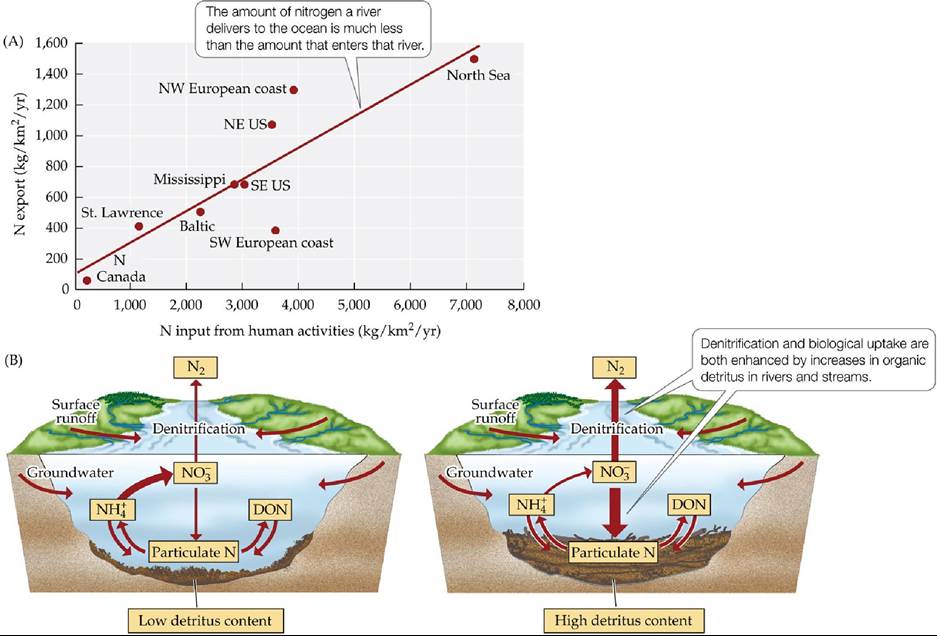
FIGURE 22.15 Rivers Are Important Modifiers of Nitrogen Exports Nitrogenthatenters rivers from terrestrial ecosystems is not simply carried to the ocean. (A) The rates of nitrogen exports to the North Atlantic Ocean from major drainage basins are correlated with rates of nitrogen inputs into rivers by human activities. The export rates, however, are substantially lower than the input rates because of biogeochemical processing of the nitrogen in the rivers (notice the difference between the scales in the x and y axes). (B) Denitrification and biological uptake are two of the main processes that lower the export of nitrogen from drainage basins. Both processes are enhanced when benthic detritus is high. DON, dissolved organic nitrogen.
(A after R. W.Howarth et al. 1996. Biogeochemistry 35: 75-139; B after E. S. Bernhardt et al. 2005. BioScience 55: P219- P230.) View larger image
Nutrients in rivers and streams are cycled repeatedly as the water flows downstream. Dissolved inorganic forms of nutrients are taken up by organisms, including fungi, bacteria, and phytoplankton, which incorporate them into organic molecules. These organisms may be consumed by others and pass through a food web, eventually entering the pool of stream detritus. Following decomposition of the detritus, the mineralized nutrients are released back into the water in dissolved inorganic forms. This repeated uptake and release in association with the movement of water can be thought of as nutrient “spiraling” (Newbold et al. 1983) (FIGURE 22.16). The time it takes for a full nutrient spiral to occur (i.e., from uptake and incorporation into organic forms to release in inorganic forms) is related to the amount of biological activity in the stream, the water velocity, and the chemical form of the nutrient. These variables have important impacts on the retention of nutrient pollutants (nitrate and phosphate) in rivers and can therefore impact the formation of dead zones in estuaries (see Concept 20.2). Greater biological retention (longer nutrient spirals) helps to buffer the impacts of nutrient pollution to downstream sources (lakes, estuaries). The turnover of nitrate in rivers tends to increase downstream, as indicated by increasing spiral lengths, while phosphate is retained equally well upstream and downstream (Ensign and Doyle 2006).
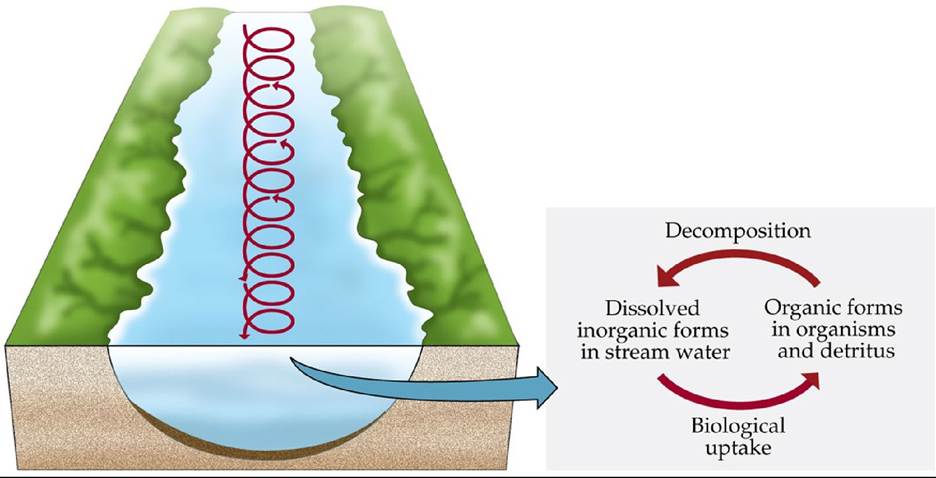
FIGURE 22.16 Nutrient Spiraling in Stream and River Ecosystems Cyclingofnutrients as the water moves downstream results in repeated spirals of nutrient uptake and release. View larger image
More on the topic Nutrients in streams and rivers cycle while moving downstream:
- Biological communities in streams and rivers vary with stream size and location within the stream channel
- Nutrients cycle at different rates according to element identity and ecosystem type
- Nutrients in lakes cycle efficiently in the water column
- CONCEPT 22.3 Nutrients cycle repeatedly through the components of ecosystems.
- While a repetitive gait cycle arises from the alternating base of support found in all bipeds, the existence of this cycle provides great opportunity for clinical and biomechanical analysis of a child with gait dysfunction.
- Streams from the “West” and their Aftermath
- Catchment studies measure losses of nutrients from ecosystems
- Moving Linguistic Borders
- Imports and upwelling are important sources of nutrients in marine ecosystems
- Minerals and atmospheric gases are the ultimate sources of nutrients
- FROM PRODUCER TO SUPPLIER AND MOVING TO A NEW SINGULARITY
- If you looked across a landscape from the top of a mountain, you would see a patchwork of different communities—say, forests, meadows, lakes, streams, and marshes (FIGURE 19.3).
- CHAPTER NINE Moving toward Caveat Venditor
- Microorganisms modify the chemical form of nutrients
- Nutrients in Aquatic Ecosystems
- In the previous section, we saw how nutrients undergo biological, chemical, and physical transformations as they are taken up by organisms and released through decomposition, ultimately returning to their original forms (or similar ones).
- Phases of the Gait Cycle