Microorganisms modify the chemical form of nutrients
Microorganisms in soil and freshwater and marine ecosystems transform some of the inorganic nutrients released during the process of mineralization. These transformations are particularly important in the case of nitrogen, since they can determine its availability to plants and the rate at which it is lost from the ecosystem (see Figure 22.11).
Certain chemoautotrophic bacteria, known as nitrifying bacteria, convert ammonia (NH3) and ammonium (NH4+) released by mineralization into nitrate (NO3-) by a process called nitrification. Nitrification occurs under aerobic conditions, so it is limited primarily to terrestrial environments. Under hypoxic conditions, some bacteria use nitrate as an electron acceptor, converting it into N2 and nitrous oxide (N2O, a potent greenhouse gas) by a process known as denitrification. These gaseous forms of nitrogen are lost to the atmosphere and thus represent a loss of nitrogen from ecosystems.Plant ecologists and physiologists once believed that nitrogen availability to plants was dependent solely on the supply of inorganic nitrogen—nitrate and ammonium. Therefore, soil fertility has traditionally been estimated using measurements of these inorganic forms of nitrogen.
During the 1990s, much effort was invested in understanding what controls nitrogen mineralization rates, particularly in ecosystems where fertilization experiments had indicated that nitrogen availability limits primary production and influences community diversity. Measurements of inorganic nitrogen production in forest and grassland soils generally came close to estimates of the amount taken up by plants. However, rates of inorganic nitrogen supply in Arctic and alpine ecosystems were substantially lower than what plants were actually taking up. These apparent shortfalls in nitrogen supply led to the realization that some plants were using organic forms of nitrogen to meet their nutritional requirements.
Earlier work in marine ecosystems had shown that phytoplankton could take up amino acids directly from water, and mycorrhizae had been shown to take up organic nitrogen from the soil and supply it to plants. However, Terry Chapin and colleagues (1993) and Ted Raab and colleagues (1996) demonstrated that some plant species, primarily sedges, take up organic forms of nitrogen without mycorrhizae. Arctic sedges may take up as much as 60% of their nitrogen in organic form. Organic nitrogen uptake has been observed in plants in other ecosystems as well, including boreal forests, salt marshes, savannas, grasslands, deserts, and rainforests. Thus, the mineralization step in decomposition may not be as important for plant nutrition as has been commonly thought (Schimel and Bennett 2004).The use of soluble organic nitrogen by plants has important implications for competition among plants and between plants and soil microorganisms. There is evidence to support the hypothesis that plants in some Arctic and alpine communities avoid competition through the preferential uptake of specific forms of nitrogen—an example of resource partitioning (described in Concept 14.2). Robert McKane and colleagues (2002) examined the forms of nitrogen taken up by several plant species growing together in the Arctic tundra of northern Alaska. For each species, they measured uptake of inorganic and organic forms of nitrogen, as well as the depth in the soil at which nitrogen was taken up and the time of year when it was taken up. They found that all three factors (form of nitrogen, depth of uptake, and timing of uptake) differed among species. Furthermore, the researchers found that the dominant plants in the community tended to be the species that used the form of nitrogen that was most abundant in the soil (FIGURE 22.9). Thus, the ability of a species to dominate a community where nitrogen limits growth may be determined in part by its ability to take up a specific form of nitrogen.
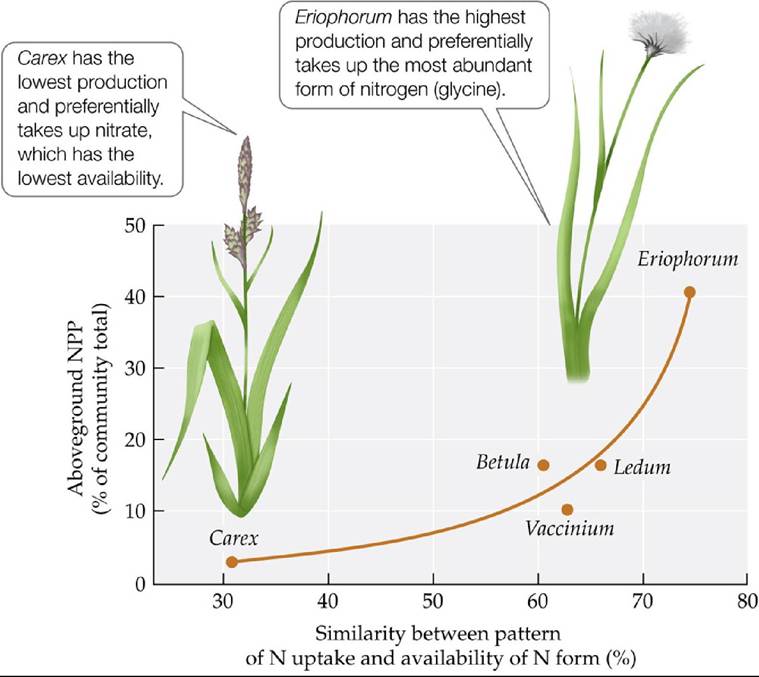
FIGURE 22.9 CommunityDominanceandNitrogenUptake Dominanceofaspeciesina plant community in the Alaskan Arctic tundra (measured by proportional contribution to the community’s total NPP) is related to the similarity between the plant's preferred form of nitrogen (ammonium, nitrate, or glycine, a small amino acid) and the availability of that form in the soil.
(After R. B. McKane et al. 2002. Nature 415: 68-71.) View larger imagePlants can recycle nutrients internally
Leaves, fine roots, and flowers contain the highest nutrient concentrations of any plant organ. During seasonal leaf senescence, nutrients and nonstructural carbon compounds (such as starch and carbohydrates) in perennial plants are broken down into simpler, more soluble chemical forms and moved into stems and roots, where they are stored. This phenomenon is most obvious in mid- to high- latitude ecosystems as chlorophyll molecules in the leaves of deciduous species are broken down to recover their nitrogen and other nutrients, while other pigments, such as carotenoids, xanthophylls, and anthocyanins, remain, providing the autumnal splendor we humans enjoy. Some of the fall coloration is due to an increase in pigment production, possibly to protect the leaves from high light levels or from herbivores. When growth resumes in spring, the nutrients are transported to growing tissues for use in biosynthesis. Plants may resorb as much as 60%-70% of the nitrogen and 40%-50% of the phosphorus in their leaves before they fall. This recycling reduces their need to take up “new” nutrients in the following growing season.
As we've traced the chemical transformations of nutrients in terrestrial ecosystems, we've seen that they move through various components of those ecosystems as they are transformed. In the next section, we'll look at those movements in more detail and trace the fates of the nutrients as they move through an ecosystem.
More on the topic Microorganisms modify the chemical form of nutrients:
- In the previous section, we saw how nutrients undergo biological, chemical, and physical transformations as they are taken up by organisms and released through decomposition, ultimately returning to their original forms (or similar ones).
- Reviewers
- SUMMARY
- Functions and composition of blood
- Digestive System
- Overview of skin structure
- GLOSSARY
- Macromolecules and cellular physiology
- Chapter summary
- Anatomy of the Cell