Decomposition is a key nutrient recycling process
As detritus (dead plants, animals, and microorganisms and egested waste products) builds up in an ecosystem, it becomes an increasingly important source of nutrients, particularly nitrogen and phosphorus, which often limit production of terrestrial and aquatic ecosystems.
Nutrients in detritus are made available by decomposition, the process by which detritivores break down organic matter to obtain energy and nutrients (FIGURE 22.6). Decomposition releases nutrients as soluble organic and inorganic compounds that can be taken up by other organisms.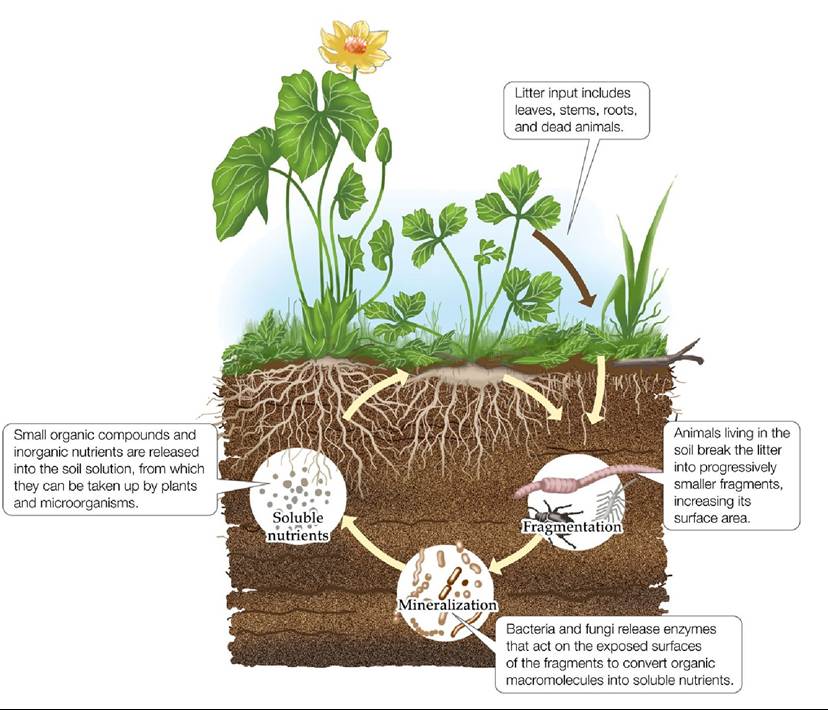
FIGURE 22.6 Decomposition Decomposition of organic matter in the soil provides an important input of nutrients into terrestrial ecosystems. Similar steps occur in freshwater and marine ecosystems.
How would the use of a nonselective pesticide (i.e., one that does not target any specific animals) to control insect herbivores affect the rate of decomposition in a lawn ecosystem?
View larger image
Organic matter in soil is derived primarily from plant matter, which comes from above and below the soil surface. Fresh, undecomposed organic matter on the soil surface is known as litter and is typically the most abundant substrate for decomposition. The litter is used by animals, protists, bacteria, and fungi as a source of energy and nutrients. As animals such as earthworms, termites, and nematodes consume the litter, they break it up into progressively finer particles. This physical fragmentation enhances the chemical breakdown of the litter by increasing its surface area.
An important final step in decomposition is the chemical conversion of organic matter into inorganic nutrients (i.e., nutrients that are not associated with carbon molecules), which is known as mineralization. It is the result of the breakdown of organic macromolecules in the soil by enzymes released by heterotrophic microorganisms.
Because plants often rely on inorganic nutrients, ecologists use measurements of mineralization to estimate rates of nutrient supply. An understanding of the abiotic and biotic controls on decomposition and mineralization is key to understanding nutrient availability to autotrophs.Rates of decomposition are greatly influenced by climate. Decomposition, like other biologically mediated processes, proceeds most rapidly at warm temperatures. Soil moisture also controls rates of decomposition by influencing the availability of water and oxygen to detritivores. Dry soils may not provide enough water for these organisms, and wet soils have low oxygen concentrations, which lower aerobic respiration and the rate of biological activity. Therefore, the activity of detritivores is highest at intermediate soil moistures and warm temperatures (FIGURE 22.7).
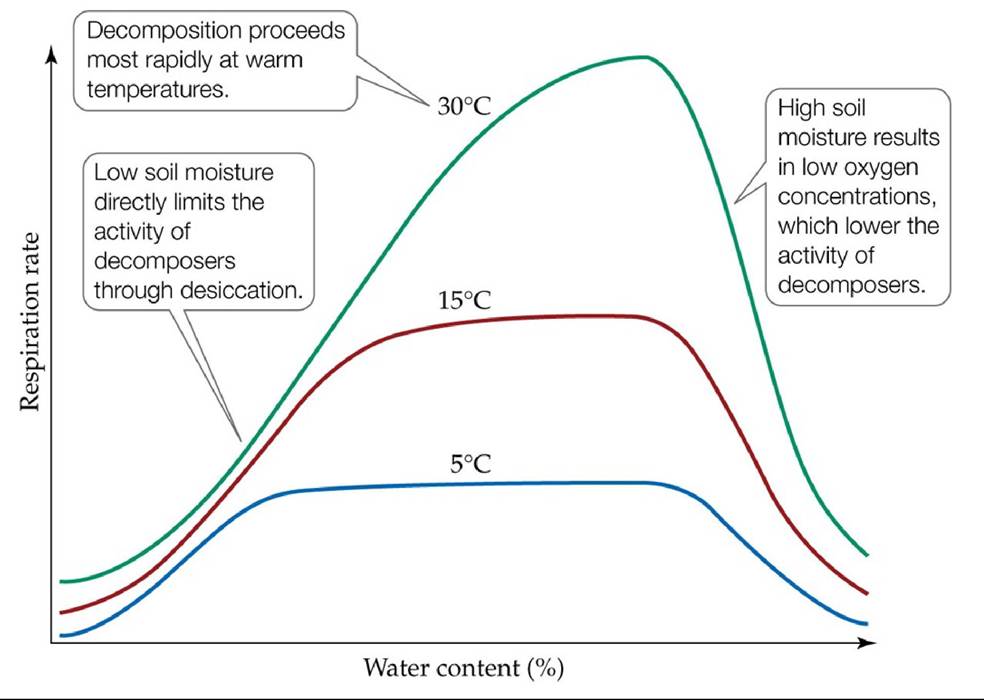
FIGURE 22.7 Climate Controls the Activity of Decomposers Changesinsoilmicrobial respiration, used as an estimate of decomposition, are modeled as a function of soil moisture at different temperatures. (After E. A. Paul and F. E. Clark. 1996. Soil Microbiology and Biochemistry.
Academic Press: San Diego, CA; F. L. Bunnell and D. E. N. Tait. 1974. In Soil Organisms and Decomposition in Tundra. Tundra Biome Steering Committee: Stockholm, Sweden.) View larger image
Some nutrients are consumed by detritivores during decomposition, so not all of the nutrients released during mineralization become available for uptake by autotrophs. The amounts of nutrients that are released from organic matter during decomposition depend on the nutrient requirements of the decomposers and the amount of energy the organic matter contains. These factors can be approximated by the ratio of carbon (representing energy) to nitrogen (since nitrogen is the nutrient most often in short supply for detritivores) in the organic matter. A high C:N ratio in organic matter will result in a low net release of nutrients during decomposition, since heterotrophic microbial growth is more limited by nitrogen supply than by energy.
For example, most heterotrophic microorganisms require approximately 10 molecules of carbon for every molecule of nitrogen they take up. About 60% of the carbon they take up is lost through respiration. Therefore, the optimal C:N ratio of organic matter for microbial growth is about 25:1. Organic matter with a C:N ratio greater than 25:1 would result in all of the nitrogen being taken up by the microbes during decomposition. Decomposition of organic matter with a C:N ratio of less than 25:1 would result in some nitrogen being released into the soil and made available for plants.Not all of the carbon in litter is equally available as an energy source for decomposers: the chemistry of that carbon determines how rapidly the material can be decomposed. Lignin, a structural carbon compound that strengthens plant cell walls, is difficult for soil microorganisms to break down and thus decomposes very slowly (FIGURE 22.8 and ANALYZING DATA 22.1). The rate of nutrient release from plant material containing high lignin concentrations, such as oak or pine leaves, is lower than that from material with low lignin concentrations, such as maple and aspen leaves. In addition, plant litter may contain secondary compounds, chemical compounds not used directly for growth (examples include those described in Concepts 5.4 and 12.2 associated with defense against herbivores and excess light), that can lower nutrient release during decomposition. Secondary compounds slow decomposition by inhibiting the activity of heterotrophic microorganisms and the enzymes they release into the soil or, in some cases, by stimulating their growth, leading to greater
microbial uptake of nutrients.
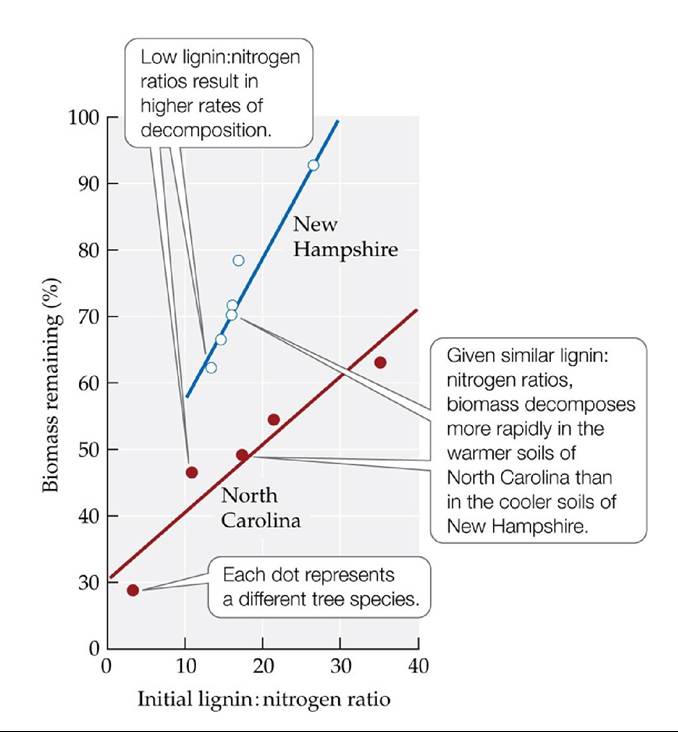
FIGURE 22.8 Lignin Decreases the Rate of Decomposition The rate of decomposition of leaf litter, expressed as the percent of biomass remaining, decreases as the ratio of lignin to nitrogen in the litter increases.
This ratio varies among forest tree species. Note, however, that climate also has an important influence on decomposition rates. (After J. M. Melillo et al. 1982. Ecology 63: 621-626.) View larger imageANALYZING DATA 22.1
Does Lignin Always Inhibit Decomposition?
We've learned that lignin, a structural compound found in leaves and stems, can lower rates of decomposition because it is a poorer carbon substrate for microorganisms. However, not all organic
matter degradation is biotic. In arid ecosystems, for example, sunlight can break down organic matter on the surface of soils, and it can be more important than biological decomposition (Austin and Vivanco 2006). How does lignin influence the abiotic decomposition associated with photodegradation? Lignin absorbs more solar radiation than cellulose, and thus it might potentially increase abiotic decomposition. To test this hypothesis, Amy Austin and Carlos Ballare (2010)* did a field experiment examining how the concentration of lignin influenced decomposition via both abiotic photodegradation and biotic activity. They used uniform cellulose sheets (filter paper) with a dilute solution of nutrients added to mimic leaf litter substrate. They added varying amounts of lignin to the sheets and then subjected them to conditions of mainly abiotic or biotic decomposition, by filtering light (biotic) or keeping the substrates isolated from the soil (abiotic). The mass loss from each sheet was measured to estimate the rate of decomposition. The results of Austin and Ballare's experiment are presented in the table.
| Biotic decomposition | Abiotic decomposition | ||
| Lignin concentration (%) | Mass loss (%/day) | Lignin concentration (%) | Mass loss (%/day) |
| 0 | 0.29 | 0 | 0.01 |
| 5 | 0.15 | 5 | 0.07 |
| 8 | 0.13 | 9 | 0.10 |
| 13 | 0.11 | 14 | 0.13 |
| 17 | 0.10 | ||
1.
Use the data in the table to plot the relationship between lignin concentration and mass loss for both biotic and abiotic decomposition.2. What can you conclude about the influence of lignin on abiotic versus biotic decomposition? How does your conclusion support the general hypothesis that plant tissues high in lignin decompose more slowly than plant tissues low in lignin?
3. Under what kinds of environmental conditions and in what types of biomes would you expect the assumption that lignin will lower decomposition not to hold true?
*Austin, A. T., and C. L. Ballare. 2010. Dual role of lignin in plant litter decomposition in terrestrial ecosystems. Proceedings of the National Academy of Sciences USA 107: 46184622.
By varying the chemistry of their litter, as well as the amount of litter they produce, plants can influence decomposition rates in the soil. Lowering decomposition rates lowers the fertility of the soil. What is the consequence for a plant of decreasing its own nutrient supply? For plants that have inherently slow growth rates, lowering soil fertility may protect them from competitive exclusion by neighbors with higher growth and resource uptake rates. Low soil nutrient concentrations can therefore be perpetuated through plant chemistry in a way that benefits the plants themselves (Van Breemen and Finzi 1998).