Phases of the Gait Cycle
Since the tasks of weight acceptance, single limb support, and swing limb advancement can only be accomplished successfully if appropriate limb movement patterns occur sequentially and with correct timing, Dr.
Perry developed a systematic method of subdividing the gait cycle to simplify pattern identification and facilitate observational gait analysis (24). Now known as the Rancho classification in honor of Rancho Los Amigos Medical Center where Dr. Perry and colleagues of the Pathokinesiology Service developed this method, it relies on eight subdivisions of the gait cycle, referred to as phases of gait. While in general, both phases and periods refer to specific time slices around the gait-cycle unit circle, Perry prefers to use the term “phase” for intervals that have specific functional significance and have a clear relationship to the three identified gait tasks described in the previous section. The Rancho classification provides a framework for functionally organizing the gait cycle harmoniously with the three fundamental gait tasks, and after 30 years of refinement, this approach has proven to be a powerful tool for identifying specific functional deficits or gait impairments during each phase of gait. Instrumented gait analysis can be used to quantify the magnitude of a functional deficit at a joint by reviewing the kinematic and kinetic data, or abnormal muscle timing by reviewing the EMG. This provides evidence and helps pinpoint the specific region or system most responsible for the overall gait abnormality, and suggests interventions to directly correct the identified functional deficit or gait impairment in each phase.The eight phases described by Dr. Perry are identified in Table 16.2. Notice that all but the first phase (initial contact) represent separate time intervals between 0% and 100% of the gait cycle. Figure 16.12 illustrates the phases of gait in sequence around the unit circle, with stick figures signifying the temporal
16.2
The Eight Phases of Gait as Described by Dr.
Jacquelin Perry| PHASE OF GAIT | DESCRIPTION |
| Initial contact | The moment when the foot strikes the ground |
| Loading response | Initial double support period when the limb is accepting weight. |
| Mid-stance | First phase of single support when the body advances over the stance limb ending ahead of the stance limb as weight is transferred to the forefoot |
| Terminal stance | Last phase of single support ending with opposite initial contact |
| Pre-swing | Final double support period when the knee rapidly flexes in preparation for swing and weight is shifted to the opposite limb |
| Initial swing | 1st third of swing period where maximum knee flexion occurs |
| Mid-swing | Middle third of swing period where maximum hip flexion occurs, ending with a vertical tibia |
| Terminal swing | Last third of swing period where final knee extension achieves maximum step length and the limb is properly positioned for weight acceptance |
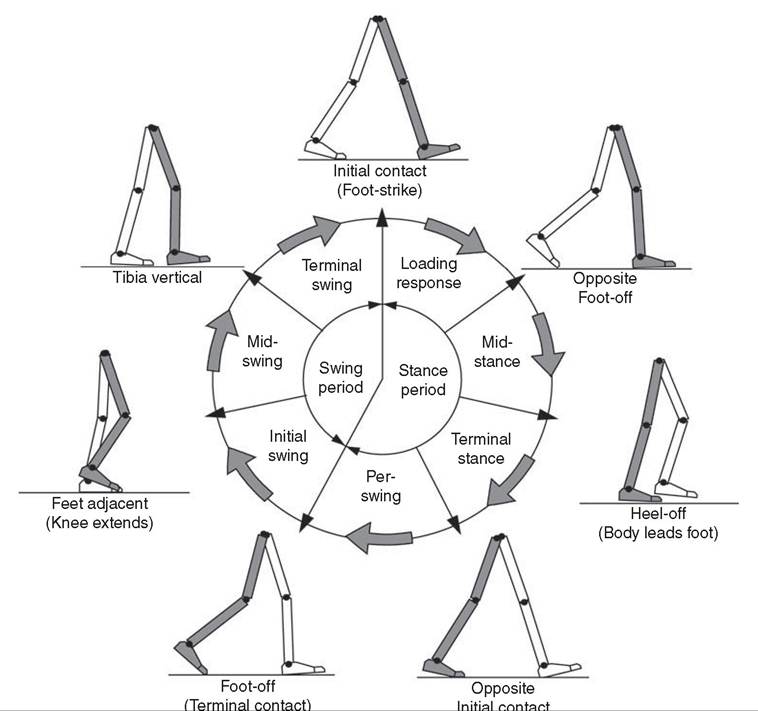
Figure 16.12 Typical gait cycle wrapped around a unit circle and subdivided into eight gait phases that have functional significance. The first phase is initial contact, and is equivalent to the temporal event by the same name. The phases are drawn in sequence and are equally spaced for clarity, but do not represent their usual duration. Refer to the text for a complete description of the phases and their functional significance.
event delineating the beginning and end of each phase.
Phases are shown equally spaced in this figure for clarity; typically, each phase will not be of the same time duration. Initial contact is considered a phase of gait since it marks an important transitional point between swing limb advancement and the challenging task of weight acceptance, although unlike the other phases, it is a single instant in time. The other important transitional period (from stance to swing) occurs during final double support and is known as the phase of pre-swing. In terms of temporal events, final double support (and therefore pre-swing) is considered part of stance period because this interval ends with foot-off. However, in terms of gait phases, this interval also marks the first phase of the swing limb advancement task, highlighting the fact that from a functional standpoint, pre-swing has more to do with preparing the limb for moving forward than supporting the body during stance (24). Also notice that three new temporal events not associated with foot/floor contact have been introduced: heel-off, feet-adjacent, and tibia vertical. These terms have been used by Whittle (5) and others (4,38) and are useful to delineate the phases in normal gait; however, there is not yet a consensus among gait investigators if these are the undisputed event markers. For example, Perry acknowledges that a rising heel usually marks the beginning of terminal stance in normal subjects, but in patients with weak ankle plantar flexors, this heel-off may be delayed into pre-swing, which would technically eliminate the terminal stance phase. Dr. Perry prefers to identify the beginning of terminal stance as the point where the body moves ahead of the limb and weight is transferred onto the forefoot (39). Similarly, the event marking the transition between initial swing and mid-swing has been identified as the point where the feet are adjacent (5), when the swing limb is directly under the body (4,38), when swing limb acceleration changes to deceleration in normal gait (36), where the knee begins to extend and the foot clears the ground (39), and mid-swing (4). Fortunately, most investigators agree that the temporal event marking the transition between mid-swing and terminal swing is the point where the tibia is directly vertical. These slight differences in the definition of the exact transition between phases are why some investigators report different phase durations for normal gait. This shouldn't be a concern, however, because determining the exact transition point between phases and comparing phase durations to normal are less important than recognizing that there are distinct phases in gait that can be identified and that certain functional accomplishments must occur in each phase.
More on the topic Phases of the Gait Cycle:
- Nutrients in streams and rivers cycle while moving downstream
- TECHNICAL FACTORS OF NEEDLE ELECTROMYOGRAPHY
- CLINICAL SPECTRUM
- Visual Impairment