Critical events link gait IMPAIRMENTS TO POSSIBLE INTERVENTIONS
With the gait cycle now subdivided both temporally and functionally into discrete phases, all that is left is to identify specific joint positions or motions in each phase that directly contribute to the accomplishment of the three functional tasks of weight acceptance, single limb support, and swing limb advancement.
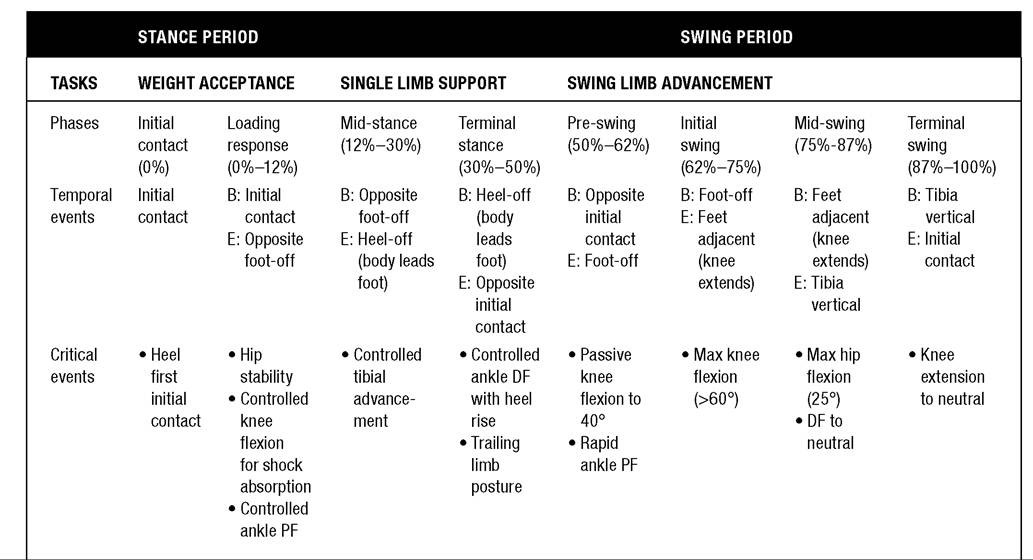
Dr. Perry and her colleagues at Rancho Los Amigos Medical Center refer to these specific joint positions or motions as critical events (39). They have identified 13 criticalevents over the entire cycle, with one or more critical events in each of the 8 phases. Critical events occur at the foot, ankle, knee, or hip, and are largely focused on angular displacements in the sagittal plane. While there are other, more subtle motions occurring in all three anatomical planes, these 13 critical events are considered the most essential to producing a normal walking pattern, typically have the largest displacements, and are most easily observed from the walking subject, with or without the help of recording instruments. The significance of this approach is that once the critical events that are essential to producing a bipedal gait pattern are known, one can use the measures from instrumented gait analysis to determine functional reasons for why a particular critical event is absent, altered, or delayed. Interventions can then be focused on restoring critical events, leading to improved walking performance. The critical events for each phase of gait are shown in Table 16.3, including their relationship to stance and swing periods and each gait task. Notice that critical events and temporal events are quite different. As has been discussed throughout this chapter, temporal events are moments or instants in time used to delineate periods in the gait cycle, and critical events are important functional components that can be used to identify gait impairments.
16.3
Relationship Between Periods, Tasks, Phases, Temporal Events, and Critical Events During the Gait Cycle
B, beginning; DF, dorsiflexion; E, end; PF, plantarflexion.