Biological communities in streams and rivers vary with stream size and location within the stream channel
Water flows downhill over the land surface in response to the force of gravity. The land surface is partly shaped by the erosional power of water, which cuts valleys as it heads toward a lake or ocean.
The descending water converges into progressively larger streams and rivers, called lotic (flowing-water) ecosystems. The smallest streams at the highest elevations in a landscape are called first- order streams (FIGURE 3.13). Two first-order streams may converge to form a second-order stream. Large rivers such as the Nile or Mississippi are equal to or greater than sixth-order streams.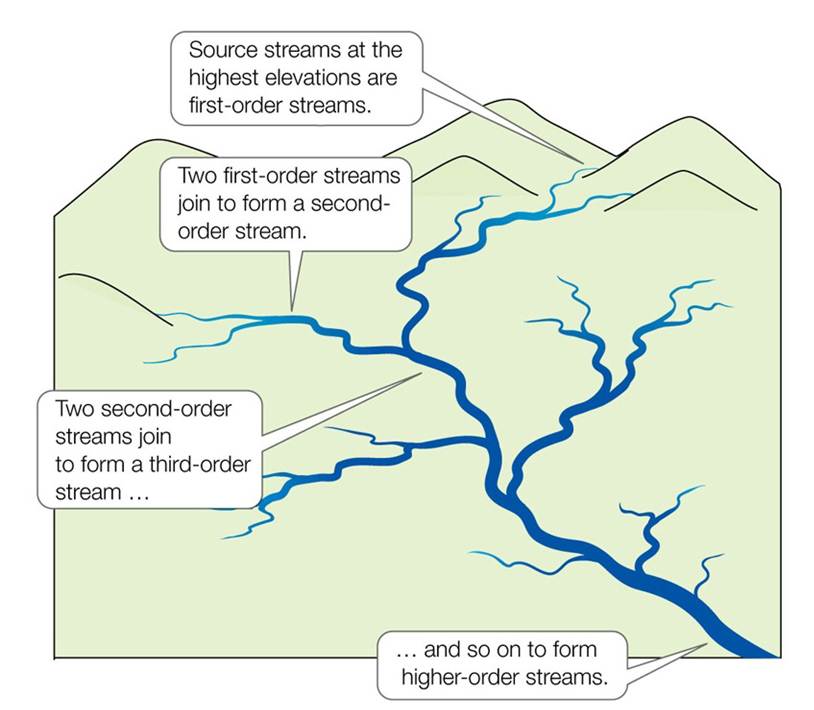
FIGURE 3.13 Stream Orders Stream order affects environmental conditions, community composition, and the energy and nutrient relationships of communities within the stream. View larger image
Individual streams tend to form repeated patterns of riffles and pools along their paths. Riffles are fast-moving portions of the stream flowing over coarse particles on the streambed, which increase oxygen input into the water. Pools are deeper portions of the stream where water flows more slowly over a bed of fine sediments. Biological communities in lotic ecosystems are associated with different physical locations within the stream and their related environments (FIGURE 3.14). Organisms that live in the flowing water of the main channel are generally swimmers, such as fish. The bottom of the stream, called the benthic zone, is home to invertebrates; some of these, such as some mayfly and fly (dipteran) larvae, consume detritus (dead organic matter), and some, such as some caddisflies and crustaceans, hunt other organisms. Some organisms, such as rotifers, copepods, and insects, are found in the substrate below and adjacent to the stream, where water, either from the stream or from groundwater moving into the stream, still flows.
This area is known as the hyporheic zone.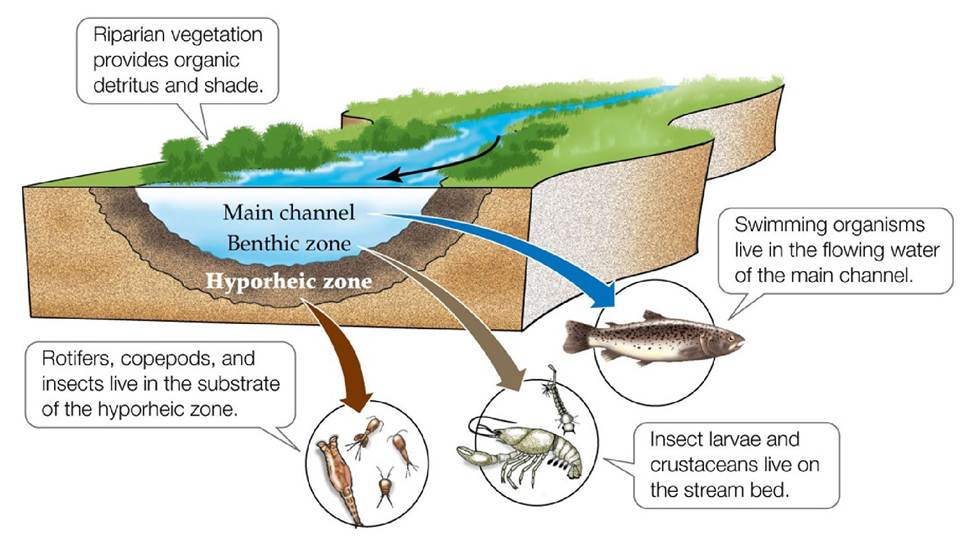
FIGURE 3.14 Spatial Zonation of a Stream Biological communities in a stream vary according to water velocity, inputs of plant material from riparian vegetation, the size of particles on the streambed, and the depth of the stream.
Where in this stream would you expect oxygen concentrations to be highest and lowest?
View larger image
The composition of biological communities in streams and rivers changes with stream order (see Figure 3.13) and channel size. The river continuum concept was developed to describe these changes in both the physical and biological characteristics of a stream (Vannote et al. 1980). This conceptual model holds that as a stream flows downslope and increases in size, the input of detritus from the vegetation adjacent to the stream (known as riparian vegetation) decreases relative to the volume of water, and the particle size in the streambed decreases, from boulders and coarse rock in the higher portions to fine sand at the lower end, facilitating greater establishment of aquatic plants in the downstream direction. As a result, the importance of terrestrial vegetation as a food source for stream organisms decreases in the downstream direction. Coarse terrestrial detritus is most important near the stream source, while the importance of fine organic matter, algae, and rooted and floating aquatic vascular plants (known as macrophytes, from macro, “large”; phyte, “plant”) increases downstream. The general feeding styles of organisms change accordingly as the river flows downstream. Shredders, organisms able to tear up and chew leaves (e.g., some species of caddisfly larvae), are most abundant in the higher parts of the stream, while collectors, organisms that collect fine particles from the water (e.g., some dipteran larvae), are most abundant in the lower parts of the stream. The river continuum concept applies best to temperate river systems, but not as well in boreal, Arctic, or tropical rivers or in rivers with high concentrations of dissolved organic substances (including tannic and humic acids) derived from wetlands.
Nonetheless, the model provides a basis for studying biological organization in stream and river systems.Human effects on lotic ecosystems have been extensive. Most fourth- and higher-order rivers have been altered by human activities, including pollution, increases in inputs of sediments, and introductions of non-native species. Streams and rivers have been used as conduits for the disposal of sewage and industrial wastes in most parts of the world inhabited by humans. These pollutants often reach levels that are toxic to many aquatic organisms. Excessive application of fertilizers to croplands results in runoff into rivers as well as leaching of nutrients into groundwater that eventually reaches rivers. Inputs of nitrogen and phosphorus from fertilizers alter the composition of aquatic communities. Deforestation increases inputs of stream sediment, which can reduce water clarity, alter benthic habitat, and inhibit gill function in many aquatic organisms. Introductions of non-native species, such as sport fishes (e.g., bass and trout), have lowered the diversity of native species in both stream and lake ecosystems. The construction of dams on streams and rivers tremendously alters their physical and biological properties, converting them into still waters— the topic of the next section.