Biological communities in lakes vary with depth and light penetration
Lakes and other still waters, called lentic ecosystems, occur where natural depressions have filled with water or where humans have dammed rivers to form reservoirs. Lakes and ponds may be formed when glaciers gouge out depressions and leave behind natural dams of rock debris (moraines), or when large chunks of glacial ice break off, become surrounded by glacial debris, and then melt.
Most temperate and polar lakes are formed by glacial processes. Lakes may also form when meandering rivers cease to flow through a former channel, leaving a section stranded, called an oxbow lake. Geologic phenomena, such as extinct volcanic calderas and sinkholes, form natural depressions that may fill with water. Lakes and ponds of biological origin, in addition to reservoirs, include beaver dams and animal wallows.Lakes vary tremendously in size, from small, ephemeral ponds to the massive Lake Baikal in Siberia, which is 1,600 m (5,200 feet) deep and covers 31,000 km2 (12,000 square miles). The size of a lake has important consequences for its nutrient and energy status and therefore for the composition of its biological communities. Deep lakes with little surface area tend to be nutrient poor compared with shallow lakes with much surface area (see Concept 22.4).
Lake biotic assemblages are associated with depth and degree of light penetration. The open water, or pelagic zone, is inhabited by plankton: small, often microscopic organisms that are suspended in the water (FIGURE 3.15). Photosynthetic plankton (called phytoplankton) are limited to the surface layer of water where there is enough light for photosynthesis, called the photic zone. Zooplankton—tiny animals and nonphotosynthetic protists—occur throughout the pelagic zone, as do other consumers such as bacteria and fungi, feeding on detritus as it falls through the water.
Fish patrol the pelagic zone, scouting for food and predators that might eat them.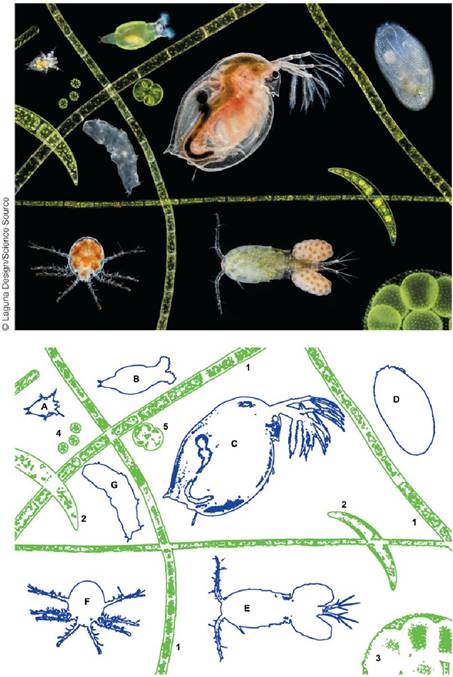
FIGURE 3.15 ExamplesofLakePlankton In this composite image of plankton from a pond, phytoplankton (green in the key) include filamentous algae (1), Closterium sp. (2), Volvox
sp. (3), and other green algae (4, 5). Zooplankton (blue in the key) include a larval copepod (A), rotifer (B), water flea (Daphnia sp., C), ciliated protist (D), adult copepod (Cyclops sp.) with egg sacs (E), mite (F), and tardigrade (G). View larger image
The nearshore zone where the photic zone reaches to the lake bottom is called the littoral zone. Here, macrophytes join with floating and benthic phytoplankton to produce energy by photosynthesis. Fish and zooplankton also occur in the littoral zone.
In the benthic zone, detritus derived from the littoral and pelagic zones serves as an energy source for animals, fungi, and bacteria. The benthic zone is usually the coldest part of the lake, and its oxygen concentrations are often low.
Let's move from fresh waters to the biological zones of the oceans. You will see that some of those zones have names and characteristics similar to those in freshwater lakes but have much greater spatial cover. As in freshwater communities, physical characteristics are used to differentiate marine biological zones.
More on the topic Biological communities in lakes vary with depth and light penetration:
- CONCEPT 3.3 Marine biological zones are determined by ocean depth, light availability, and the stability of the bottom substrate.
- Biological communities in streams and rivers vary with stream size and location within the stream channel
- If you looked across a landscape from the top of a mountain, you would see a patchwork of different communities—say, forests, meadows, lakes, streams, and marshes (FIGURE 19.3).
- CONCEPT 3.2 Biological zones in freshwater ecosystems are associated with the velocity, depth, temperature, clarity, and chemistry of the water.
- Ecologists often delineate communities by their physical or biological characteristics
- Biomes are large-scale biological communities shaped by the physical environment in which they are found.
- Biological communities in mountains occur in elevational bands
- CONCEPT 16.3 Communities can be characterized by complex networks of direct and indirect interactions that vary in strength and direction.
- Nutrients in lakes cycle efficiently in the water column
- Hunting communities Agricultural communities The "Indo-European" influence The Vedic period The ritual system
- THE FIRST UNIVERSAL LIGHT
- Light Cycle Aberrations
- THE MINIMUM LIGHT SPAN OF CREATION