Biological communities in mountains occur in elevational bands
Approximately one-fourth of Earth's land surface is mountainous. Mountains create climate gradients that change more rapidly over a given distance than those associated with changes in latitude.
Temperatures decrease with elevation (for reasons described in Concept 2.3); for example, temperatures in temperate continental mountain ranges decrease approximately 6.4°C for every 1,000 m increase in elevation (or 3.6°F per 1,000 feet), a decrease equivalent to that over approximately a 13° change in latitude, or a distance of 1,400 km (870 miles). As we might expect from our consideration of biomes and their close association with climate, coarse biotic assemblages similar to biomes occur in elevational bands on mountains. Finer-scale biotic distinctions are found in association with slope aspect (e.g., north-facing vs. south-facing), proximity to streams, and the orientation of slopes in relation to prevailing winds (see Concept 2.4).The biological communities that occur from the base to the summit of a temperate-zone mountain range resemble what we would find along a latitudinal gradient toward higher latitudes. An elevational transect on the eastern slope of the southern Rocky Mountains in Colorado, for example, includes grassland to alpine vegetation across a 2,200 m (7,200-foot) increase in elevation (FIGURE 3.11). The changes in climate and vegetation are similar to the transition from grassland to tundra that occurs with a 27° increase in latitude, from Colorado to the Northwest Territories of Canada. Grasslands occur at the base of the mountains, but they give way to pine savannas on the initial slopes (the lower montane zone). Fire plays an important role in determining the vegetation structure of both montane grasslands and savannas. With increasing elevation, the pine savannas are replaced by denser stands of mixed pine-and-aspen forests (the montane zone), which resemble temperate evergreen and deciduous forest biomes.
Spruce and fir trees make up the forests of the subalpine zone, which resemble the boreal forest biome. Mountain tree lines are similar to the transition from boreal forest to tundra, although topography can play an important role through its influence on snow distribution and avalanches. The alpine zoneabove the tree line includes diminutive plants such as sedges, grasses, and forbs, including some of the same species that occur in the Arctic tundra. Although the alpine zone resembles the tundra, its physical environment is different, with higher wind speeds, more intense solar radiation, and lower atmospheric partial pressures of oxygen (O2) and carbon dioxide (CO2).1
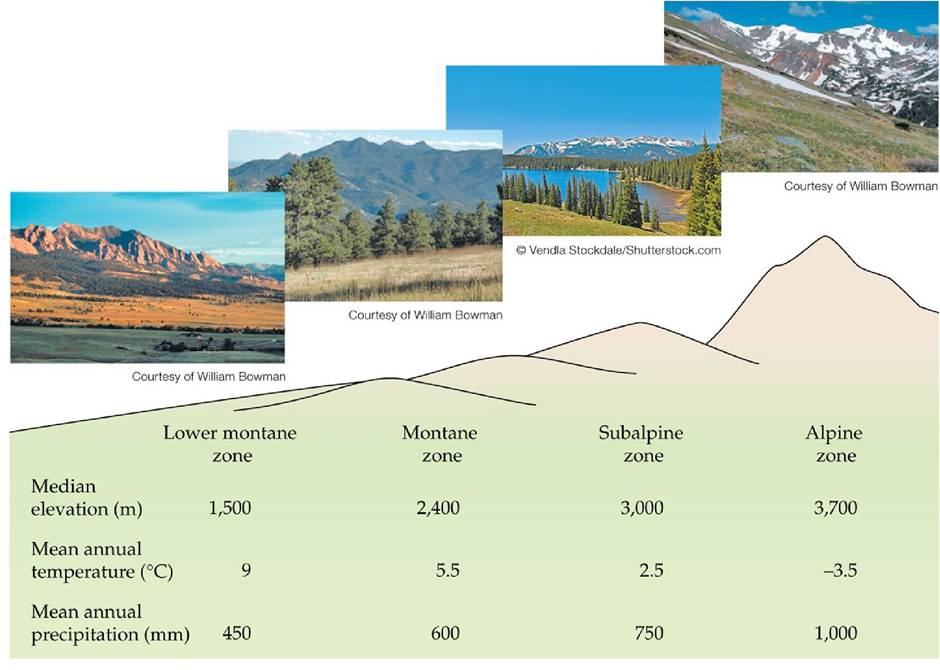
FIGURE 3.11 Mountain Biological Zones An elevational transect on the eastern slope of the southern Rocky Mountains passes through climate conditions and biome-like assemblages similar to those found along a latitudinal gradient between Colorado and northern Canada.
Would you expect the same biological zonation on east-facing and westfacing slopes in a temperate mountain range near the west coast of a continent?
(Data from J. W. Marr. 1967. Ecosystems of the East Slope of the Front Range of Colorado. University of Colorado Press: Boulder, CO.) View larger image
Mountains are found on all continents and at all latitudes. As indicated in the example above, the changes in climate associated with changes in elevation alter the composition of the local vegetation. Not all of the vegetation assemblages that occur in mountains resemble major terrestrial biomes, however. Some mountain-influenced biological communities have no biome analogs. For example, daily temperature changes at high-elevation sites in the tropics (e.g., Kilimanjaro and the tropical Andes) are greater than seasonal temperature changes. Subfreezing temperatures occur on most nights in the tropical alpine zone.
As a result of these unique climate conditions, tropical alpine vegetation does not resemble that of the temperate alpine zone or the Arctic tundra (FIGURE 3.12).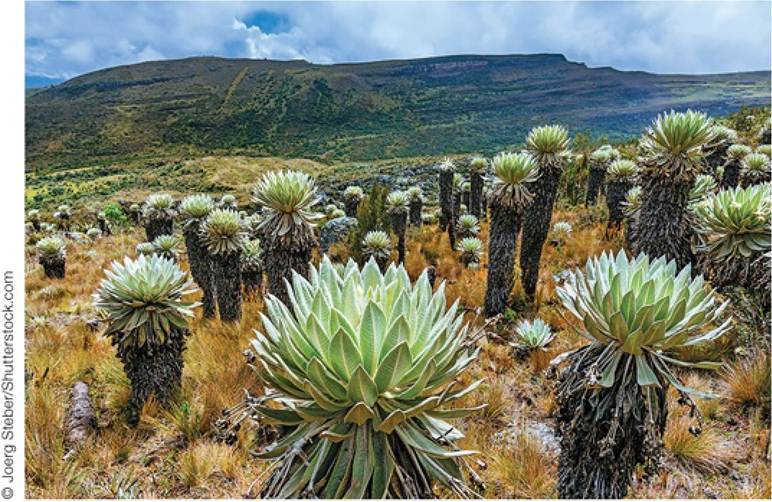
FIGURE 3.12 Tropical Alpine Plants Frailejon (Espeletia spp.) grows in alpine grasslands in the Ecuadorian Andes. Its growth form, characterized by a circle of leaves (rosette), is typical of plants in the tropical alpine zones of South America and Africa. The adult leaves help protect the developing leaves and stems at the apex of the plant from nightly frosts. Such giant rosettes are found exclusively in the tropical alpine zone and do not have analogs in the Arctic or Antarctic. View larger image
1
- The partial pressure of a gas is defined as the pressure exerted by a particular component of a mixture of gases. The concentrations of CO2 and O2 are the same at high elevations as they are at sea level, but their partial pressures are lower because total atmospheric pressure is lower. The exchange of a gas between an organism and the atmosphere is determined by its partial pressure rather than its concentration.