If you looked across a landscape from the top of a mountain, you would see a patchwork of different communities—say, forests, meadows, lakes, streams, and marshes (FIGURE 19.3).
You could be sure that each of those communities would have a different species richness and composition. The meadows would be dominated by a variety of grasses, herbs, and terrestrial insects.
The lakes would be filled with various species of fish, plankton, and aquatic insects, and they might possibly harbor as many species as the meadows. Even though some species (such as amphibians) would be able to move from one community to another, the communities would still be highly distinct.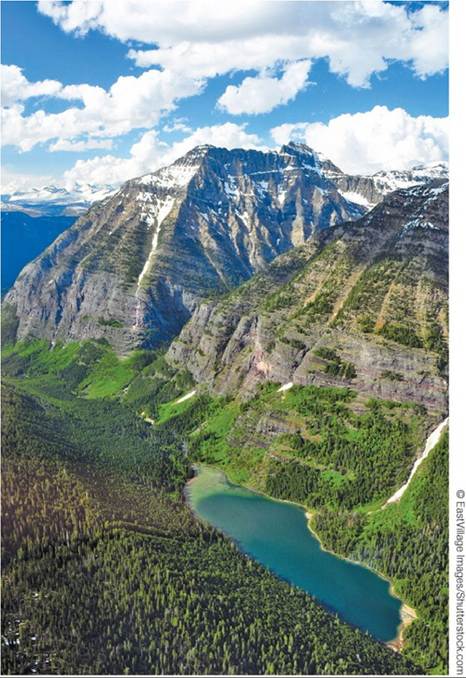
FIGURE 19.3 A View from Above Looking at these mountains in Glacier National Park, Montana, it is easy to see that the landscape is made up of a patchwork of communities of different types. View larger image
How do collections of species end up coming together to form different communities? One way to answer this question is to consider the factors that control species membership in communities. If you think about the sheer number of species that coexist within any community, it is clear that no one process is responsible for all the species we find there. As we saw in Concepts 9.3 and
18.1, the distributions and abundances of organisms are dependent on three interacting factors: (1) regional species pools and dispersal ability (species supply), (2) environmental conditions, and (3) species interactions. We can think of these three factors as “filters” that act to exclude species from (or include them in) particular communities (FIGURE 19.4). Let’s briefly consider each of them in more detail.
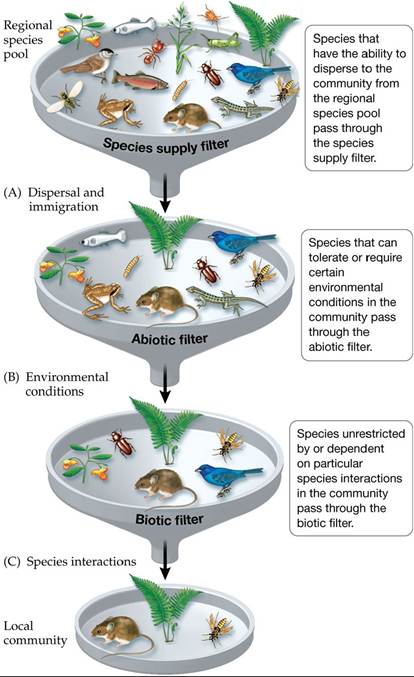
FIGURE 19.4 Community Membership: A Series of Filters Speciesendupinalocal community by passing through a series of “filters” that determine community membership. Species are lost at each filter, so local communities contain a fraction of the species in the regional pool. In practice, all the filters work at the same time, rather than in series as the figure suggests.
Would it make sense for the fish and frog species in the regional pool to be present in the local community shown in the figure? Explain.
(After J. H. Lawton. 2000. In Community Ecology in a Changing World, O. Kinne [Ed.], Excellence in
Ecology, Vol. 11. Ecology Institute: Luhe, Germany.) View larger image
More on the topic If you looked across a landscape from the top of a mountain, you would see a patchwork of different communities—say, forests, meadows, lakes, streams, and marshes (FIGURE 19.3).:
- Overshadowed by the spectacular conquests of the nomads and by the sophisticated civilization of the coastal cities, the obscured population of Ukraine’s northern forests, meadows, and river banks seemed for ages to be little more than a human backdrop for the fast-moving developments in the south.
- Biological communities in lakes vary with depth and light penetration
- Biological communities in streams and rivers vary with stream size and location within the stream channel
- The mountain masses and mountain chains of the peninsula do not constitute a regular, well-defined system... This irregularity... has its analogue in the distribution of the various races which inhabit the peninsula.
- In the Case Study at the opening of this chapter, we saw lower hantavirus prevalence in small-mammal communities with higher species diversity than in those with lower species diversity (see Figure 19.2).
- Nutrients in lakes cycle efficiently in the water column
- Mountain Marriage
- Nutrients in streams and rivers cycle while moving downstream
- Streams from the “West” and their Aftermath
- Rocky Mountain Spotted Fever
- The Men at the Top
- Childrearing: Starting at the Top, or the Bottom
- Hunting communities Agricultural communities The "Indo-European" influence The Vedic period The ritual system
- What is the Maidan, and what made it top news around the world?
- Wolves in the Yellowstone Landscape: A Case Study
- Violence converges from the bottom-up, top-down, and side-ways. Individuals most apt to find themselves in this convergence will do so at home and/or as children.
- Corridors can help maintain biodiversity in a fragmented landscape