Wolves in the Yellowstone Landscape: A Case Study
The Greater Yellowstone Ecosystem (GYE) both symbolizes the soul of the American wilderness and encapsulates the challenges of managing public lands. The landscape is shaped by a unique complex of natural elements: volcanic eruptions, geothermal activity, glaciers, and repeated fires, sometimes on a massive scale.
In addition, the interplay between large herbivores and their predators has the potential to impact the landscape, including the vegetation and landforms. All of these factors have contributed to the mosaic of forests, meadows, grasslands, lakes, and rivers that characterize the GYE.Prior to the early twentieth century, wolves were important predators in the GYE, but extermination programs led to their local extinction. After 70 years of absence, wolves were reintroduced into the GYE between 1995 and 1997 from populations in Canada and northwestern Montana. Wolves hunt among a wide diversity of ungulates and other prey (FIGURE 24.1). The reintroduction of wolves was the culmination of years of research effort and hotly contested policy debate, with strong objection from some residents of the region. Twenty years later, its ecological consequences have proved to be multifaceted and profound, and public opinion has become generally more favorable. Wolf reintroduction is perceived as restoring an important natural element to the GYE.
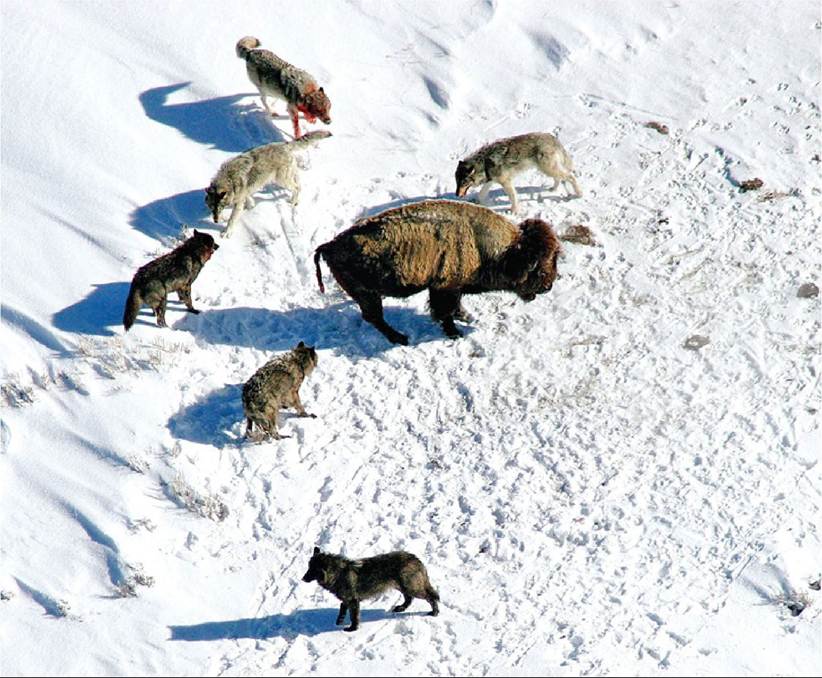
FIGURE 24.1 A Top Predator Returns A showdown between a pack of wolves (Canis lupus) and an American bison (Bison bison). After nearly 70 years of absence, wolves were reintroduced in 1995 to Yellowstone National Park, where they are now the main predators of ungulate herbivores including bison, moose, and elk. © NPS Photo/Alamy Stock Photo View larger image
But how “wild” and natural is the GYE? Larger in area than the state of West Virginia, the GYE includes two national parks and seven national forests as well as other public and private lands (FIGURE 24.2).
The region is actively managed by more than 25 different state and federal agencies as well as private corporations, nongovernmental organizations, and private landowners. Decisions about the use of its land and natural resources are complex and often uncoordinated, yet when considered together, these decisions determine which species will or will not be sustained by the ecosystem (Parmenter et al. 2003).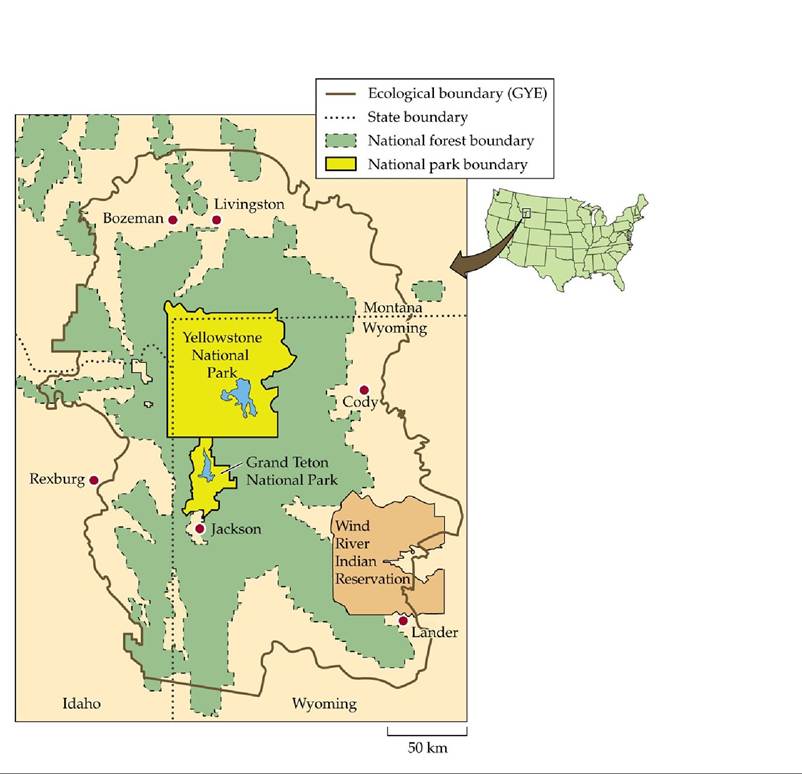
FIGURE 24.2 The Greater Yellowstone Ecosystem The Greater Yellowstone Ecosystem contains Yellowstone and Grand Teton National Parks, seven different national forests, and land managed by the Bureau of Land Management, as well as private lands. (After A. Parmenter et al. 2003. Ecoi Appi 13: 687-703.) View larger image
Despite its fragmented management, the GYE is often perceived as one of the most biologically pristine regions in North America. It sustains seven species of native ungulates and five large carnivore species. Understanding how these predator and prey populations interact, and how their abundances affect the whole ecosystem, has been a persistent challenge to ecologists who study the GYE, particularly in light of a century of management of wildlife populations. After wolves were eradicated in the mid-1920s, there were concerns that elk were overgrazing meadows in the northern part of the park. The elk population was regulated from the 1920s to the late 1960s by exporting animals to elk farms and by culling. In 1968, a new policy of “natural regulation” without human intervention in population growth was implemented. The elk population nearly quadrupled over a 30-year period and suppressed the plants they fed on. The reintroduction of wolves has not only reduced the elk population but has also affected the populations of many other species. How?
To start to answer that question, let's go back to the 1950s, when ecologists noticed that beavers had become scarce in Yellowstone National Park. Gradually, it became clear that the cause was increased elk herbivory on the beavers' preferred food plants, willow and aspen. But a whole suite of other species depend on beaver ponds for their own persistence, and their abundances had declined along with the beavers'. The decision to eradicate wolves did not anticipate these ecological changes to the Yellowstone ecosystem. How can ecologists help managers of nature reserves make decisions that will take future consequences into account?
More on the topic Wolves in the Yellowstone Landscape: A Case Study:
- A Fragile Crust: A Case Study
- Case Study: Darug Clan, Australia
- Case study
- Case study contributors
- The First Farmers: A Case Study
- A Case Study of Solomon islands
- A Case Study of the Idu Mishmi
- “Killer Algae!”: A Case Study
- Enslaver Parasites: A Case Study
- A Sea in Trouble: A Case Study
- Nemo Grows Up: A Case Study
- Toolmaking Crows: A Case Study
- Frozen Frogs: A Case Study
- Case Study: Uruk 3000 B.C
- Snowshoe Hare Cycles: A Case Study
- Human Population Growth: A Case Study
- Infanticide in Lion Packs: A Case Study
- Toxins in Remote Places: A Case Study