Infanticide in Lion Packs: A Case Study
Lions are unique among cats in that they live in social groups called prides. A typical lion pride contains anywhere from 2 to 18 adult females and their cubs, along with a few adult males.
The adult females form the core of the pride, and they are closely related: they are mothers, daughters, aunts, and cousins. The adult males in a pride may be closely related as well (e.g., brothers or cousins), or they may be a coalition of unrelated individuals that help one another.The lions in a pride hunt cooperatively, and the females often feed, care for, and protect one another's cubs. But life in a pride has a dark side as well. Some males in the pride will attack and kill cubs in the pride (FIGURE 8.1), a behavior that seems both horrific and puzzling. Why do adult male lions do this? To shed light on this murderous behavior, let's consider some aspects of the life history of lions in more detail.
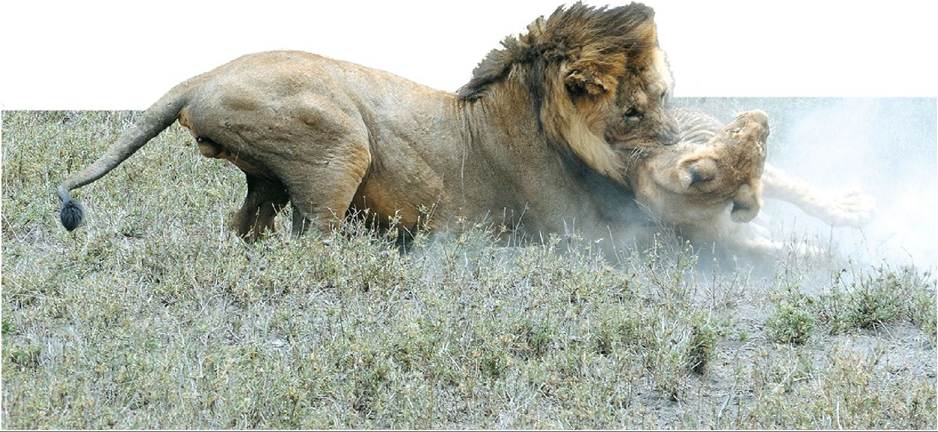
FIGURE 8.1 KillingtheCub The male African lion shown here is attempting to kill the juvenile offspring of another male; such attempts often succeed. Why might this behavior be evolutionarily adaptive for the murdering male? © Laura Romin & Larry Dalton/Alamy Stock Photo View larger image
As young adults, male lions are driven from the pride into which they were born. A group of young males expelled from a pride may stay together to form a “bachelor pride.” Bachelor prides may also consist of males from different prides that meet and begin to hunt together. By the time they are 4 or 5 years old, the young males in a bachelor pride are large and strong enough to challenge the adult males of an established pride. If their challenge is successful, the new males drive off the “dethroned” males, and they typically try to kill any young cubs that were recently fathered by those males.
Although the females fight back, the new males often succeed in killing cubs.If a female's cubs are killed, she becomes sexually receptive soon thereafter. In contrast, it can take up to 2 years for a female with cubs to resume sexual cycling. This delay in reproductive activity helps clarify the behavior of the incoming males. On average, incoming males remain with a pride for just 2 years before they are defeated and displaced by a new group of younger males. By killing cubs when he enters a pride, a new male increases the chance that he will reproduce before he is displaced by a younger male. As a result, incoming males that commit infanticide should leave more offspring than do males that do not commit infanticide. This logic suggests that infanticidal behavior by males is favored by natural selection, leading us to expect that it would be common in lion populations (which it is).
Infanticide is just one of the seemingly odd behaviors we see in animals. Fruit flies, for example, sometimes lay their eggs in food sources that contain high concentrations of ethyl alcohol, a toxic substance. Why do they do this? And why is it that the females of many species are more “choosy” than the males in selecting a mate—and yet in some species, such as the birds in FIGURE 8.2, the males are choosy and the females try to mate with as many males as possible? For answers, we turn to the strange and wonderful world of animal behavior.
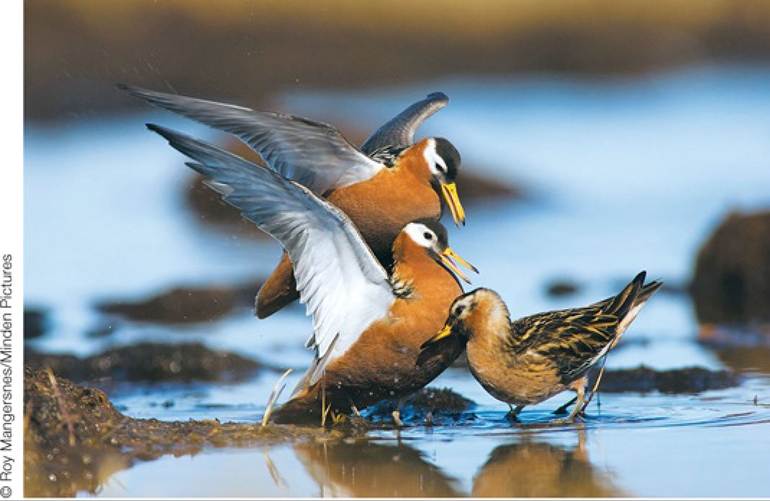
FIGURE 8.2 Females That Fight to Mate with Choosy Males Red phalarope (Phalaropus fulicarius) females (the two birds on the left) are larger and more colorful than the males of their species (on the right). In this species, the females fight over the right to mate with the males—and the males choose which females they will mate with. View larger image
More on the topic Infanticide in Lion Packs: A Case Study:
- Case Study: Darug Clan, Australia
- Case study
- Case study contributors
- The First Farmers: A Case Study
- Infanticide
- A Case Study of Solomon islands
- A Case Study of the Idu Mishmi
- “Killer Algae!”: A Case Study
- Enslaver Parasites: A Case Study
- A Sea in Trouble: A Case Study
- Nemo Grows Up: A Case Study
- Toolmaking Crows: A Case Study
- Frozen Frogs: A Case Study
- A Fragile Crust: A Case Study
- Case Study: Uruk 3000 B.C