Frozen Frogs: A Case Study
The idea of suspended animation—life being put on hold temporarily—has captured the imagination and hopes of people waiting for medical science to develop ways to cure untreatable diseases or reverse the ravages of aging.
Cryonics is the preservation of the bodies of deceased people at subfreezing temperatures with the goal of eventually bringing them back to life and restoring them to good health. Proponents of cryonics exist throughout the world, some more visible than others. In Nederland, Colorado, there is a yearly “Frozen Dead Guy Days” festival, considered to be the “Mardi Gras of cryonics.” This festival commemorates the efforts of a former resident who had his grandfather frozen immediately after his death from heart failure, hoping that one day his grandfather could be brought back to life and given a heart transplant (as documented in the movie Grandpa’s Still in the TuffShed).To some, cryonics seems far-fetched, a thing of science fiction and comedy (such as the TV show Futurama and the Austin Powers movies). Bringing life to a halt and then restarting it after a long period of quiescence doesn't seem plausible. Yet strange tales from nature provide examples of life apparently springing out of death. While seeking the existence of the Northwest Passage in the boreal and Arctic zones of Canada in 1769-1772, the English explorer Samuel Hearne found frogs under shallow layers of leaves and moss in winter “frozen as hard as ice, in which state the legs are as easily broken off as a pipe-stem” (Hearne 1911) (FIGURE 4.1). Hearne wrapped the frogs in animal skins and placed them next to his campfire. Within hours, the rock-hard amphibians came to life and began hopping around. The American naturalist John Burroughs found
frozen frogs under a shallow cover of dead leaves in a New York forest in winter. Return visits to the same locations over a period of months indicated that the frogs hadn't moved, yet by spring they had disappeared (J.
Burroughs 1914). Could a complex organism like a frog, with a sophisticated circulatory and nervous system, have achieved cryonic preservation as an evolutionary response to a harsh winter climate?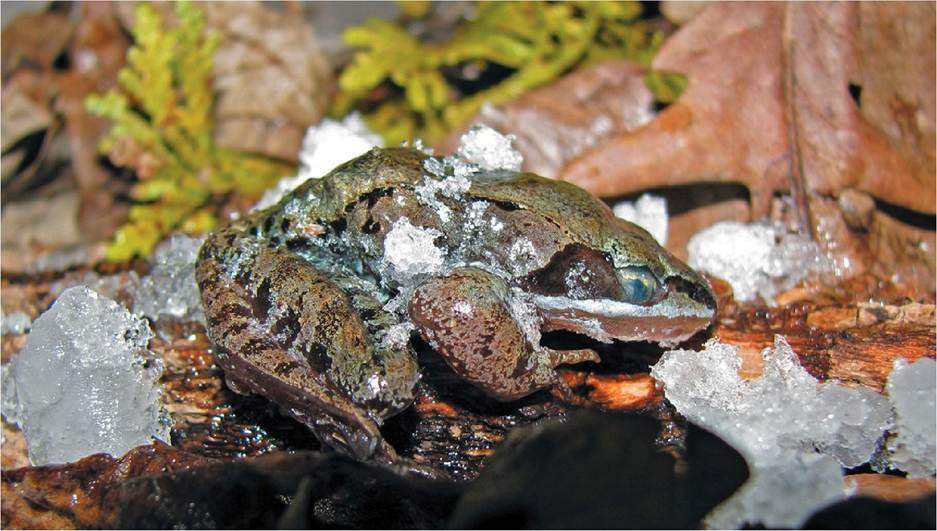
FIGURE 4.1 A Frozen Frog Wood frogs (Rana sylvatica) spend winters in a partially frozen state, without breathing and with no circulation or heartbeat. Courtesy of J. M. Storey View larger image
Organisms of the temperate and polar zones face tremendous challenges imposed by a seasonal climate that includes subfreezing temperatures in winter. Amphibians are unlikely candidates to have solved this challenge by allowing their bodies to partially freeze. Aside from their aforementioned complex organ and tissue systems, amphibians are “cold-blooded” (generating little heat internally) and, as a group, first evolved in tropical and subtropical biomes. Yet two frog species, the wood frog (Rana sylvatica, also known as Lithobates sylvaticus) and the boreal chorus frog (Pseudacris maculata), live in the tundra biome (FIGURE 4.2) (Pinder et al. 1992). These frogs survive extended periods of subfreezing air temperatures in shallow burrows in a semifrozen state, with no heartbeat, no blood circulation, and no breathing. Among the vertebrates, only a few species of amphibians (four frogs and one salamander) and one turtle species can survive a long winter in a semifrozen state. Freezing in most organisms results in substantial damage to tissues as ice crystals perforate cell membranes and organelles. How do these vertebrates survive being frozen without turning to mush in spring when they thaw out and reinitiate their blood circulation and breathing?
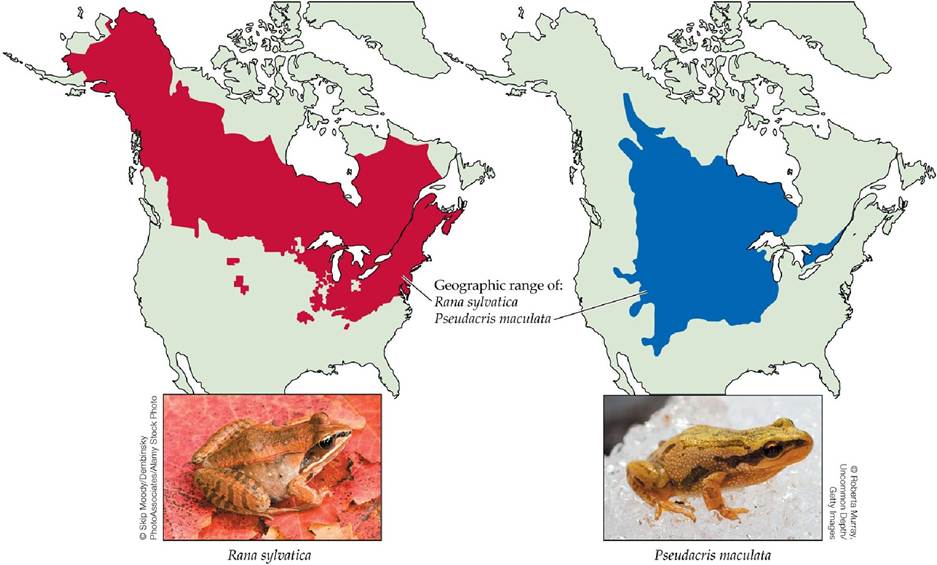
FIGURE 4.2 Northern Exposure Wood frogs (Rana sylvatica) and boreal chorus frogs (Pseudacris maculata) have geographic ranges that extend into the boreal forest and tundra biomes. (Range data from IUCN [International Union for Conservation of Nature], Conservation International & NatureServe. 2008. The IUCN Red List of Threatened Species Version 2019-2.
https://www.iucnredlist.orq/species/58728/78907321 and https://www.iucnredlist.org/species/136004/78906835. Downloaded on 14 June 2019.) View larger image