“Killer Algae!”: A Case Study
In 1988, a French marine biology student dove into the crystal-clear water of the Mediterranean Sea and made an unusual discovery. On the seafloor, just below the cliffs on which stood the palatial Oceanographic Museum of Monaco, grew an unusual seaweed, Caulerpa taxifolia (FIGURE 16.1), a native of the warm tropical waters of the Caribbean.
The student told Alexandre Meinesz, a leading expert on tropical algae and a professor at the University of Nice, about the unusual species. Over the following year, Meinesz confirmed its presence and determined that its feathery fluorescent green fronds, interconnected by creeping underground stems called rhizomes, carpeted an underwater area in front of the museum.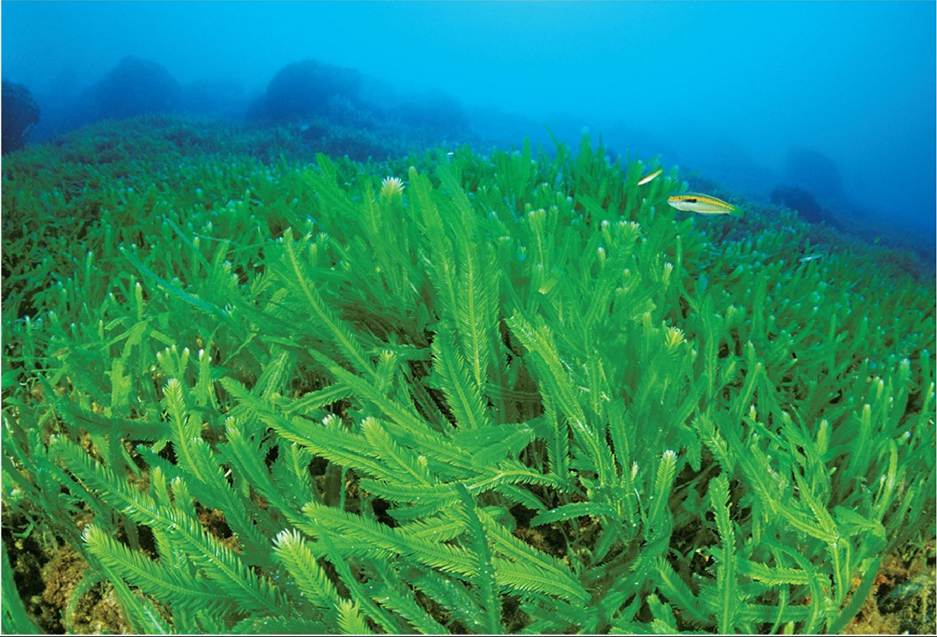
FIGURE 16.1 Invading Seaweed Caulerpa taxifolia rapidly invaded and dominated marine communities in the Mediterranean Sea. © Roberto Rinaldi/Minden Pictures View larger image
Meinesz was astonished because this species had never been seen in such cold waters, and it had certainly never reached the high densities he recorded. As it later turned out, earlier sightings from 1984 allowed Meinesz to calculate a spread of more than 1 hectare (ha) in 5 years. Over the next few months, he asked himself and his colleagues some important questions. First, how did the seaweed get to the Mediterranean in the first place, and how could it survive in temperatures as cold as 12°C-13°C (54°F-55°F), given that its normal temperature range is 18°C-20°C (64°F-68°F)? Second, did this species occur anywhere else in the Mediterranean, and was it spreading beyond the soft- sediment habitats found in front of the museum? Most importantly, at such high population densities, how was it interacting with native algae and seagrasses, both of which are critical habitats and sources of food for fish and invertebrate species?
A definitive answer to the second question came in July 1990, when the alga was found 5 km east of the museum, at a popular fishing location.
Evidently, fragments had been caught on the gear and anchors of fishing vessels and transported to new sites of colonization. The find generated media coverage that included information on the toxicity of the seaweed, which produces a peppery secondary compound to deter the fish and invertebrate herbivores that abound in the tropics. The press sensationalized Caulerpa,s natural toxicity with headlines such as “Killer algae!”—a misleading title that suggested that the seaweed was toxic to humans (it is not). As the news spread, so did the sightings of Caulerpa. By 1991, 50 sightings had been reported in France alone. The fluorescent green alga indiscriminately colonized muddy, sandy, and rocky bottoms at a depth of 3-30 m. By 2000, the alga had moved from France to Italy, then to Croatia to the east and Spain to the west, eventually spreading as far as Tunisia (FIGURE 16.2). It had invaded thousands of hectares, despite frantic but futile efforts to remove it.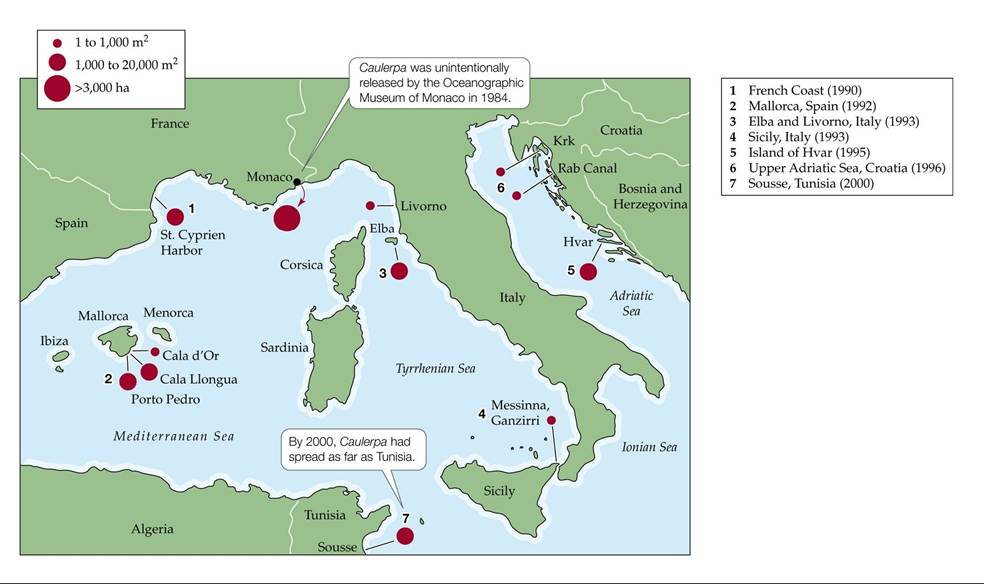
FIGURE 16.2 Spread of Caulerpa in the Mediterranean Sea Caulerpa taxifolia first invaded the waters off Monaco and France. By 2000, this algal species had reached Croatia and Tunisia.
Using the order of appearance on the map, describe the possible invasion pathways of Caulerpa within this region.
(After A. Meinesz et al. 2001. Biol Inv 3: 201. Based on A. Meinesz. 1997. Le roman noir de l'algue “tueuse”: Caulerpa taxifolia contre la Mediterranee. Belin Editeur: Paris.) View larger image
From the very beginning, Meinesz suspected that the answer to his first question lay with the museum. In 1980, a cold-resistant strain of Caulerpa taxifolia had been discovered and propagated in the tropical aquariums at the Wilhelma Zoo in Stuttgart, Germany. Cuttings were sent to other aquariums, including the one in Monaco, to be grown as aesthetically pleasing backdrops to tropical fish displays. The museum admitted to unintentionally releasing Caulerpa in the process of cleaning tanks but believed the alga would die in the cold waters of the Mediterranean.
Given that Caulerpa did not die, but instead quickly invaded and overtook shallow areas of the Mediterranean, scientists and fishermen alike wanted to understand how this abundant and fast-spreading seaweed would affect marine habitats and the fisheries dependent on them. How do interactions with one very abundant species influence the hundreds of other species with which it shares a community?