Enslaver Parasites: A Case Study
In science fiction books and movies, villains sometimes use mind control or physical devices to break the will and control the actions of their victims. In these stories, people may be forced to perform strange or grotesque actions, or to harm themselves or others—all against their will.
Real life can be just as strange. Consider the hapless cricket shown in FIGURE 13.1. This cricket does something that a cricket ordinarily would never do: it walks to the edge of a body of water, jumps in, and drowns. Shortly afterward, a hairworm begins to emerge from the body of the cricket (see Figure 13.1). For the worm, this is the final step in a journey that begins when a terrestrial arthropod—such as a cricket—drinks water in which a hairworm larva swims. The larva enters the cricket's body and feeds on its tissues, growing from microscopic size into an adult that fills all of the cricket's body cavity except its head and legs. When fully grown, adult hairworms must return to the water to mate. After the adults mate, the next generation of hairworm larvae are released to the water, where they will die unless they are ingested by a terrestrial arthropod host.
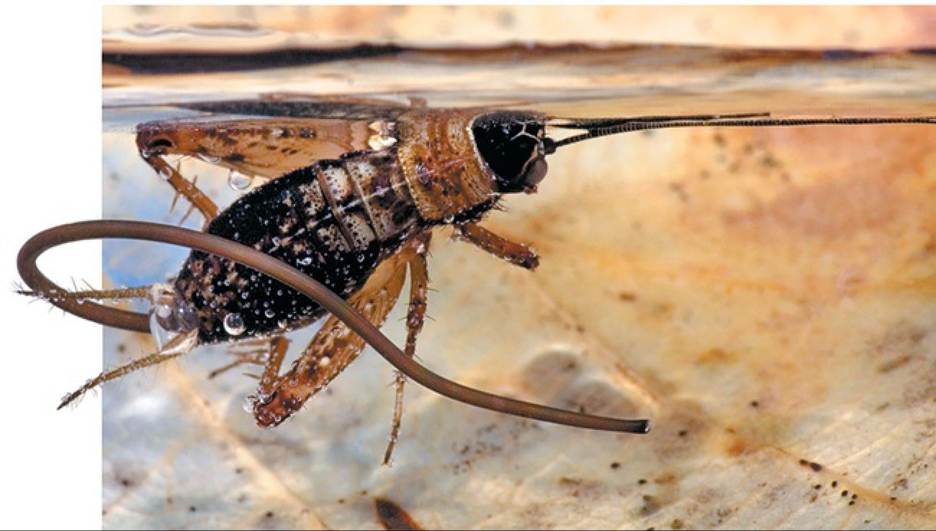
FIGURE 13.1 Driven to Suicide The behavior of this wood cricket (Nemobius sylvestris) was manipulated by the hairworm (Paragordius tricuspidatus) emerging from its body. By causing the cricket to jump into water (where it drowns), the parasite is able to continue its life cycle. © Pascal Goetgheluck/Science Source View larger image
Has the hairworm “enslaved” its cricket host, forcing it to jump into the water— an act that kills the cricket but is essential for the hairworm to complete its life cycle? The answer appears to be yes. Observations have shown that when crickets infected with hairworms are near water, they are much more likely to enter the water than are uninfected crickets (Thomas et al.
2002). Furthermore, in ten out of ten trials, when infected crickets were rescued from the water, they immediately jumped back in. Uninfected crickets do not do this.Hairworms are not the only parasites that enslave their hosts. Maitland (1994) coined the term “enslaver parasites” for several fungal species that alter the perching behavior of their fly hosts in such a way that fungal spores can be dispersed more easily after the flies die (FIGURE 13.2). The fungus Ophiocordyceps unilateralis also manipulates the final actions of its host, the ant
Camponotus leonardi. First, an infected ant climbs down from its home in the upper branches of trees and selects a leaf in a protected environment about 25 cm above the soil (Andersen et al. 2009). Then, just before the fungus kills it, the ant bites into the selected leaf with a “death grip” that will hold its body in place after it is dead. The fungus grows well in such protected environments, but it cannot survive where the ant usually lives—at the tops of trees, where the temperature and humidity are more variable. Thus, while the ant's final actions do not benefit the ant, they do allow the fungus to complete its life cycle in a favorable environment.
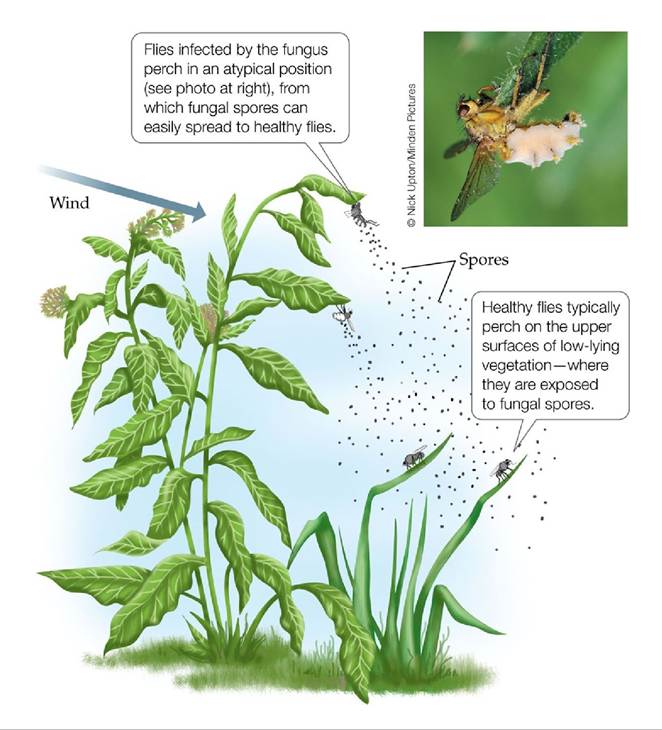
FIGURE 13.2 EnslavedbyaFungus Shortly before they die from the infection, yellow dung flies infected by the fungus Entomophthora muscae move to the downwind side of a relatively tall plant and perch on the underside of one of its leaves. This position increases the chance that fungal spores released by Entomophthora will land on healthy yellow dung flies.
(After D. P. Maitland. 1994. Proc R Soc London 258B: 187-193.) View larger image
Even vertebrates can be enslaved by parasites. Rats typically engage in predator avoidance behaviors in areas that show signs of cats. However, rats infected with the protist parasite Toxoplasma gondii behave abnormally: they do not avoid cats, and in some cases they are actually attracted to cats. While such a behavioral change can be a fatal attraction for the rat, it benefits the parasite because it increases the chance that the parasite will be transmitted to the next host in its complex life cycle—a cat.
How do some parasites enslave their hosts? Can the hosts fight back? More generally, what can these remarkable interactions tell us about host-parasite relationships?