Introduction
More than half of the millions of species that live on Earth are parasites, meaning that they live in or on other organisms and have a negative effect on those species (see Figure 12.3).
To begin to understand how many parasites there are, we need look no further than our own bodies (FIGURE 13.3). Our faces are home to mites that feed on exudates from the pores of our skin and on secretions at the base of our eyelashes. There are bacteria and fungi that grow on our skin and under our toenails. Arthropods such as lice may live on our heads, pubic regions, and other parts of our bodies. Moving inward, our tissues, organs, and body cavities can be infested with a rich variety of organisms, from viruses to bacteria to worms to fungi to protists.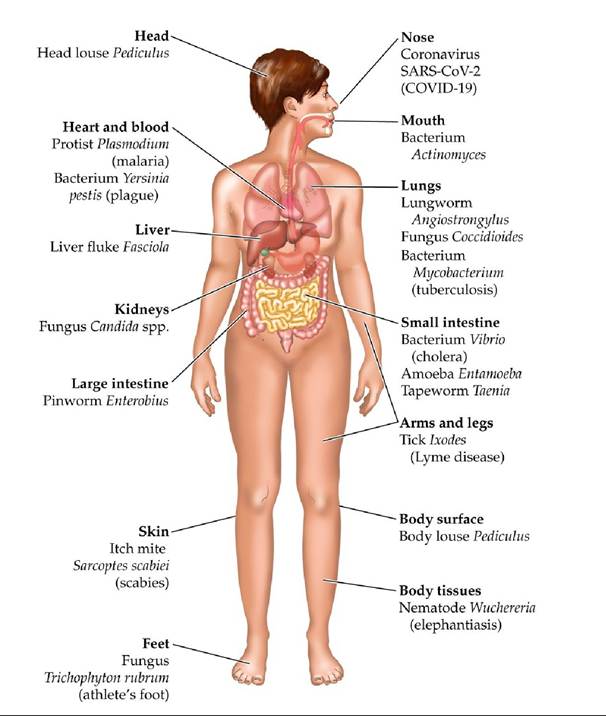
FIGURE 13.3 The Human Body as Habitat for Symbionts Differentpartsofourbodies provide suitable habitat for a wide range of symbionts, many of which are parasites; only a few examples are shown here. Some of these organisms are pathogens that cause disease. View larger image
Parasites consume the tissues or body fluids of the organism on or within which it lives, called its host; some parasites, called pathogens, cause diseases. Unlike carnivores but similar to herbivores, parasites typically harm, but do not immediately kill, the organisms they eat. The negative effects of parasites on their hosts vary widely, from mild to lethal. We see this variation in our own species, for which some parasites, such as the fungus that causes athlete's foot, are little more than a nuisance. Others, such as the protist Leishmania tropica, can cause disfigurement, and still others, such as the malaria bacterium Plasmodium falciparum or the coronavirus SARS-CoV2 (COVID-19), can kill. There is similar variation in the degree of harm caused by parasites that infect other species. Parasites vary in many other ways, as we'll see next as we examine their basic biology.
More on the topic Introduction:
- 1 Introduction
- Introduction
- Introduction
- 19 Introduction
- Introduction
- Introduction
- INTRODUCTION
- Introduction
- Introduction
- Introduction
- Introduction
- Introduction: Hegel, Marx and the Dialectic
- INTRODUCTION: OVERVIEW OF COMPLICATIONS ASSOCIATED WITH HIV THERAPY
- Introduction