Learning Objectives
13.1.1 Know why parasites are abundant and typically specialists.
13.1.2 Compare and contrast ectoparasites and endoparasites.
Parasites vary in size from relatively large species (macroparasites), such as arthropods and worms, to species too small to be seen with the naked eye (microparasites), such as viruses, bacteria, protists, and unicellular fungi.
But whether they are large or small, parasites typically feed on only one or a few host individuals over the course of their lives. Thus, defined broadly, parasites include herbivores, such as aphids or nematodes that feed on only one or a few host plants, as well as parasitoids, insects whose larvae feed on a single host, almost always killing it.Most species are attacked by more than one parasite (FIGURE 13.4), and even
parasites have parasites. Because parasites spend their lives feeding on one or a few host individuals, they tend to have a close relationship to the organisms they eat. For example, many parasites are closely adapted to particular host species, and many attack only one or a few host species. This specialization at the species level helps to explain why there are so many species of parasites—many host species have at least one parasite that eats only them. Overall, although the total number of parasite species is not known, a rough estimate is that 50% of the species on Earth are parasites (Windsor 1998).
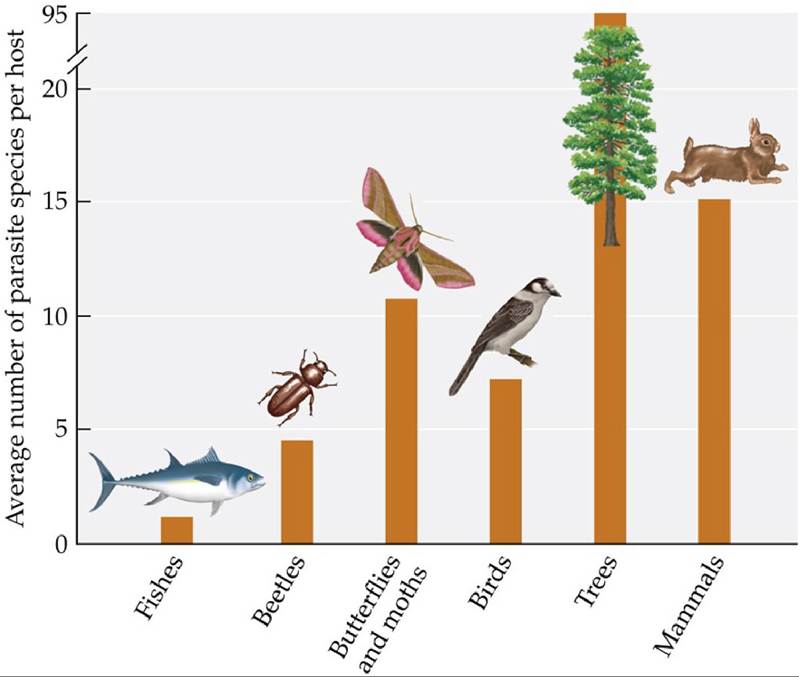
FIGURE 13.4 Many Species Are Host to More Than One Parasite Species Inastudy conducted in Britain, most host species were found to harbor more than one parasite species. The number of parasite species shown here for fishes, birds, and mammals includes only helminth worm parasites and hence is an underestimate of the actual number of parasite species found in these vertebrates.
Averaging across the six groups of organisms other than vertebrates (which we exclude because the data underestimate the true number of parasites), what is the average number of parasite species per host? Suppose the number of parasite species was determined for a previously unstudied host from one of the six groups. Is it likely that the number of parasites in that host would be close to the average you calculated? Explain.
(After P. D. Stiling. 2002. Ecology: Theories and Applications, 4th ed. Prentice-Hall: Upper Saddle River, NJ.) View larger image
Parasites are also specialized for living on or eating certain parts of the host's body. We'll focus next on this aspect of parasite specialization by describing both ectoparasites and endoparasites.