Ectoparasites live on the surface of their host
An ectoparasite lives on the outer body surface of its host (FIGURE 13.5). Ectoparasites include plants such as dodder and mistletoe that grow on, and obtain water and food from, another plant (see Figure 5.3).
As described in Concept 5.1, such parasitic plants use modified roots called haustoria to penetrate the tissues of their host. Dodder cannot photosynthesize and hence depends on its host for both mineral nutrients and carbohydrates. In contrast, mistletoes are hemiparasitic: they extract water and mineral nutrients from their hosts, but since they have green leaves and can photosynthesize, they do not rely exclusively on their hosts for carbohydrates.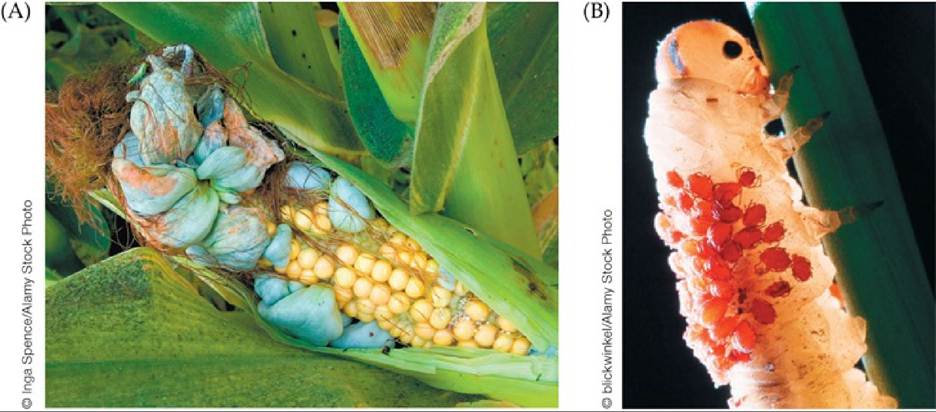
FIGURE 13.5 Ectoparasites A wide range of parasites live on the outer surfaces of their hosts, feeding on host tissues. Examples include (A) the corn smut fungus (Ustilago maydis), seen here growing on an ear of corn, and (B) the velvet mite (Trombidium spp.), which in its larval form feeds parasitically on the blood of insects, such as this sawfly larva. View larger image
There are also many fungal and animal parasites that live on the surfaces of plants, feeding on their hosts' tissues or body fluids. More than 5,000 species of fungi attack important crop and horticultural plants, causing billions of dollars of damage each year. Some fungi that attack plants, including mildews, rusts, and smuts, grow on the surface of the host plant and extend their hyphae (fungal filaments) within the plant to extract nutrients from its tissues (see Figure 13.5A). Plants are also attacked by numerous animal ectoparasites, including aphids, whiteflies, and scale insects, which are found on stems and leaves, and nematode worms, beetles, and (juvenile) cicadas, which are found on roots. Animal ectoparasites that eat plants and live on their outer surfaces can sometimes be thought of both as herbivores (because they eat plant tissues) and as parasites (especially if they remain on a single host plant for much of their lives).
A similar array of fungal and animal ectoparasites can be found on the surfaces of animals. Familiar examples include Trichophyton rubrum, the fungus that causes athlete's foot, and fleas, mites, lice, and ticks, which feed on the tissues or blood of their hosts (see Figure 13.5B). Some of these parasites also transmit diseases to their hosts, including fleas that spread the plague and ticks that spread Lyme disease.