Endoparasites live inside their host
If we ignore the details of their shape, we can think of people and most other animals as being constructed in a similar way: their bodies consist of tissues that surround an open tube called the alimentary canal.
The alimentary canal runs through the middle of the body, from the mouth to the anus. Parasites that live inside their hosts, called endoparasites, include species that inhabit the alimentary canal as well as species that live within host cells or tissues.The alimentary canal provides an excellent habitat for parasites. The host brings in food at one end (the mouth) and excretes what it cannot digest at the other (the anus). Parasites that live within the alimentary canal often do not eat host tissues at all; instead, they rob the host of nutrients. A tapeworm, for example, has a scolex, a structure with suckers (and sometimes hooks) that it uses to attach itself to the inside of the host's intestine (FIGURE 13.6A). Once it is attached, the tapeworm simply absorbs food that the host has already digested. Tapeworms that infect humans can grow up to 5-10 m (16-33 feet) long; large tapeworms such as these can block the intestines and cause nutritional deficiencies.
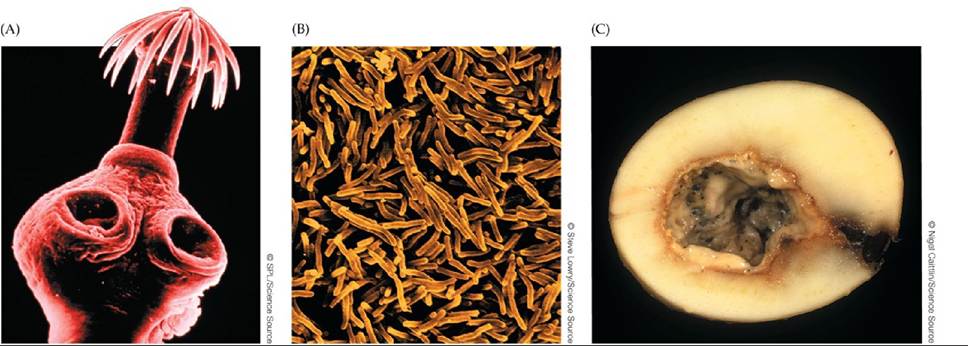
FIGURE 13.6 Endoparasites Many parasites live within the body of their host, feeding on the host's tissues or robbing it of nutrients. (A) The tapeworm Taenia taeniaeformis uses the suckers and hooks shown here to attach to the intestinal wall of its mammalian host, often a rodent, rabbit, or cat. Once attached, an adult can grow to over 5 m (16 feet) in length. (B) The bacterium Mycobacterium tuberculosis causes the lung disease tuberculosis, which kills 1-2 million people each year. (C) This section of a potato tuber shows the destruction wrought by Erwinia carotovora, a bacterium that causes soft rot. Affected areas become soft with decay and develop a distinctive foul odor.
View larger imageMany other endoparasites live within the cells or tissues of animal hosts, causing a wide range of symptoms as they reproduce or consume host tissues. Examples in humans include Yersinia pestis, the bacterium that causes the plague, and Mycobacterium tuberculosis, the bacterium that causes tuberculosis (TB) (FIGURE 13.6B). TB is a potentially fatal lung disease, aptly referred to as the “Captain of Death”; with the possible exception of malaria, it has killed more people than any other disease in human history. TB continues to kill 1-2 million adults each year (a number comparable to the roughly 1 million that currently die each year from AIDS). Another example is the COVID-19 pandemic caused by the coronavirus SARS-CoV2, which has caused nearly 7 million deaths since January 2020.
Plants too are attacked by a wide variety of endoparasites, including bacterial pathogens that cause soft rot in various plant parts, such as fruits (e.g., tomatoes) or storage tissues (e.g., potatoes; FIGURE 13.6C). Other plant pathogens include fungi that cause plant parts to rot from the inside out. Some bacteria invade plant vascular tissues, where they disrupt the flow of water and nutrients, causing wilting and often death. Plant pathogens can have large effects on natural communities, as illustrated by the protist Phytophthora ramorum, which causes sudden oak death, a disease that has recently killed more than a million oaks and other trees in California and Oregon (see also the chestnut blight in Figure 13.14).
More on the topic Endoparasites live inside their host:
- As we have just seen, Plasmodium has specific mechanisms that enable it to live inside a red blood cell. When both a parasite and its host possess such specific mechanisms, that observation suggests that the strong selection pressure that hosts and parasites impose on each other has caused their populations to evolve.
- Ectoparasites live on the surface of their host
- CONCEPT 13.1 Parasites typically feed on only one or a few host species, but host species have multiple parasite species.
- Parasites have mechanisms that circumvent host defenses
- Climate controls where and how organisms live
- View from the Inside: How are the Amendments being Applied?
- Inside the firm: The organization of work
- View from the Inside: Have the Aims of the Act been Achieved?
- Live Attenuated Whole-Cell Vaccines
- This chapter is about how to live with this disease and stay in one piece.
- OUTSIDE INFLUENCES OR AN INSIDE JOB—THE EXTRINSIC AND INTRINSIC PATHWAYS
- Developing a Pro-Russian Population Inside Ukraine
- Skill-biased technical change: Inside the black box