Parasites have mechanisms that circumvent host defenses
To survive and reproduce, a parasite must be able to tolerate or evade its host's defensive mechanisms. Aphids and other ectoparasites, for example, must be able to pierce the protective outer covering of the host, and they must be able to tolerate whatever chemical compounds are present in the host tissues or body fluids that they eat.
Viewed broadly, the challenges faced by ectoparasites are similar to those faced by herbivores and carnivores as they attempt to cope with the toxins and physical structures that their prey use to defend themselves. We discussed such challenges in Concept 12.2, so here we focus on how endoparasites cope with defenses found inside the host.Counterdefenses Against Encapsulation
Endoparasites face formidable challenges from host immune systems and related aspects of host biochemistry. Host species typically have a number of ways to destroy parasite invaders. In addition to the strategies we have already described, some hosts can cover parasites or parasite eggs with capsules that kill them or render them harmless, a process called encapsulation.
Some insects defend themselves against macroparasites using encapsulation. Insect blood cells can engulf small invaders, such as bacteria, but they cannot engulf large objects, such as nematodes or parasitoid eggs. However, some insects have Iamellocytes, which are blood cells that can form multicellular sheaths (capsules) around large objects. When an insect mounts such an encapsulation defense, most or all of the attacking parasites may be destroyed. As a result, the parasites are under strong selection to develop a counterdefense.
For example, Drosophila fruit flies have an effective defense against wasp parasitoids: they encapsulate (and hence kill) their eggs. Parasitoid wasps that attack fruit flies avoid encapsulation in several different ways. When wasps in the genus Leptopilina lay their eggs inside a fruit fly host, they also inject viruslike particles into the host.
These particles infect the host's lamellocytes and cause them to self-destruct, thus weakening the host's resistance and increasing the percentage of wasp eggs that survive (Rizki and Rizki 1990). Other parasitoid wasps, such as Asobara tabida, lay eggs covered with filaments. These filaments cause the eggs to stick to and become embedded in fat cells and other host cells, where they are not detected by circulating lamellocytes.Counterdefenses Involving Hundreds of Genes
Some endoparasites have a complex set of adaptations that allows them to thrive inside their host. One such endoparasite is Plasmodium falciparum, a protist that causes malaria, a disease that kills half a million people each year (FIGURE 13.9). Plasmodium, like many endoparasites, has a complex life cycle with specialized stages that allow it to alternate between a mosquito and a human host. Infected mosquitoes contain one specialized Plasmodium stage, called a sporozoite, in their saliva. When an infected mosquito bites a human, sporozoites enter the victim's bloodstream and travel to the liver, where they divide to form another stage, called a merozoite. The merozoites penetrate red blood cells, where they multiply rapidly. After 48-72 hours, large numbers of merozoites break out of the red blood cells, causing the periodic chills and fever that are associated with malaria. Some of the offspring merozoites attack more red blood cells, while others transform into gamete-producing cells. If another mosquito bites the victim, it picks up some of the gamete-producing cells, which enter its digestive tract and form gametes. After fertilization occurs, the resulting zygotes produce thousands of sporozoites, which then migrate to the mosquito's salivary glands, where they await their transfer to another human host.
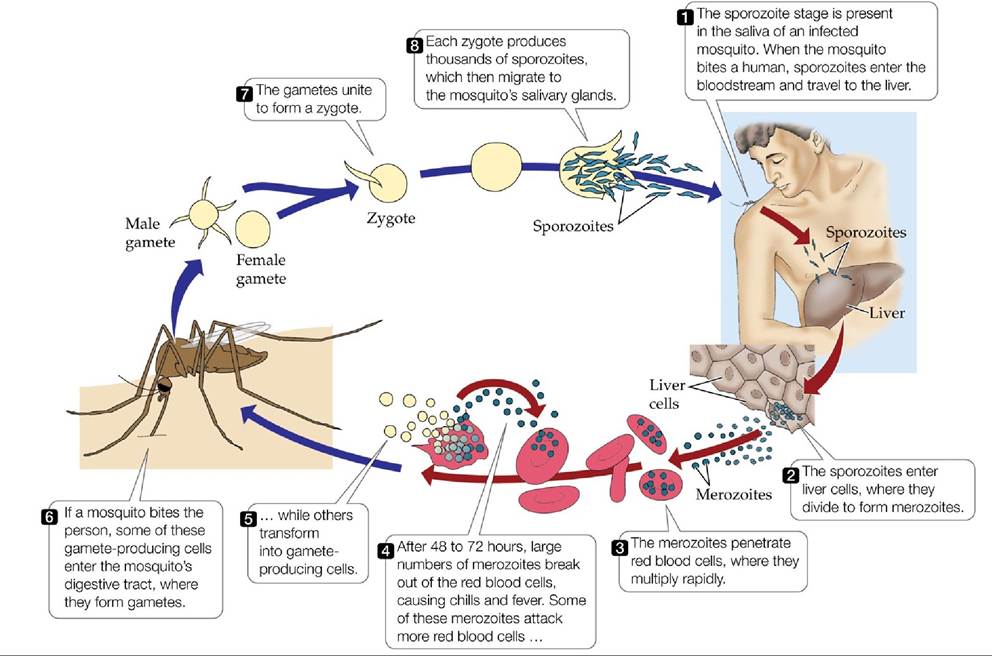
FIGURE 13.9 Life Cycle of the Malaria Parasite The life cycle of the protist Plasmodium falciparum includes specialized stages that facilitate the dispersal of this endoparasite from one host to another.
The sporozoite stage, for example, enables the parasite to disperse from an infected mosquito to a human host.Which stage in the life cycle enables the parasite to disperse from a human host to a mosquito?
View larger image
Plasmodium faces two potentially lethal challenges from its human host. First, red blood cells do not divide or grow, and hence they lack the cellular machinery needed to import nutrients necessary for growth. A Plasmodium merozoite inside a red blood cell would starve if it did not have a way to obtain essential nutrients. Second, after 24-48 hours, a Plasmodium infection causes red blood cells to have an abnormal shape. The human spleen recognizes and destroys such deformed cells, along with the parasites inside.
Plasmodium addresses these challenges by having hundreds of genes whose function is to modify the host red blood cell in ways that allow the parasites to obtain food and escape destruction by the spleen (Hiller et al. 2004; Marti et al. 2004). Some of these genes cause transport proteins to be placed on the surface of the red blood cell, thereby enabling the parasite to import essential nutrients into the host cell. Other genes guide the production of unique knobs that are added to the surface of the red blood cell. These knobs cause the infected red blood cell to stick to other human cells, thereby preventing it from traveling in the bloodstream to the spleen, where it would be recognized as infected and then destroyed. The proteins on these knobs vary greatly from one parasite individual to another, making it difficult for the human immune system to recognize and destroy the infected cells.
More on the topic Parasites have mechanisms that circumvent host defenses:
- CONCEPT 13.2 Hosts have mechanisms for defending themselves against parasites, and parasites have mechanisms for overcoming host defenses.
- As we have just seen, Plasmodium has specific mechanisms that enable it to live inside a red blood cell. When both a parasite and its host possess such specific mechanisms, that observation suggests that the strong selection pressure that hosts and parasites impose on each other has caused their populations to evolve.
- Host defenses and parasite counterdefenses both have costs
- Immune systems, biochemical defenses, and symbionts can protect hosts against parasites
- CONCEPT 13.1 Parasites typically feed on only one or a few host species, but host species have multiple parasite species.
- Parasites can drive host populations to extinction
- Parasites can influence host population cycles
- Initial host-defense mechanisms against invasion by a pathogen include:
- Hamsters are host to numerous enteric protozoa, which are often listed and discussed in reviews of parasites, but very few protozoa have any pathogenic significance in the hamster.
- In addition to the parasites outlined in this section, there are other parasites that are rarely seen in rats maintained in well-managed facilities.
- BEHAVIORAL DEFENSES OF VERTEBRATES
- Escaping carnivores: Physical defenses, toxins, mimicry, and behavior
- B. The actio publiciana and Defenses
- Endoparasites live inside their host
- APPENDIX ONE Systematics of Major Parasites Groups
- Ectoparasites live on the surface of their host