Parasites can influence host population cycles
Ecologists have long sought to determine the causes of population cycles. As we saw in Concept 12.3, such cycles may be caused by three-way feeding relationships—by the effects that predators and herbivorous prey have on each other, coupled with the effects that those prey and their food plants have on each other.
Population cycles can also be influenced by parasites. Consider the work of Peter Hudson and colleagues, who manipulated the abundances of parasites in red grouse (Lagopus lagopus) populations on moors in northern England. In this region, red grouse populations tend to crash every 4 years. Previous studies had shown that a parasitic nematode, Trichostrongylus tenuis, decreased the survival and reproductive success of individual red grouse. Hudson et al. (1998) investigated whether this parasite might also cause grouse populations to cycle.
The researchers studied changes in red grouse numbers in six replicate populations over the course of two population cycles. Long-term data on grouse population cycles indicated that these populations were likely to crash in 1989 and again in 1993. In two of the six study populations, the researchers treated as many grouse as they could catch in 1989 and 1993 with a drug that killed the parasitic nematodes. In two of the other study populations, grouse were caught and treated for parasites in 1989 only. The remaining two populations served as unmanipulated controls. Because each replicate population covered a very large area (17-20 km2), it was not possible to count red grouse directly. Instead,
Hudson and colleagues used the number of red grouse shot by hunters as an index of the actual population size.
In the control populations, red grouse numbers crashed as predicted in 1989 and 1993 (FIGURE 13.15). Although parasite removal did not completely stop the red grouse population cycle, it did reduce the fluctuation in grouse numbers considerably; this was particularly true for the populations that were treated for parasites in both 1989 and 1993. Thus, the experiment provided strong evidence that parasites influence—and may be the primary cause of—red grouse population cycles.
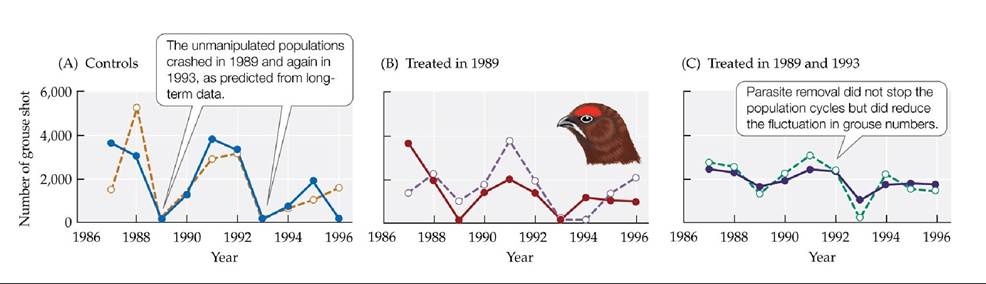
FIGURE 13.15 Parasite Removal Reduces Host Population Fluctuations Hudsonetal. studied the effects of parasites on the cycling of six red grouse populations subjected to three treatments: (A) two control populations, (B) two populations treated for nematode parasites in 1989, and (C) two populations treated for parasites in 1989 and 1993.
If parasite removal completely stopped the population cycles, how might the results in (C) differ from those actually obtained?
(After P. J. Hudson et al. 1998. Science 282: 2256-2258.) View larger image
As we've seen, parasites that cause diseases (pathogens) can greatly affect the population dynamics of both wild and domesticated plant and animal species. Pathogens also have large effects on human populations—so much so that they are thought to have played a major role in the rise and fall of civilizations throughout the course of human history (McNeill 1976; Diamond 1997). One example is the European conquest of North America, where up to 95% of the native population (19 million of the original 20 million) were killed by new diseases brought to the continent by European trappers, missionaries, settlers, and soldiers. Even with such massive mortality, the conquest took roughly 400 years; without it, the conquest would certainly have taken longer, and might have failed. Pathogens continue to be a major source of human mortality today. Despite medical advances, millions of people die each year from diseases such as COVID-19, AIDS, tuberculosis, and malaria.