Simple models of host-pathogen dynamicssuggest ways to control the establishment and spread of diseases
Considerable effort has been devoted to the development of mathematical models of host-pathogen population dynamics. These models often differ in three ways from those we have seen in earlier chapters.
First, the host population is subdivided into categories, such as susceptible individuals, infected individuals, and recovered and immune individuals. Second, it is often necessary to keep track of both host and pathogen genotypes because, as we have seen, host genotypes may differ greatly in their resistance to the pathogen, and pathogen genotypes may differ greatly in their ability to cause disease. Third, depending on the pathogen, it may be necessary to account for other factors that influence its spread, such as (1) differences in the likelihood that hosts of different ages will become infected; (2) a latent period, in which a host individual is infected but cannot spread the disease; and (3) vertical transmission, the spread of the disease from mother to newborn, as can occur in AIDS.Models that include all of these factors can be very complicated. Here we'll
consider a simple model that does not incorporate most of these complicating factors, yet still yields a key insight: a disease will spread only if the density of susceptible hosts exceeds a critical threshold density.
To develop a model that can be used to estimate the threshold density, we must determine how to represent the transmission of the disease from one host individual to the next. We'll denote the density of susceptible individuals by S and the density of infected individuals by I. For a disease to spread, infected individuals must encounter susceptible individuals. Such encounters are assumed to occur at a rate that is proportional to the densities of susceptible and infected individuals; here, we'll assume that this rate is proportional to the product of their densities, SI.
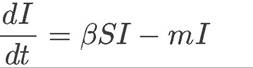
Diseases do not spread with every such encounter, however, so we multiply the encounter rate (SI) by a transmission coefficient (β) that indicates how effectively the disease spreads from infected to susceptible individuals. Thus, an essential feature of the model—disease transmission—is represented by the term βSI.The density of infected individuals increases when the disease is transmitted successfully (at the rate βSI) and decreases when infected individuals die or recover from the disease. If we set the combined death and recovery rate equal to m, these assumptions yield the equation
(13.1)
where dI/dt represents the change in the density of infected individuals at each instant in time.
A disease will become established and spread when the density of infected individuals in a population increases over time. This occurs when dI/dt is greater than zero, which, according to Equation 13.1, occurs when

We can rearrange this equation to get
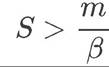
Thus, a disease will become established and spread when the number of susceptible individuals exceeds m∕β; this number of susceptible individuals is the threshold density, denoted by St. In other words,
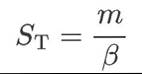
For some diseases that affect people or animals, the transmission rate β and the death and recovery rate m are known, permitting estimation of the threshold density.
Controlling the Spread of Diseases
As Equation 13.1 suggests, to prevent the spread of a disease, the density of susceptible individuals must be kept below the threshold density (St). There are several ways of achieving this goal.
People sometimes slaughter large numbers of susceptible domesticated animals to reduce their density below St and hence prevent disease spread. This is typically done when the disease in question can spread to humans, as in highly virulent forms of bird flu. In human populations, if an effective and safe vaccine is available, the density of susceptible individuals can be reduced below St by a mass vaccination program. Such programs work, as illustrated by the dramatic results of a measles vaccination program in Romania (FIGURE 13.16).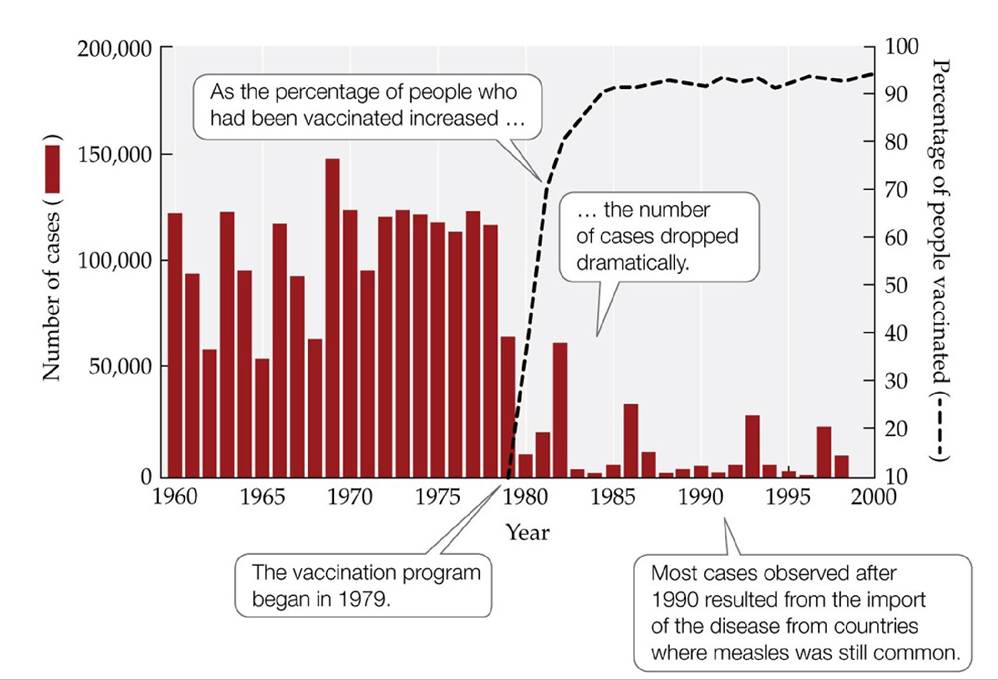
FIGURE 13.16 Vaccination Reduces the Incidence of Measles in Humans Theresultsof a measles vaccination program in Romania show that lowering the density of susceptible individuals can control the spread of a disease. Measles often kills (especially in populations that are poorly nourished or that lack a history of exposure to the disease) and can cause severe complications in survivors, including blindness and pneumonia. (After P. M. Strebel and S. L. Cochi. 2001. Nature 414: 695-696.) View larger image
Other public health measures can also be taken to raise the threshold density, thereby making it more difficult for the disease to become established and spread. For example, the threshold density can be raised by taking actions that increase the rate at which infected individuals recover and become immune (thereby increasing m and hence increasing St = m∕β). One way to increase the recovery rate is to improve the early detection and clinical treatment of the disease. The threshold density can also be raised if β, the disease transmission rate, is decreased. This can be achieved by quarantining infected individuals or by convincing people to engage in behaviors (such as hand washing or masks) that make it more difficult for the disease to be transmitted from one person to the next.
The same principles can be applied to wild populations. Dobson and Meagher (1996) studied bison populations to determine how best to prevent the spread of the bacterial disease brucellosis. Using data from previous studies in which 16 bison herds in six national parks in Canada and the United States had been tested for exposure to the disease, they found that the threshold density (St) for disease establishment appeared to be a herd size of 200-300 bison (FIGURE 13.17). This field-based estimate of St was very similar to the estimated threshold density of 240 individuals calculated from a model similar to Equation 13.1. Many of the herds in the six national parks had 1,000-3,000 individuals, so reducing herd sizes below a threshold value of 200-300 individuals would require implementing a vaccination program or killing large numbers of bison. An effective vaccine was not available, and killing many bison was not acceptable, either politically or ecologically (since herds as small as 200 individuals would face an increased risk of extinction). Thus, Dobson and Meagher concluded that it would be difficult to prevent the establishment of brucellosis in wild bison populations.
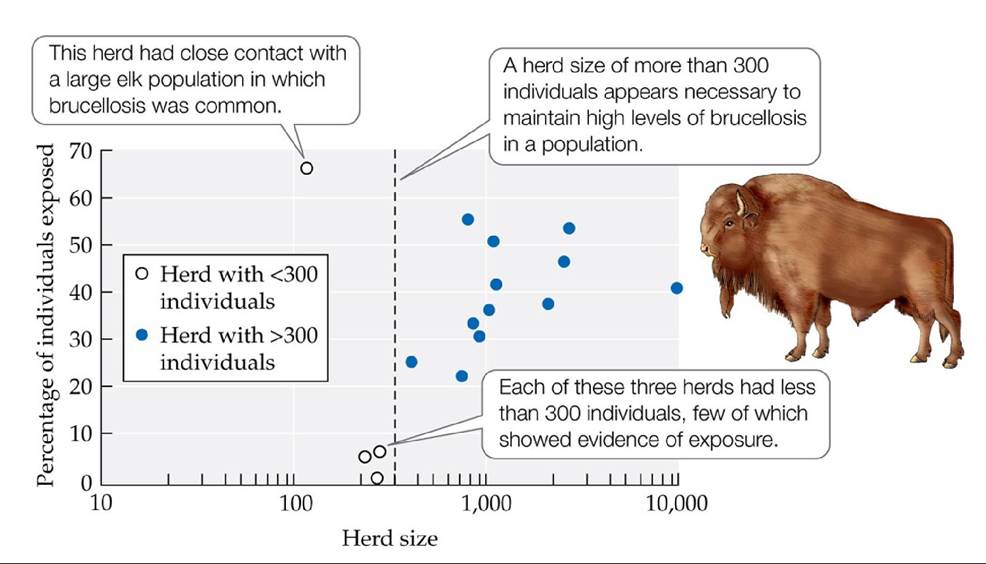
FIGURE 13.17 Determining Threshold Population Densities for Disease Control The percentage of bison that showed evidence of previous exposure to brucellosis was monitored in six national parks in the United States and Canada. By plotting this percentage versus the size of each of 16 bison herds, researchers obtained a rough estimate of the threshold density for establishment of the disease (200-300 individuals, the upper bound of which is shown by the dashed line). (After A. Dobson and M. Meagher. 1996. Ecology 77: 1026-1036.) View larger image
More on the topic Simple models of host-pathogen dynamicssuggest ways to control the establishment and spread of diseases:
- Initial host-defense mechanisms against invasion by a pathogen include:
- Host and Pathogen Factors in Paratuberculosis
- Host and Pathogen Characteristics That Define Ovine Paratuberculosis
- Host-Pathogen Interactions and Intracellular Survival of Mycobacterium avium subsp. paratuberculosis
- For some diseases there is a simple relationship between the infection, the animal and the treatment needed.
- There are two possible ways to look at the control of energy flow through ecosystems.
- CONCEPT 13.1 Parasites typically feed on only one or a few host species, but host species have multiple parasite species.
- The various cardiovascular diseases observed in HIV-infected patients and widely described in the literature have been predominantly coronary and peripheral arterial diseases (PAD) and remain poorly known.
- A very simple model
- A simple-minded functionalist theory of pain
- The Spread of Islam
- Spread of Infection (Epidemiology)
- The Spread of the Crisis to Other Countries
- TEMPORAL AND GEOGRAPHIC SPREAD OF MITHRAISM
- SIMPLE ANALYSIS FOILS ELABORATE DECEPTION
- A simple idea-based growth model
- 13 Simple Diagnosis and Treatment of Pruritic Otitis
- THE CRISIS AND ITS SPREAD WORLDWIDE