Parasites can drive host populations to extinction
The amphipod Corophium volutator lives in North Atlantic tidal mudflats.
Corophium is small (1 cm long) and often very abundant, reaching densities of up to 100,000 individuals per square meter.
Corophium builds tubular burrows in the mud, from which it feeds on plankton suspended in the water and on microorganisms found in sediments near the burrow opening. It is eaten by a wide range of organisms, including migratory birds and trematode parasites. The parasites can reduce the size of Corophium populations greatly, even to the point of local extinction. For example, in a 4-month period, attack by trematodes caused the extinction of a Corophium population that initially had 18,000 individuals per square meter (Mouritsen et al. 1998).Parasites can also drive host populations to extinction over a large geographic region. The American chestnut (Castanea dentata) once was a dominant member of deciduous forest communities in eastern North America (FIGURE 13.14), but the parasitic fungus Cryphonectria parasitica changed that completely. This fungal pathogen causes chestnut blight, a disease that kills chestnut trees. The fungus was introduced to New York City from Asia in 1904 (Keever 1953). By midcentury, the fungus had wiped out most chestnut populations, greatly reducing the geographic range of this once-dominant species.
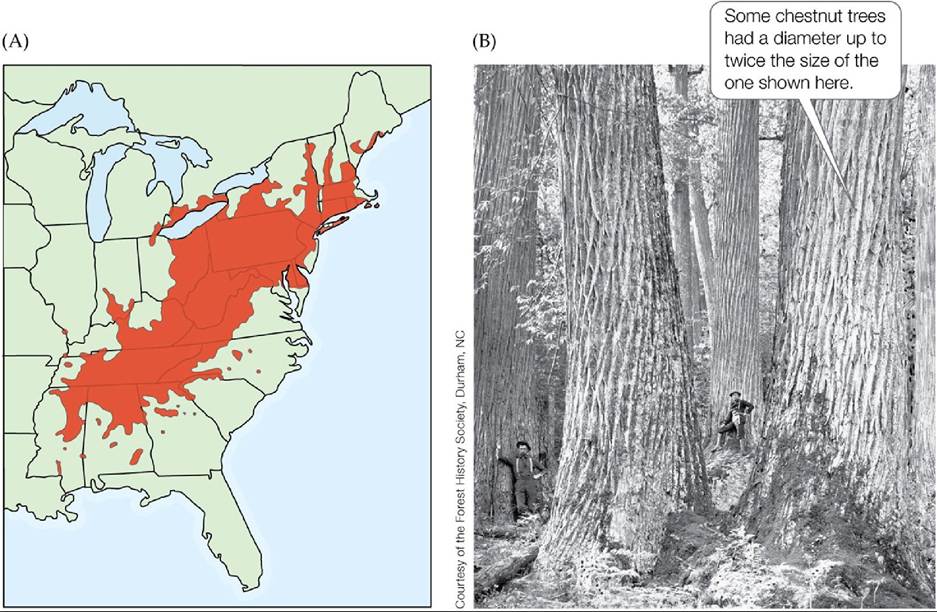
FIGURE 13.14 Parasites Can Reduce Their Host's Geographic Range (A)Theoriginal distribution of the American chestnut (Castanea dentata) is shown in darker, shaded region. Although a few chestnut trees remain standing, a fungal parasite drove this once-dominant species virtually extinct throughout its entire former range. (B) Chestnuts were once important timber trees (note the two loggers shown in the photograph). (Range detail courtesy of Elbert L. Little, Jr. 1970. Atlas of United States Trees. U.S. Department of Agriculture, Forest Service, and other publications.) View larger image
Isolated chestnut trees still can be found in North American forests, and some of these trees show signs of resistance to the fungus. But it is likely that many of the standing trees simply have not yet been found by the fungus. Once the fungus reaches a tree, it enters the tree through a hole or wound in the bark, killing the aboveground portion of the tree in 2-10 years. Before they die, infected trees may produce seeds, which may germinate and give rise to offspring that live for 10-15 years before they are killed by the fungus in turn. Some infected trees also produce sprouts from their roots, but these are usually killed a few years after they appear aboveground. Efforts are under way to breed resistant chestnut varieties, but at present it is not known whether chestnut populations will ever recover from the onslaught of the chestnut blight fungus.