Learning Objectives
13.4.1 Understand how parasites can influence the population dynamics of hosts.
13.4.2 Explain how simple models of host-pathogen dynamics can be used to control the establishment and spread of diseases.
As we've seen, parasites can reduce the survival, growth, or reproduction of their hosts—an observation that is illustrated clearly by the large drop in reproductive success that a sexually transmitted mite can inflict on its beetle host (FIGURE 13.13). At the population level, the harm that parasites cause host individuals translates into a reduction of the host population growth rate, λ (see Concept 11.1). As we will see in this section, the reduction in λ can be drastic: parasites may drive local host populations extinct or even reduce the geographic range of the host species. In other, less extreme cases, parasites may reduce host abundances or otherwise alter host population dynamics without causing the
extinction of host populations.
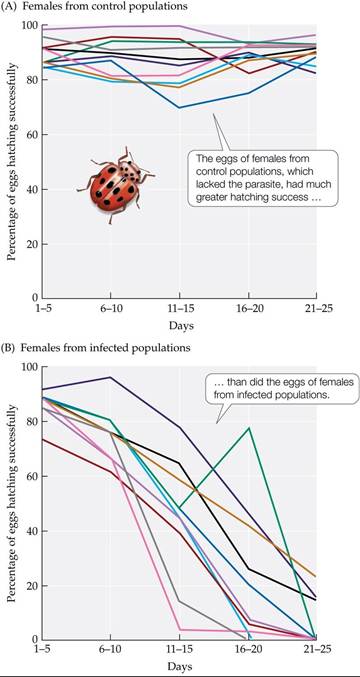
FIGURE 13.13 ParasitescanReduceHostReproduction Researchersinfected experimental populations of the beetle Adalia decempunctata with a sexually transmitted mite parasite (Coccipolipus hippodamiae). Over the next 25 days, they monitored the proportions of the eggs laid by female beetles from (A) control and (B) infected populations that hatched. Each curve represents the eggs laid by a single female. (After K. M. Webberley et al. 2004. JAnim Ecol 73: ι-ιo.) View larger image
More on the topic Learning Objectives:
- Learning Objectives
- Learning Objectives
- Learning Objectives
- Learning Objectives
- Learning Objectives
- Learning Objectives
- Learning Objectives
- Learning Objectives
- Learning Objectives
- Learning Objectives
- Learning Objectives
- Learning Objectives
- Learning Objectives
- Learning Objectives
- Learning Objectives
- Learning Objectives
- Learning Objectives
- Learning Objectives
- Learning Objectives