Learning Objectives
12.1.1 Understand why carnivores tend to be generalists and have broad animal prey diets.
12.1.2 Know why herbivores tend to be specialists and have narrow plant prey diets.
Although they share some similarities, carnivores and herbivores differ from each other in many aspects.
The most obvious difference is that carnivores invariably kill their prey (it is hard to eat only part of an animal without killing it), while herbivores usually do not kill the plants they eat, at least not immediately. Another difference is that animal prey can usually move away or hide from their predators but most plant prey cannot. Finally, even though plant prey are often more abundant, their body tissues have much lower nitrogen content, and thus are less nutritious, than animal prey (FIGURE 12.5). Thesethree factors have important consequences for the dietary preferences of carnivores versus herbivores.
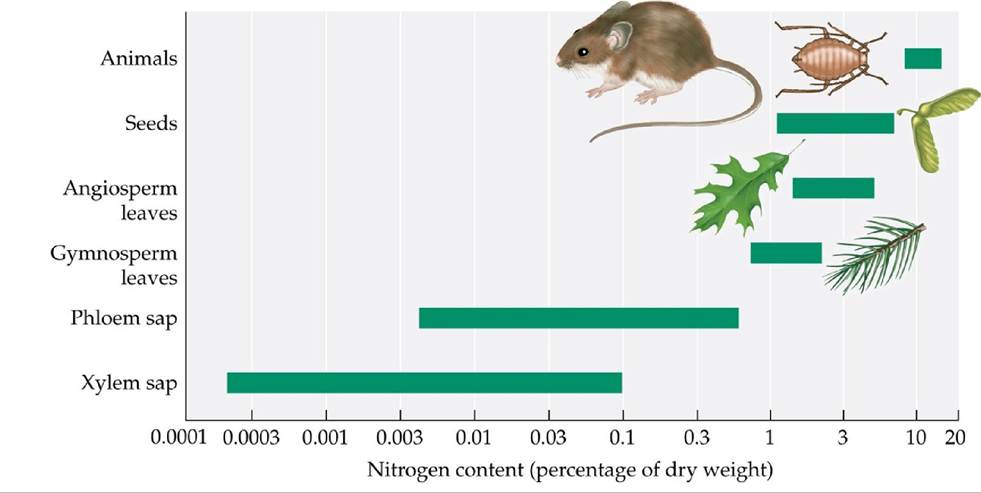
FIGURE 12.5 The Nitrogen Contents of Plants and Animals Differ Nitrogenisan essential component of any animal's diet. Body tissues of animals have much higher nitrogen content than those of plants. Of plant tissues, leaves tend to have the highest nitrogen content of any plant parts other than seeds. (After W. J. Mattson, Jr. 1980. Ann RevEcol Syst 11: 119-161.) View larger image
As we learned in Concept 8.2, optimal foraging and dietary preferences are thought to be dependent on two factors: (1) encounter rate, a function of search time, or the time it takes to search for and find prey, and (2) handling time, or the time it takes to subdue and consume the prey. If the encounter rate for prey is low, as would be the case for predators searching for mobile animal prey, then the prediction is that the predators should not be too narrow in their prey choices. As a consequence, these predators (carnivores) should be generalists and have fairly broad diets. On the other hand, if prey are relatively easy to search for but their handling times are longer, as is the case for immobile but less nutritious plants, then the predators (herbivores) should be specialists and have narrow diets. Let's consider these predictions in more detail below.
More on the topic Learning Objectives:
- Learning Objectives
- Learning Objectives
- Learning Objectives
- Learning Objectives
- Learning Objectives
- Learning Objectives
- Learning Objectives
- Learning Objectives
- Learning Objectives
- Learning Objectives