Introduction
One certainty for all species on Earth is that they interact with other species. These interactions not only affect individuals, populations, and communities but often lead to evolutionary change.
In this unit, we will focus on two species interactions, such as one species eating another or two species competing for the same limiting resources. In the next unit, we will consider the more complicated but real-life situation in which species interact with multiple species as part of an integrated community.Ecologists characterize species interactions based on the effects species have on each other—positive (+), negative (-), or neutral (0)—and whether that effect is trophic (feeding) or non-trophic (competitive and facilitative) (FIGURE 12.3). In addition, species interactions may include a symbiosis, a positive or negative interaction in which one species lives in close physical and/or physiological contact. Finally, species interactions vary in their strength, a characteristic that we will consider in more detail in Concepts 14.1 and 16.3. Four broad categories into which species interactions fall are predation, competition, positive interactions, and amensalism.
Species 1
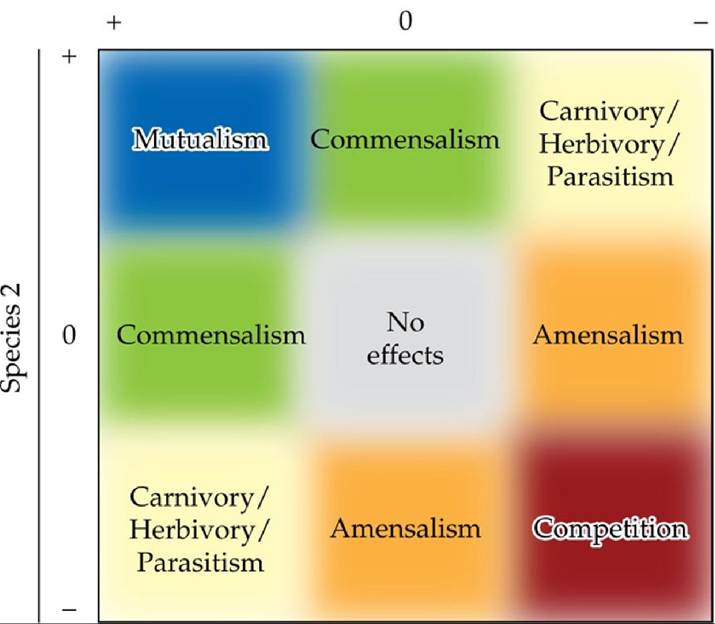
FIGURE 12.3 TypesofTwospeciesInteractions Interactionsbetweentwospeciescanbe grouped based on whether the effect of the interacting species (here denoted as species 1 and species 2) is negative (-), positive (+), or neutral (0). The strength of the two species' interaction increases from the center (no effect) to the corners. (After E. G. Pringle. 2016. PLOS Biol 14: e2000891.) View larger image
1. Predation is a trophic interaction in which an individual of one species (a predator) kills and/or consumes individuals (or parts of individuals) of another species (its prey).
Predation includes carnivory, in which the predator and prey are both animals; herbivory, in which the predator is an animal and the prey is a plant or algae; and parasitism, in which the predator (a parasite) lives symbiotically on or in the prey (its host) and consumes only certain tissues without necessarily killing the host. Some parasites are pathogens that cause disease in their hosts.2. Competition is a non-trophic interaction in which two or more species overlap in the use of at least some of the same required limiting resources, negatively affecting their growth, reproduction, and/or survival. The limiting resource need not be food; species may compete for water, space, nesting sites, or sunlight.
3. Positive interactions (also known as facilitations) are trophic or non- trophic interactions in which at least one species benefits from the interaction and none are harmed. Positive interactions include mutualisms, in which both species benefit from the interaction, sometimes in a highly dependent and symbiotic manner. Commensalism is a type of positive interaction in which one participant benefits but the other is unaffected; it includes a wide range of interactions that typically encompass the provisioning of resources that improve conditions for the commensal organism.
4. Amensalisms occur when one participant is harmed but the other is not affected. An example is a herd of animals trampling vegetation; the animals are not affected by this event, but the plants clearly are. Another example includes small understory plants that grow under trees. The understory plants are deprived of light but likely have no effect on the trees.
Over the course of this and the next chapter, we will consider the three broad categories of predation given above: carnivory, herbivory, and parasitism. These broad categories seem simple, and it is easy to think of examples: a lion that kills and eats a zebra, an insect that eats a plant leaf, a tapeworm that robs a dog of nutrients in its digestive tract.
But the natural world defies such simple categorization. Consider those prototypical herbivores, sheep: they get most of their food from plants, but they have also been known to eat the helpless young of ground-nesting birds. Conversely, carnivores can act like herbivores: wolves, for example, will eat berries, nuts, and leaves. And some organisms do not fit neatly into any category. Parasitoids are insects that typically lay one or a few eggs on or in another insect (the host) (FIGURE 12.4). After they hatch from their eggs, the parasitoid larvae remain with the host, which they eat and usually kill. Parasitoids can be considered unusual parasites (because they consume most or all of their host, almost always killing it) or unusual carnivores (because over the course of their lives they eat only one individual, killing it slowly).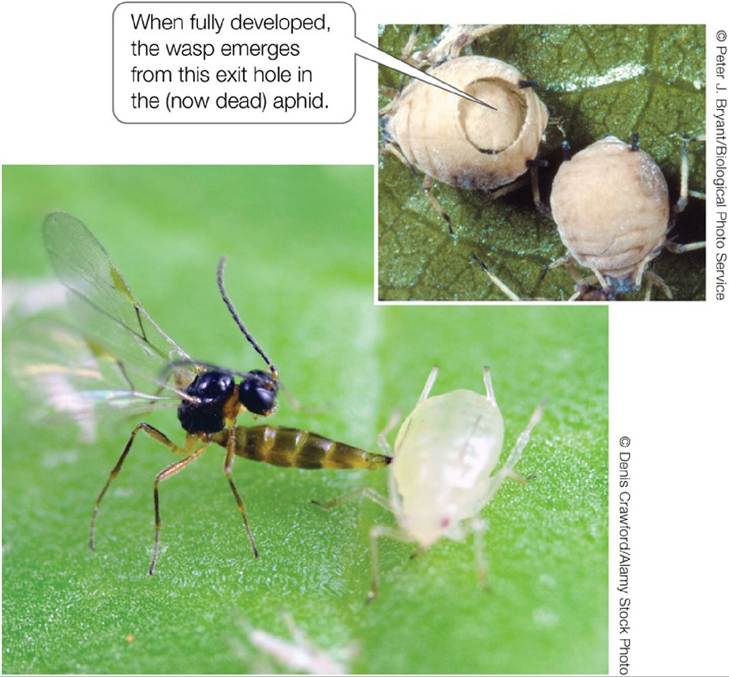
FIGURE 12.4 Are Parasitoids Carnivores or Parasites? Parasitoidssuchasthewasp Aphidius colemani, shown here depositing an egg into an aphid, can be considered unusual carnivores because during their lifetime they eat and slowly kill only one prey individual. Parasitoids can also be viewed as unusual parasites that eat all or most of their host, thereby killing it. View larger image
Despite these and other complications, we will approach the rich variety of trophic interactions in two chapters: this chapter will cover carnivory and herbivory, and Chapter 13 will focus on parasitism. We will begin by exploring some aspects of carnivores and herbivores that define and characterize their dietary preferences.