Many carnivores have broad diets
Most carnivores eat prey in relation to their availability without showing a preference for any particular prey species. This lack of preference is likely a result of a generalist strategy.
A predator can be said to show a preference for a particular prey species if it eats that species more often than would be expected based on that prey's availability.Some carnivores do show a strong preference for certain prey species. Lynx and coyotes, for example, eat more hares than would be expected based on their availability; even when hares constitute only 20% of the available food, they constitute 60%-80% of the diet of lynx and coyotes.
Some carnivores concentrate their foraging on whatever prey is most plentiful. When researchers provided guppies with two kinds of prey, fruit flies (floating on the water surface) and tubificids (aquatic worms found on the bottom), the guppies ate disproportionate amounts of whichever prey was most abundant (FIGURE 12.6). Predators like these guppies that focus on abundant prey tend to “switch” from one prey species to another. Such switching may occur because the predator forms a search image of the most common prey type and hence tends to orient toward that prey, or because learning enables it to become increasingly efficient at capturing the most common prey type. As we saw in Concept 8.2, in some cases predators switch from one type of prey to another in a manner consistent with the predictions of optimal foraging theory.
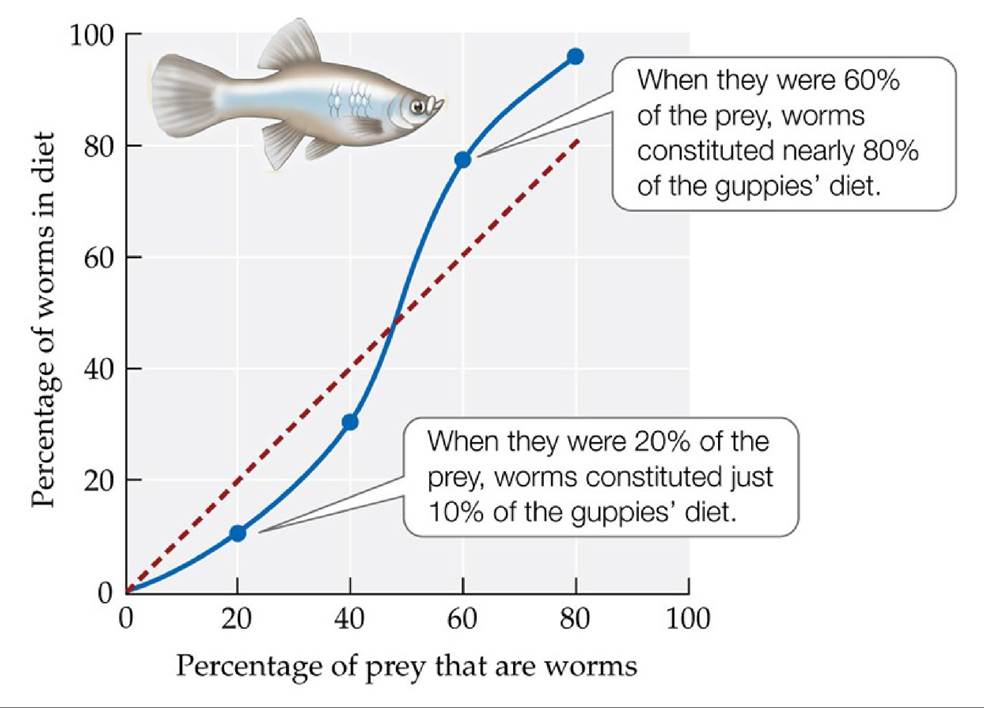
FIGURE 12.6 A Predator That Switches to the Most Abundant Prey Guppiesfocused their foraging efforts on whichever prey species was most common in their habitat: aquatic worms (tubificids) or fruit flies. The dashed red line indicates the results that would have been expected if the guppies had captured worms according to their availability instead of switching to whichever prey species was more abundant (solid blue line). (After W. W. Murdoch et al. 1975. Ecology 56: 1094-1105.) View larger image
More on the topic Many carnivores have broad diets:
- Many carnivores have broad diets
- Answers to Review Questions
- Reviewers
- Escaping carnivores: Physical defenses, toxins, mimicry, and behavior
- Heterotroph diets can be determined from the isotopic composition of food sources
- Heterotrophs vary in the complexity of their digestion and assimilation