Heterotrophs vary in the complexity of their digestion and assimilation
As we have seen, food consumed by heterotrophs consists of a mix of complex compounds that must be chemically transformed into simpler compounds before they can be used as energy sources.
Digestion breaks down proteins, carbohydrates, and fats into their component amino acids, simple sugars, and fatty acids. The evolution of digestion and assimilation is related to improving the efficiency of energy and nutrient extraction and to meeting the specific needs of physiological functions. Insect flight, for example, has a high energy demand, and some insects must maintain fat storage bodies to supply the energy required for initiation of flight. Humans require carbohydrates to fuel brain activity, which explains why a low blood sugar level can lead to poor cognitive ability. Thus, digestion and absorption of food are important steps in the energy acquisition and functioning of heterotrophs.The evolution of feeding in heterotrophic protists and animals has led to increasing complexity in the ingestion, digestion, and absorption of food. Small protozoans such as amoebas and ciliates ingest food particles into their cells, where the food is digested in special organelles. With the advent of multicellular animals, specialized tissues for absorption, digestion, transport, and excretion evolved, and the efficiency of energy assimilation increased. Digestive systems evolved from simple chambers with a single input and output port, such as those in hydroid animals, to a tube with an input port (mouth) and an output port (anus). Further advancements included chambers specializing in specific digestive steps (e.g., stomachs) and absorption (e.g., intestines). Mechanisms evolved for breaking food down into smaller bits to increase the surface area exposed to digestion, including gizzards (which contain small rocks for grinding food) in earthworms and birds and molar teeth in mammals.
As you might guess from the discussion of food chemistry above, the diet of an animal can influence its digestive adaptations. For example, herbivores consume a food source—plants—that contains a large amount of fiber and small amounts of carbohydrates and proteins. To cope with this poor-quality diet, most herbivores have digestive tracts that are longer than those of carnivores, which increases food processing time and increases the surface area for absorbing energy (FIGURE 5.23). In order to further increase the exposure of food to the digestive tract, some herbivores, including many small vertebrate herbivores such as rabbits, reingest their feces (a strategy called coprophagy). Young animals may also ingest the feces of older animals. While this feeding strategy might seem disgusting to humans, it enhances the efficiency of digestion and absorption of poor-quality food, and it also helps to maintain a healthy colony of beneficial microorganisms in the animal's gut. Coprophagy generally does not seem to enhance the digestion of fiber in food, but instead is more important for capturing vitamins and nutrients (Karasov and Martinez del Rio 2007).
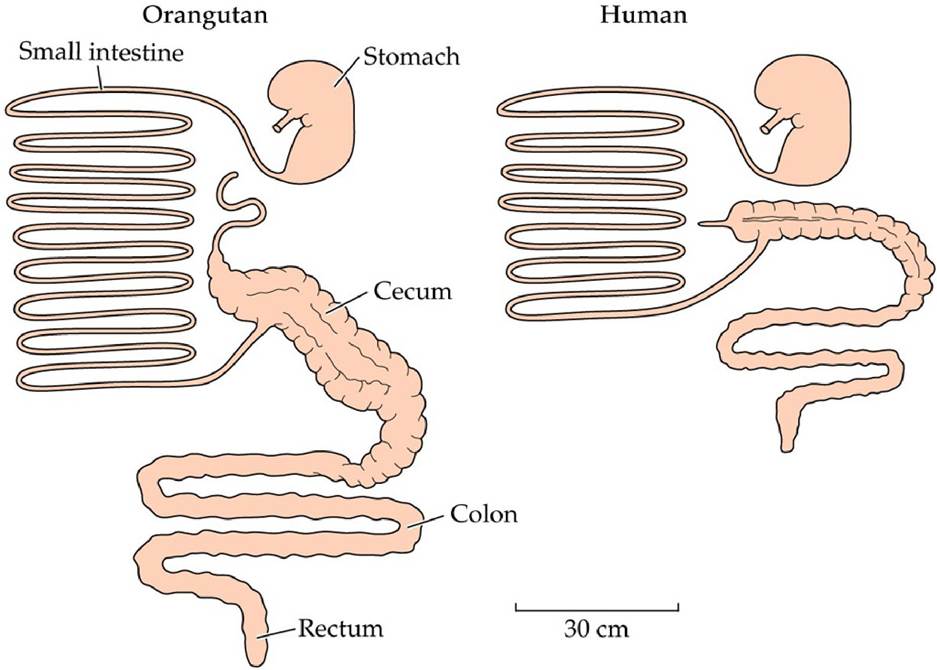
FIGURE 5.23 Herbivores Have Long Digestive Systems Compared with omnivorous humans, herbivorous primates such as the orangutan have longer digestive systems. The greater volume and absorptive area of herbivore digestive tracts serve to enhance energy absorption from poor-quality food. (After O. M. Wrong et al. 1981. The Large Intestine: Its Role in Mammalian Nutrition and Homeostasis. Halsted: New York.) View larger image
Some herbivores have bacterial symbionts that greatly enhance the efficiency of digestion. Most animal digestive tracts are inhabited by archaea, bacteria, fungi, and even some protists, although the roles of many of these organisms in helping or hurting their hosts are unknown. For some animals, this relationship between the herbivore and its gut biota is clear: both benefit from the relationship.
Ruminants, a group of herbivorous mammals that include cattle and giraffes, have a specialized stomach compartment (the rumen) in which large populations of bacteria facilitate the chemical breakdown of cellulose into simple sugars. The rumen acts like a fermentation chamber, providing environmental conditions that favor the growth of these beneficial bacteria. Material from the rumen is eventually passed into another stomach chamber, which absorbs not only the compounds released from digested plant matter, but also the compounds released from the bacteria that accompany the mass of digested food. Ruminants also exhibit rumination, or cud chewing, which is the regurgitation of material from a forestomach for additional chewing. Rumination allows these animals to “eat on the run,” consuming large amounts of plant material in a short time and thereby minimizing their exposure to predators that might consume them. They can then more thoroughly chew and digest their food at a later time when the threat of being eaten is lower.We've seen several examples of digestive adaptations to different food types. Can organisms acclimatize to eating different foods? The answer for some animals is yes. Organisms that consume a diverse diet of both plants and animals (omnivores) can adjust their digestive morphologies and produce different enzymes as needed to enhance digestion of their food. For example, warblers in the genus Setophaga make seasonal migrations that are associated with changes in their diet. The birds spend their breeding season (May-September) in forests of North America, eating mostly insects, and the rest of the year in Central America, consuming fruit and nectar. An experiment with captive warblers, including the pine warbler (Setophaga pinus), showed that their diets influenced the efficiency of fat assimilation. Compared with birds raised on diets of insects and fruit (which have a moderate and a low fat content, respectively), birds raised on seeds (which have a high fat content) showed the greatest ability to take up fats from their food due to longer food retention times in the gut and production of higher amounts of fat-degrading enzymes (FIGURE 5.24) (Karasov and Martinez del Rio 2007).
This ability to acclimatize to different food sources allows omnivores such as warblers to select the best food source available at any given time. We'll discuss other aspects of diet flexibility andspecialization in Concept 12.1.
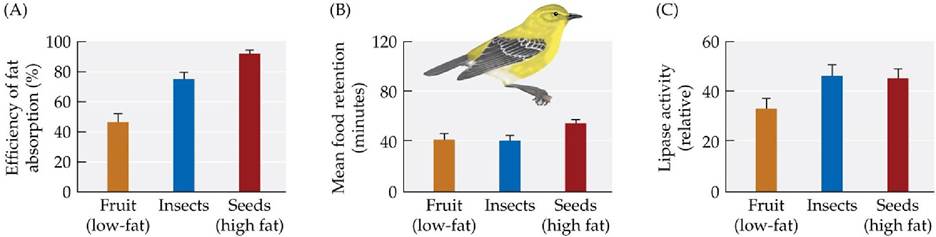
FIGURE 5.24 Adjustment of Digestion Efficiency with a Changing Diet Migrating warblers consume different diets in different parts of their ranges. To investigate the influence of fat content in the diet on their efficiency of fat absorption, researchers fed captive birds diets that were high (seed), medium (insect), or low (fruit) in fat, then measured the efficiency of fat absorption (the proportion of the fat in the diet taken up by the birds). The increase in the efficiency of fat absorption that accompanied a high-fat diet (A) was associated with longer food retention times (B) and greater production of a fat-degrading enzyme (lipase) by the pancreas (C).
Error bars show one SE of the mean. (After W. H. Karasov and C. Martinez del Rio. 2007. Physiological Ecology: How Animals Process Energy, Nutrients, and Toxins. Princeton University Press: Princeton, NJ.) View larger image
A Case Study Revisited
Toolmaking Crows
We've seen that foraging animals often display behavioral as well as morphological and biochemical specializations that increase their efficiency in harvesting and digesting food. The specialized bill of crossbills is a morphological adaptation that improves their feeding efficiency. Warblers are able to adjust their digestive efficiencies to match their food source. Does tool use by crows enhance their ability to gain energy by allowing them to obtain food more efficiently or obtain food of higher quality?
New Caledonian crows are omnivores with a wide variety of food sources to select from, including vertebrate and invertebrate prey, plants, and dead animals (carrion). As we discussed earlier, the benefit a foraging animal gets from its food is determined by the effort it invests in finding and obtaining the food, the chemistry of the food, and the ability of the animal to digest and absorb it.
There is a cost to tool use: collecting materials and fashioning the tools can be time-consuming, and young crows may not initially be adept at using them. Evaluating the benefit of tool use to the crows requires knowledge of their energy requirements, the energetic benefits of their potential food sources, and the crows' actual diet.The crows' shy nature and their tropical forest habitat make observational studies difficult. To evaluate the energetic benefit of toolmaking and tool use, Christian Rutz and colleagues (2010) used stable isotope measurements (see Ecological Toolkit 5.1) to evaluate what the birds were eating and then used measurements of the lipid content of their potential food sources to estimate the energetic benefits of each. They also estimated the energy demands of the crows. Initial observations suggested that the birds relied on two high-quality food items, both of which had a lipid content of about 40%: nuts from candlenut trees, which the crows crack open by dropping them onto rocks; and beetle larvae, which these birds obtain by using tools. Stable isotope measurements of N and C in the crows' blood and feathers and in their potential food sources indicated that they used a variety of food resources (FIGURE 5.25A) but that over 80% of their lipid intake was coming from the nuts and larvae (FIGURE 5.25B). This result indicates that a large proportion of the crows' energetic demand is met using two behaviors: tool use and nut cracking.
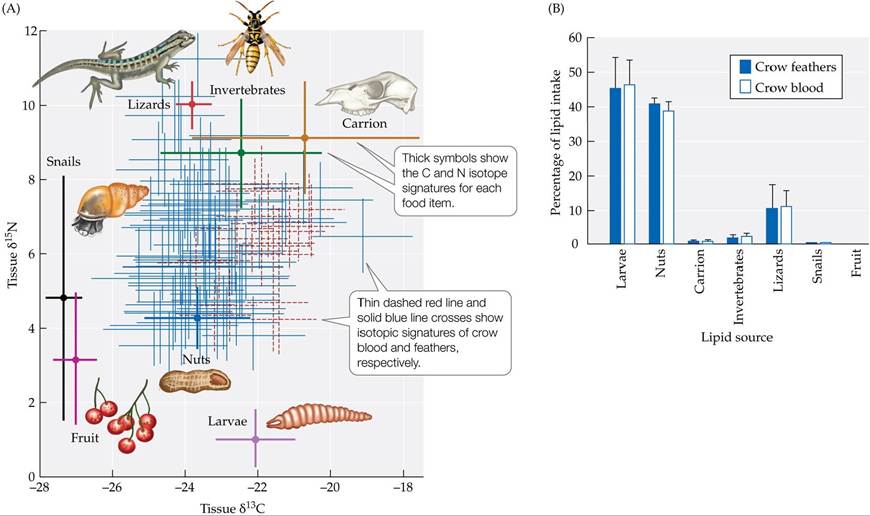
FIGURE 5.25 Diet Selection and Energy Gain by New Caledonian Crows (A) Each of the different food items available to the crows has a unique combination of C and N stable isotopes. Knowing the isotopic composition of the potential food sources provides a tool to estimate what proportion of an individual crow's diet comes from each item. (B) Estimated contributions of the food items to dietary lipid intake based on the isotopic composition of crow blood and feathers.
Error bars show one SE of the mean. (After C. Rutz et al. 2010. Science 329: 1523-1526.) View larger imageTo address whether tool-aided beetle larva extraction alone could meet the energetic demand of the crows, Rutz and his colleagues determined the minimum number of beetle larvae needed on a daily basis to sustain a crow of average weight. They found that only three larvae per day were needed, because of their high lipid content. Observations indicated that most adult crows can easily obtain three larvae per day; one competent adult crow was able to extract 15 larvae in 80 minutes. Tool use clearly provides a substantial benefit to the New Caledonian crows, giving them access to a high-quality food item that would otherwise not be available to them, or would at least require a very high investment of
energy to obtain.
Connections in Nature
Tool use: Adaptation or Learned Behavior?
How widespread is tool use among birds and other nonprimate animals? Many anecdotes of toolmaking and other innovative foraging techniques have been reported, but few have been examined thoroughly. The orange-winged sittella (Daphoenositta chrysoptera) of Australia uses sticks to forage for insect larvae, much like the New Caledonian crows. Egyptian vultures (Neophron percnopterus) crack open ostrich eggs using rocks. There are additional reports of tool use by insects, mammals, and other bird species (Beck 1980). The multitude of reports involving a wide range of animal species thoroughly dispels the notion of human monopoly on tool use. But how do these tool-using skills develop? Are these behaviors learned from other animals, or are they innate (i.e., determined genetically)? Several studies indicate that both learning and genetic inheritance can influence the development of tool use in animals.
As we learned above, tool use has a clear energetic benefit for New Caledonian crows, but does that benefit exert strong enough selection pressure to have resulted in a behavioral adaptation—are the birds inheriting the ability to use tools? To address this question, Ben Kenward and colleagues reared New Caledonian crows in captivity, without exposure to adult birds. Some of the birds received “tutoring” in toolmaking and tool use by human foster parents, while a control group did not (Kenward et al. 2005). To evaluate the birds' toolmaking abilities, the researchers placed supplemental food in tight crevices in the birds' aviaries, where it was not accessible to the birds without the assistance of tools. Twigs and leaves were also left in their aviaries. The captive crows developed the ability to make and use tools to retrieve the food in the crevices, whether they had been tutored or not (FIGURE 5.26). Kenward and colleagues concluded that the ability of New Caledonian crows to manufacture tools is at least partly inherited, rather than an acquired skill learned from adult birds in the wild. Very similar results were reported for experiments with captive woodpecker finches, birds endemic to the Galapagos archipelago that use twigs and cactus spines to forage for arthropods (Tebbich et al. 2001). Additional evidence that toolmaking is part of the genetic makeup of New Caledonian crows comes from an evaluation of their bill morphology, which has unique structural features consistent with tool manufacture and use as a selective force in its design (Matsui et al. 2016).
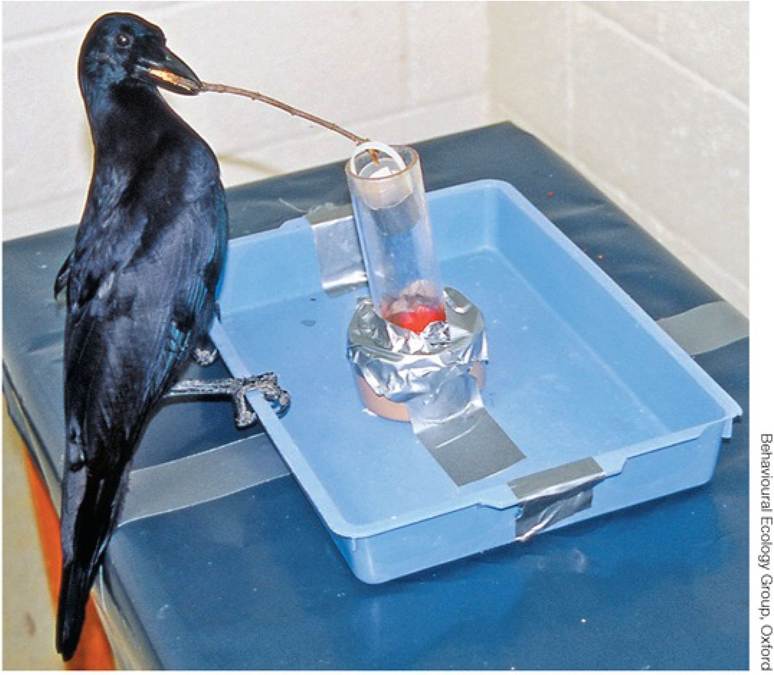
FIGURE 5.26 Untutored Tool Use in Captive Crows AcaptiveNewCaledonian crow (Corvus moneduloides) uses a stick tool to retrieve food from artificial crevices in a laboratory setting, despite never having been exposed to tool use, either by humans or by other birds. View larger image
An additional twist to the crow toolmaking story is the apparent variation in tool styles among different crow populations on New Caledonia. In other words, there appears to be the potential for technological evolution in the styles of tools manufactured by crows. Gavin Hunt and Russell Gray conducted a survey of 21 sites on New Caledonia and examined 5,550 different cutting tools constructed by crows from Pandanus leaves (see Figure 5.2C) (Hunt and Gray 2003). They found three distinct widths of tools: wide, narrow, and stepped. Most of the tools found at a given site were very similar, and the geographic ranges of the tool types showed little overlap. There were no apparent correlations between where a tool type was found and local ecological factors such as forest structure or climate. Hunt and Gray suggested that the three tool designs were derived from a single original tool (of the wide type) subjected to additional modifications, including additional stripping of leaf material. Their study suggests ongoing innovation in toolmaking by the New Caledonian crows. This crow engineering challenges our traditional view of technological advancement in nonhuman animals.
Learned behavior is also important for toolmaking in some species. A notable example comes from studies of bottlenose dolphins in Shark Bay, Australia. Researchers observed that some dolphins swim with sponges plucked from the ocean floor on their noses (technically, their rostra) (FIGURE 5.27). The sponges appear to protect the sensitive rostra from sharp objects and stinging animals such as stonefish as the dolphins probe the seafloor for fish. The group of dolphins displaying this innovation is part of a larger group under study. The researchers’ knowledge of the genetics and family structure of these dolphins allowed them to address the question of whether this unique behavior is learned or inherited. Michael Krutzen and colleagues found that the majority of “sponging” dolphins were female. They reasoned that a single sex- linked gene (the kind of genetic basis one might expect for a trait occurring in only one sex) was a highly unlikely cause for a complex trait such as sponging. A comparison of the genetic fingerprints of individuals that sponged with those of nonsponging dolphins indicated that most of the sponging occurred within a single family line (Krutzen et al. 2005). The combination of these results led Krutzen and colleagues to conclude that sponging was a learned behavior passed from mother to daughter. This finding supports the idea of a cultural phenomenon in animals that influences the efficiency of their feeding behavior and challenges the notion that cultural learning is unique to humans.
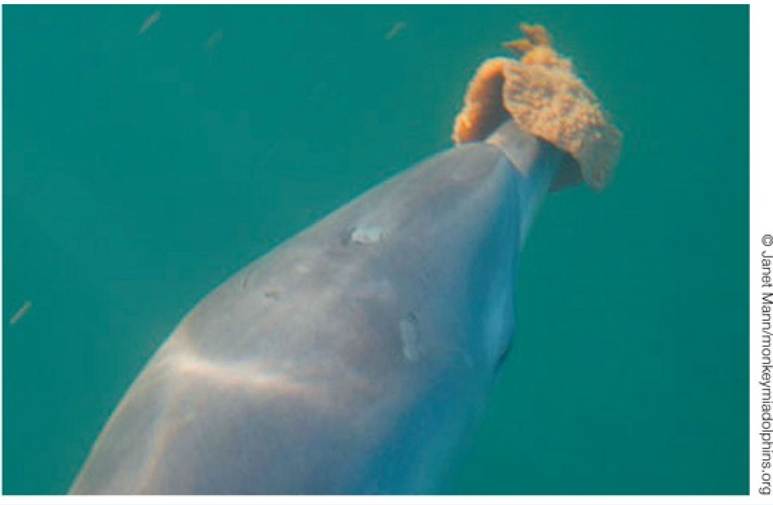
FIGURE 5.27 Dolphin Nose Gear in Shark Bay, Australia A bottlenose dolphin wears a sponge to protect its rostrum while foraging on the seafloor. View larger image
More on the topic Heterotrophs vary in the complexity of their digestion and assimilation:
- Heterotrophs vary in the complexity of their digestion and assimilation
- Dispersion, Assimilation, and Collective Identity
- Reviewers
- Functions and composition of blood