SUMMARY
CONCEPT 5.1 Organisms obtain energy from sunlight, from inorganic chemical compounds, or through the consumption of organic compounds.
5.1.1 Differentiate autotrophy from heterotrophy in the context of building energy compounds using external sources of energy versus consuming them from organic matter.
Autotrophs convert energy from sunlight (by photosynthesis) or inorganic chemicals (by chemosynthesis) into energy stored in the carbon-carbon bonds of carbohydrates.
Heterotrophs acquire energy by consuming organic compounds from other organisms, living or dead.
CONCEPT 5.2 Radiant and chemical energy captured by autotrophs is converted into stored energy in carbon-carbon bonds.
5.2.1 Summarize chemosynthesis, which results in the synthesis of energy-rich carbon-carbon bonds.
During chemosynthesis, bacteria and archaea oxidize inorganic substrates to obtain energy, which they use to fix carbon and synthesize sugars.
5.2.2 Outline the steps in the light-driven reactions and carbon reactions of photosynthesis, describing their outcomes and how they produce energy-rich compounds in photoautotrophs.
Photosynthesis has two main steps: the absorption of sunlight by pigments to produce energy in the form of ATP and NADPH (the light-driven reactions) and the use of that energy in the Calvin cycle to fix CO2 and synthesize carbohydrates (the carbon reactions).
5.2.3 Illustrate how photosynthetic organisms acclimatize and adapt to variations in the intensity of light.
Photosynthetic responses to variation in light levels, water availability, and nutrient availability include both short-term acclimatization and long-term adaptation.
5.2.4 Evaluate the trade-offs that result when a plant controls water loss.
Keeping stomates open while tissues lose water can permanently impair physiological processes in the leaf.
Closing stomates, however, not only limits photosynthetic CO2 uptake, but also increases the chances of light damage to the leaf.5.2.5 Describe how temperature influences photo-synthetic rates through its effect on enzymes and chloroplast membranes.
Autotrophs acclimatize and adapt to temperature variation by changing properties of the Calvin cycle enzymes and/or the photosynthetic membranes. Different photosynthetic organisms have different forms of the same photosynthetic enzymes that operate best under the environmental temperatures where the organisms occur.
CONCEPT 5.3 Environmental constraints have resulted in the evolution of biochemical pathways that improve the efficiency of photosynthesis.
5.3.1 Explain the difference between photosynthesis and photorespiration and evaluate conditions where photorespiration is detrimental to plant growth.
Photorespiration operates in opposition to photosynthesis, lowering the rate of energy gain, particularly at high temperatures and low atmospheric CO2 concentrations.
5.3.2 Summarize how biochemical and anatomical adaptations associated with the C4 photosynthetic pathway minimize photorespiration, thereby enhancing photosynthesis rates.
The C4 photosynthetic pathway concentrates CO2 at the site of the Calvin cycle, minimizing photorespiration.
5.3.3 Describe how crassulacean acid metabolism reduces water loss relative to the C3 or C4 photo-synthetic pathways.
CAM plants reduce transpirational water loss by opening their stomates at night to take up CO2 and releasing it to the Calvin cycle during the day, when the stomates are closed.
CONCEPT 5.4 Heterotrophs have adaptations for acquiring and assimilating energy efficiently from a variety of organic sources.
5.4.1 Illustrate how the chemical makeup of a food item determines the benefit it provides to the consumer eating it.
Variations in the chemistry and availability of food determine how much energy heterotrophs gain from different food sources.
5.4.2 Explain how morphological and behavioral adaptations enable heterotrophs to obtain food more efficiently.
Heterotrophs display tremendous diversity in behavioral, morphological, and physiological adaptations that enhance their efficiency of energy acquisition and assimilation.
5.4.3 Describe how increasing complexity in the digestive systems of heterotrophs makes the assimilation of energy and nutrients more efficient.
Complex digestive systems, such as a tube with an input port and an output port, or additional chambers specializing in specific digestive steps (e.g., stomachs) and absorption (e.g., intestines), make the assimilation of energy and nutrients more efficient.
REVIEW QUESTIONS
1. Define autotrophy and heterotrophy, and provide a few examples of each that illustrate the diversity of the ways in which organisms obtain energy.
2. How does the CAM photosynthetic pathway influence water loss from plants?
3. What are the trade-offs associated with heterotrophic consumption of live animals versus dead plant material?
HONE YOUR PROBLEM-SOLVING SKILLS
Our earlier comparison of the C3 and C4 photosynthetic pathways emphasized the benefit of the C4 pathway through its capacity to minimize photorespiration by increasing the concentration of CO2 inside the leaf. With the advent of elevated atmospheric CO2 concentrations over the past century, ecologists have speculated whether C3 plants might benefit more than C4 plants from possible CO2 fertilization. Such speculation is based on laboratory measurements and modeling of plant responses to variation in CO2 concentrations. An example is such as shown in the figure. (After H. Lambers et al. 2008. Plant Physiological Ecology, 2nd ed. Springer: New York.)
1. Based on the modeled response in the figure, what are the absolute and relative (as a percent) increases in photosynthesis for C3 and C4 plants from preindustrial levels of CO2 (280 ppm) to the current level of CO2 (412 ppm)? What are the possible consequences of any differences in the responses of C3 and C4 plantsto elevated CO2 in plant communities where they co-occur and compete for limited resources?
2.
A review of 62 studies examining the responses of C3 and C4 grasses to elevated CO2 found that on average photosynthesis increased by 33% and 25% in these groups, respectively (Wand et al. 1999). How does this compare with your estimate from question 1? What might account for any discrepancies? Possible contributions may be related to the influence of CO2 on lowering stomatal opening and the demand for nitrogen to make enzymes.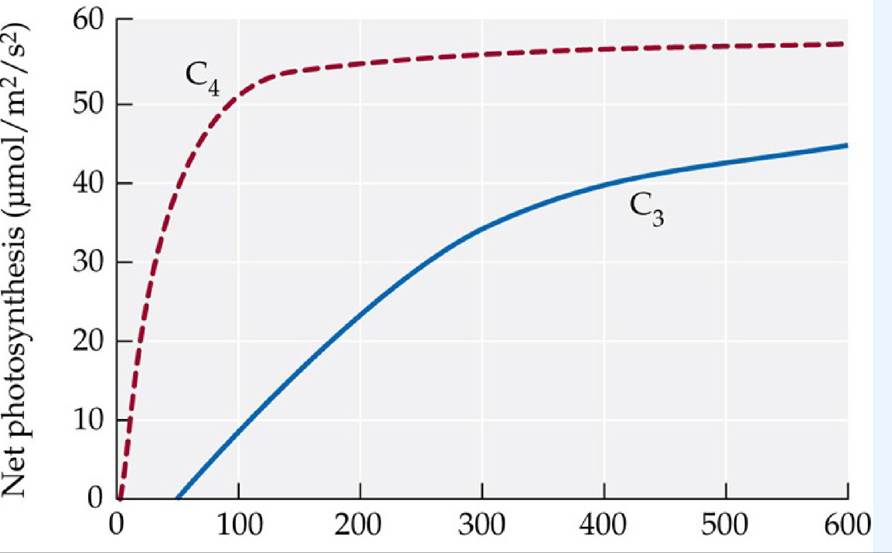
Atmospheric CO7 concentration (ppm)
LIST OF KEY TERMS
C3 photosynthetic pathway
C4 photosynthetic pathway
Calvin cycle
chemosynthesis
crassulacean acid metabolism (CAM) detritus
fixation
Heterotrophs photorespiration photosynthesis