Heterotrophs obtain food using diverse strategies
Heterotrophs vary in size from archaea and bacteria (as small as 0.5 μm) to blue whales (up to 25 m long). The ratio of body size to food ingested varies widely, but it generally increases as body size increases.
Bacteria may be bathed in their food, while food for larger heterotrophs is usually more diffuse and smaller relative to the consumer. Feeding methods and the complexity of food absorption are accordingly very diverse among heterotrophs.Prokaryotic heterotrophs typically absorb food directly through their cell membranes. Archaea, bacteria, and fungi excrete enzymes into the environment to break down organic matter, acting in effect to digest their food outside their cells. Heterotrophic bacteria have adapted to a wide variety of organic energy sources and produce a large number of enzymes capable of breaking down organic compounds. This capacity of microorganisms as a group to use diverse energy sources has been exploited in environmental waste management as an approach to cleaning up toxic chemical wastes, a process known as bioremediation. Spills of fuels, pesticides, sewage, and other toxins have been effectively contained by using microorganisms to break down these harmful compounds. Consumption of oil by marine bacteria is thought to have been an important contributor to cleaning up the oil spill in the Gulf of Mexico that resulted when the Deepwater Horizon oil drilling rig exploded in 2010, releasing about 4.9 million barrels (780 ? 103 liters) of oil. Much of the oil was released directly to the deeper layers of the ocean from the wellhead, which flowed for 87 days unabated until it was finally capped (FIGURE 5.19). The oil spill posed a substantial hazard to marine life, and it was feared that its impact would be longterm, as the impacts of other oil spills had been. Some reports suggest that up to half the oil released in the Deepwater Horizon spill was consumed and respired by marine microorganisms (Du and Kessler 2012), although others suggest that the blooms of microorganisms observed after the spill resulted from consumption of natural gas that leaked from the well rather than the oil itself (Valentine et al.
2010). While the magnitude of consumption is still debated, it is clear that the environmental impact of the oil spill was lessened by the action of marine microorganisms that used the spilled oil as an energy source.
FIGURE 5.19 AnEnvironmentalDisaster Oil pours from the fractured wellhead of the Deepwater Horizon oil drilling rig at the seafloor 1,700 m (5,700 feet) below the surface. About 57,000 barrels (9.1 million liters) were released each day for more than 3 months. The impact of this disaster may have been somewhat lessened by the activities of marine microorganisms that were able to use the oil as an energy source. View larger image
Multicellular heterotrophs usually must seek out food, or move it toward themselves in the case of some sessile marine animals. The evolution of mobility was probably associated with the need to seek out food sources, as well as with the need to avoid being eaten by other consumers. Continued morphological and behavioral adaptations for efficiently finding and capturing food in different environments led to additional diversification of form and function. Animals display tremendous diversity in their specialized feeding adaptations, which reflect the diversity of the foods they consume. Here we present several examples that serve to demonstrate the morphological diversification of heterotrophs; we will take a closer look at behavioral adaptations for feeding in Concept 8.2.
Morphological Diversity of Insect Mouthparts
Insects display tremendous diversity in facial appearance, which reflects the diversity of their food sources, which include detritus, plants, and other animals. They may eat animal prey whole or suck out their body fluids. All insects have the same basic set of mouthparts, consisting of several paired appendages that are used to seize, handle, and consume their food. Morphological variation in these mouthparts reflects the feeding specializations that have evolved within different insect groups (FIGURE 5.20).
Common houseflies have “sponging” mouthparts that release saliva onto their food, then soak up and ingest the partially digested solution. Female mosquitoes and aphids have piercing and sucking mouthparts for extracting fluids from their food sources—blood from animals and sap from plants. Biting flies have razor-sharp appendages that cut through skin to draw blood for drinking, similar to the cutting mouthparts of insects that consume leaves.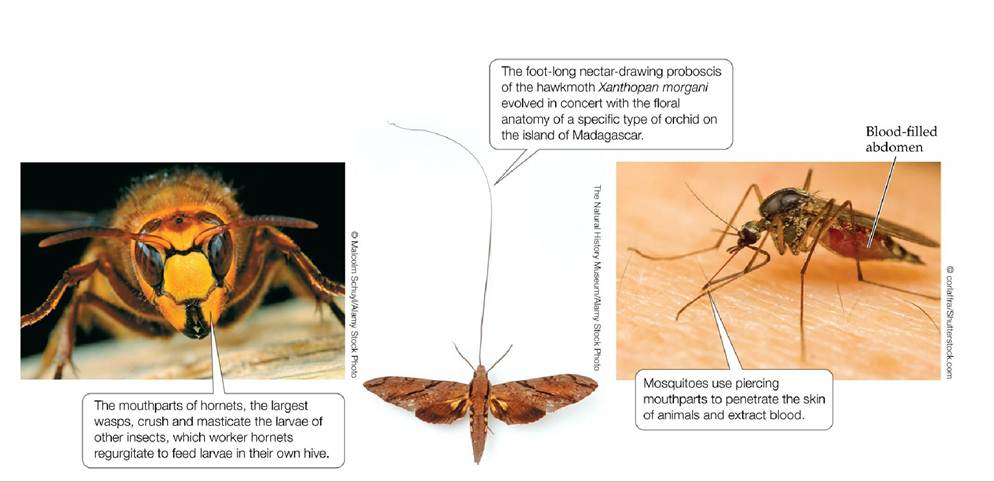
FIGURE 5.20 Variations on a Theme: Insect Mouthparts Differences in the morphology of insect mouthparts reflect different strategies for effectively acquiring and consuming the food types the insects prefer. View larger image
Morphological Adaptation in Bird Bills
Like those of insects, the mouthparts of birds—that is, their bills—display morphological adaptations that reflect the multitude of ways they capture, manipulate, and consume their food (FIGURE 5.21). The morphology of a bird's bill is closely associated with the taxonomic group to which the bird belongs. In other words, the flat bills of ducks and the hooked bills of raptors vary little within those groups. However, subtle differences in bill morphology among closely related species reflect slight differences in food acquisition and handling. This variation reflects adaptations that help to optimize food acquisition and minimize competition among species (see Concept 14.2).
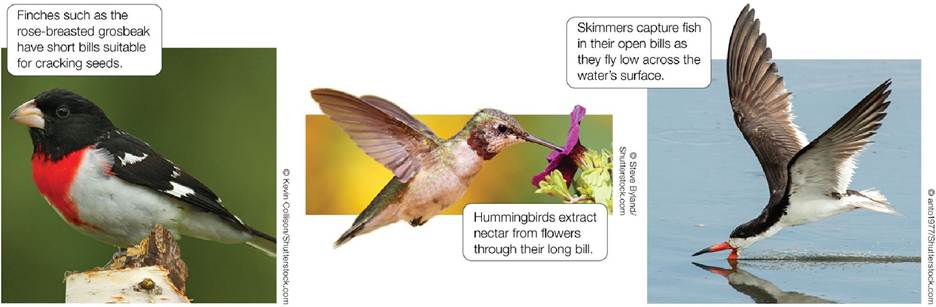
FIGURE 5.21 Variations on a Theme: Bird Bills Bird bill morphology is associated with the feeding behavior of a species and enhances the acquisition of its preferred food resources. View larger image
Craig Benkman studied the relationship between differences in bill morphology among crossbills as they relate to differences in the conifer seeds they use as food (Benkman 1993, 2003).
As their name indicates, crossbills have unique asymmetrical bills with crossing tips (FIGURE 5.22A). Crossbills are adept at using their bills to open the cones of coniferous trees and pull out seeds for consumption. Across their geographic range, crossbills have multiple conifer species available as potential food sources; however, the tree species that are most abundant vary across this range. Benkman wondered if there were differences in the bill morphologies of crossbills that were associated with the morphologies of the cones of their preferred conifer species.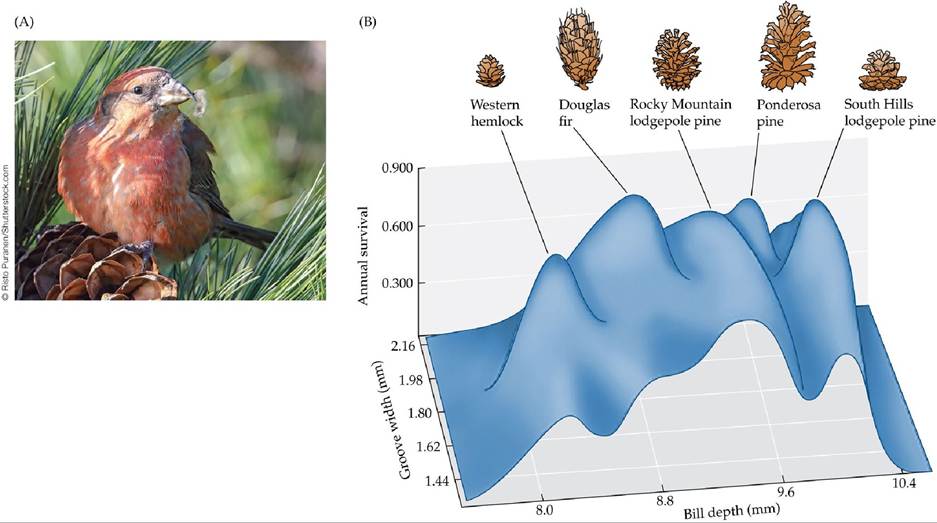
FIGURE 5.22 Crossbill Morphology, Food Preference, and Survival Rates (A)Red crossbill (Loxia curvirostra). (B) A three-dimensional plot of Craig Benkman's data shows the relationship between bill morphology (groove width and bill depth) and annual survival rates in five incipient crossbill species. Each incipient species shows an “adaptive peak” in association with the conifer species it preferentially feeds on; that is, each incipient species has higher survival rates when feeding on the conifer species its bill morphology is best suited to exploit. The cones shown are drawn to relative scale. (B after C. W. Benkman. 2003. Evolution 57: 1176-1181.) View larger image
Benkman tested this hypothesis experimentally using captive and wild birds from five incipient species (subspecies that are in the process of becoming species) of the red crossbill species complex (Loxia curvirostra). He showed in a series of studies that a bird's speed of seed extraction from a given conifer's cone was associated with its bill depth. In addition, Benkman demonstrated that the speed of seed husking (removing the outer cover) was associated with the width of the groove in the bill where the seed is held (Benkman 1993, 2003). Each incipient crossbill species extracted and husked the seeds of one conifer species more efficiently than the seeds of other conifers. The study showed an association between the bill depth of an incipient species and the depth at which the seeds are held in the cones of its preferred conifer species. Furthermore, Benkman found that the annual survival rate for each incipient crossbill species was related to its feeding efficiency, which varied according to the conifer species it was feeding on. When he put these results together, Benkman found a series of five “adaptive peaks,” showing that bill morphology of each incipient species was associated with the conifer species on which it fed most efficiently and survived best (FIGURE 5.22B). Benkman (2003) concluded that red crossbills are currently undergoing evolutionary divergence (speciation; see Concept 6.4) as a result of selection associated with differences in available food resources across their range and the effects of those differences on bill morphology.