Heterotroph diets can be determined from the isotopic composition of food sources
As we saw in Concept 5.4, chemistry is an important determinant of the benefit heterotrophs get from their food. In particular, the ratios of carbon to nutrients such as nitrogen and phosphorus influence the growth rates and reproductive output of heterotrophs and thus their secondary production.
We will revisit this topic in Concept 21.2.Determining what heterotrophs eat may be as simple as watching them feed. Such observations, however, may be a time-consuming and imprecise exercise. Another option is examining their fecal material, which can also be imprecise and not a pleasant task. An alternative method of determining a heterotroph's diet involves measuring stable isotopes (see Ecological Toolkit 5.1). The ratios of naturally occurring stable isotopes of carbon ( C/ C), nitrogen ( N/ N), и/ VZ X X Z z tz ∖ χ z
and sulfur (34S∕32S) differ among potential food items. Measurements of the isotopic composition of a heterotroph and its potential food sources can identify the food sources that make up its diet (Peterson and Fry 1987).
Isotopic measurements of preserved bone specimens have been used to study the diets of extinct animals as well as modern ones. One mystery in feeding ecology that was solved using isotopic measurements was the diet of European cave bears (Ursus spelaeus). Cave bears went extinct about 25,000 years ago, during the peak of the last Ice Age. Cave bears were much larger than the temperate- zone bears of today, as much as triple the size of the modern grizzly bear (Ursus arctos horribilis) of North America. Examination of the teeth and the jaw structure of cave bears led some mammalogists to hypothesize that they were primarily herbivores. However, the fact that plants are a poor-quality food, as noted in Concept 5.4, led to skepticism about an herbivorous diet adequately sustaining such a massive bear. G.
V. Hilderbrand and colleagues measured the C and N isotope composition of bone samples provided by museums from across the world (Hilderbrand et al. 1996). The samples included cave bears and the herbivores that occurred alongside them (woolly rhinoceros, woolly mammoth, horse, and aurochs, an ancestor of modern cattle). Hilderbrand and colleagues found that bones of cave bears had an isotopic composition different from that of Pleistocene herbivores (FIGURE 20.18). Using information about the isotopic composition of food sources, the researchers estimated that the average diet of cave bears consisted of 58% meat (range from 41% to 78%). This finding refuted the hypothesis that cave bears were primarily herbivores, indicating that the bulk of their diet was meat. In this and other studies, isotopic measurements have provided a useful tool for determining the diets of animals that is more accurate and integrative, and less time-consuming, than other techniques. See the Hone Your Problem-Solving Skills for this chapter to see how isotopic analysis can be used to compare grizzly bear diets in different environments.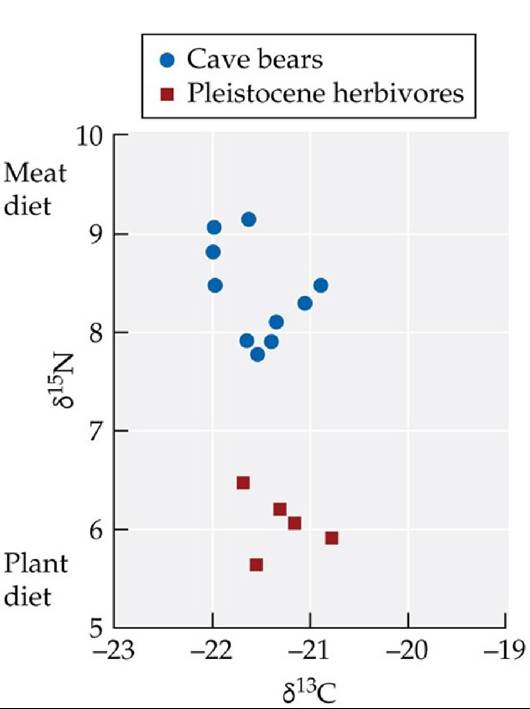
FIGURE 20.18 Isotopic Composition and Diet Carbon and nitrogen isotope composition of bones of museum specimens of cave bears and herbivores from about 20,000 years ago. The isotopic compositions are expressed as ratios of heavier to lighter isotopes compared with a standard. Higher numbers mean more of the heavier isotope. (After G. V. Hilderbrand et al. 1996. CanJZool 74: 2080-2088.) View larger image
More on the topic Heterotroph diets can be determined from the isotopic composition of food sources:
- Heterotroph diets can be determined from the isotopic composition of food sources
- SUMMARY
- Heterotrophs vary in the complexity of their digestion and assimilation
- Index