Escaping carnivores: Physical defenses, toxins, mimicry, and behavior
Many prey species have physical features that reduce their chances of being killed by predators. Such physical defenses include large size (e.g., elephants), a body plan designed for rapid or agile movement (e.g., gazelles), and body armor (e.g., snails and armored mammals such as the pangolin in FIGURE 12.9A).
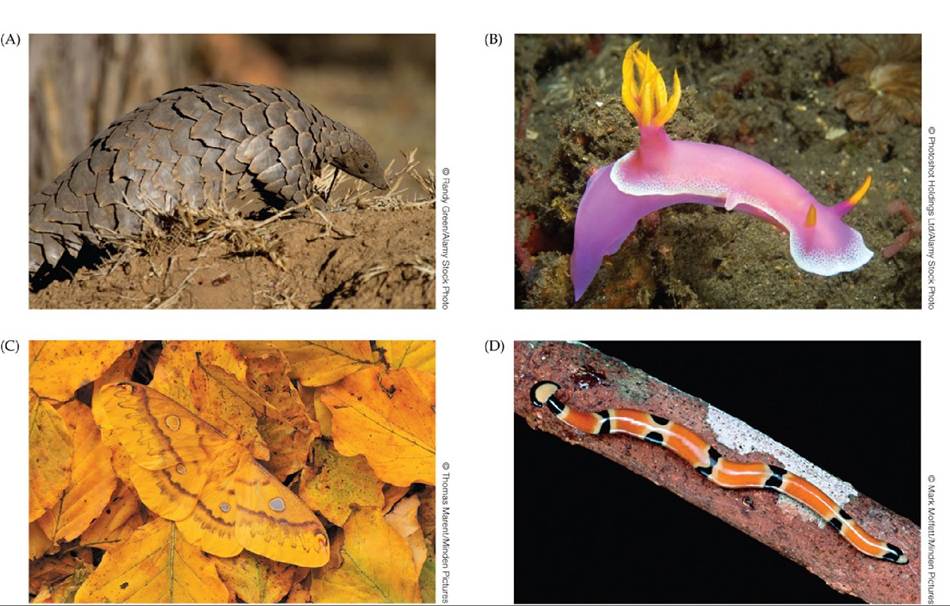
FIGURE 12.9 Adaptations to Escape Being Eaten Prey have evolved a wide range of mechanisms to escape from predators, including (A) physical features, such as the armor of the ground pangolin of South Africa (Manis temmenickii); (B) toxins, advertised by bright warning colors such as those of the nudibranch Hypselodoris bullockii; (C) crypsis, or camouflage, as in this female Saturniid moth (Rhodinia fugax), which blends in with the leaf litter on the forest floor; and (D) mimicry, as in this terrestrial flatworm (Bipalium everetti) that resembles a snake. View larger image
Other species use poisons to defend themselves against predators. Species that contain powerful toxins are often brightly colored (FIGURE 12.9B). Such warning (aposematic) coloration can itself provide protection from predators, which may instinctually avoid prey that are brightly colored or may learn from experience not to eat them.
Other prey species use mimicry as a defense: by resembling less palatable organisms or physical features of their environment, they cause potential predators to mistake them for something less desirable to eat. There are many forms of mimicry. Some species have a shape or coloration that provides camouflage, allowing them to avoid detection by predators (FIGURE 12.9C); this form of mimicry is called crypsis (from cryptic, “hidden”). Other prey species use mimicry as a form of “false advertising”: their shape and coloration mimic those of a species that is fierce or that contains a potent toxin (FIGURE 12.9D).
Finally, many prey species change their behavior when predators are present. When predators are abundant, snowshoe hares, like the elk described in Concept 8.2, forage less in open areas (where they are most vulnerable to attack). When threatened, musk oxen form a defensive circle, which makes them a difficult target (see Figure 8.19).In some cases, there may be a trade-off between different types of defenses. For example, among four species of marine snails eaten by the green crab (Carcinus maenas), the species whose shells could be crushed most rapidly by crabs were the quickest to take refuge when crabs were detected, and vice versa (FIGURE 12.10). The exact negative correlation between resistance to crushing and predator avoidance behavior suggests that there may be a trade-off between a snail's physical and behavioral defenses.
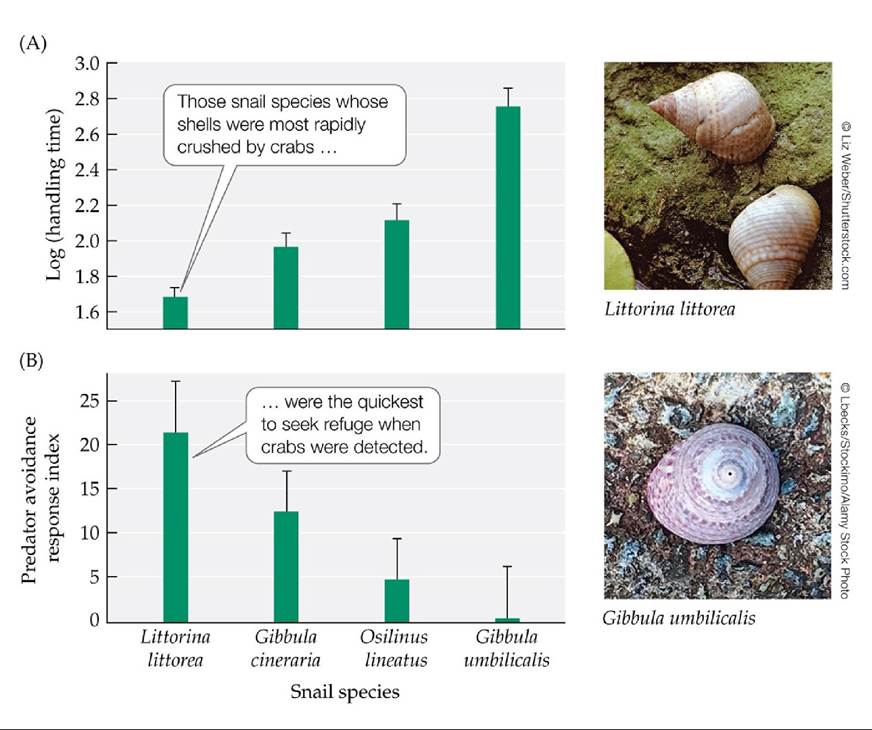
FIGURE 12.10 A Trade-Off in Snail Defenses against Crab Predation? (A)Handlingtime taken by green crabs (Carcinus maenas) to manipulate and crush the shells of each of four snail species. (B) Index of the strength of the predator avoidance response of each of four snail species; larger values indicate a more rapid behavioral response to crabs. Error bars show one standard error of the mean. (After P. A. Cotton et al. 2004. Ecology 85: 1581-1584.) View larger image
More on the topic Escaping carnivores: Physical defenses, toxins, mimicry, and behavior:
- Researchers studying animal behavior can seek to answer questions using a variety of approaches focusing on different aspects of the behavior under study.
- Parasites have mechanisms that circumvent host defenses
- Environmental Toxins
- Many carnivores have broad diets
- Some carnivores move to search for and capture prey, while others sit and wait
- Hobbes: Escaping the state of nature
- CASE 227: Escaping a Tutor
- Toxins in Remote Places: A Case Study
- CANINE DISTEMPER IN CARNIVORES
- Werner Reiss, author of the most detailed recent discussion on the subject of violence in the Greek world, defined violence as ‘a physical act', stating further that it is a ‘process in which a human being inflicts harm on another human being via physical strength’.1
- BEHAVIORAL DEFENSES OF VERTEBRATES