Reciprocal plant-herbivore interactions
As we have learned, herbivores generally consume only parts of their food plant and usually do not kill them. Moreover, because most plants are not mobile and thus unable to escape herbivory in space, they employ defenses to reduce being eaten.
Let's first consider plant responses to reduce herbivory and then ways that herbivores can respond.Reducing Herbivory: Avoidance, Tolerance, and Defenses
Some plants avoid herbivory by producing great numbers of seeds in some years and few or no seeds in other years. For example, up to 100 years may pass between bouts of seed production, as in the mass flowering of bamboos in China. This phenomenon, known as masting, allows plants to hide (in time) from seed-eating herbivores, then overwhelm them by sheer numbers. Plants can also avoid herbivores in other ways, such as by producing leaves at times of the year when herbivores are scarce.
Other plants have adaptive growth responses that allow them to compensate for, and hence tolerate, the effects of herbivory—at least up to a point. Compensation occurs when removal of plant tissues stimulates a plant to produce new tissues, allowing for relatively rapid replacement of the material eaten by herbivores. When full compensation occurs, herbivory causes no net loss of plant tissue. Compensation may occur when, for example, removal of leaf tissue decreases self-shading, resulting in increased plant growth, or when removal of apical buds (those at the end of a branch or shoot) allows lower buds to open and grow. Beech trees respond to simulated herbivory (clipping) by increasing both their leaf production and their photosynthetic rate. Similarly, moderate to high levels of herbivory may benefit field gentians (Gentianella campestris) under some circumstances (FIGURE 12.11). In this case, the timing of herbivory is critical: early in the growing season (up to July 20), the plant more than fully compensates for the lost tissue, but later in the season (July 28), it does not.
If the amount of material removed from a field gentian—or any other plant—is large enough, however, or if insufficient resources are available for growth, the plant cannot fully compensate for the damage.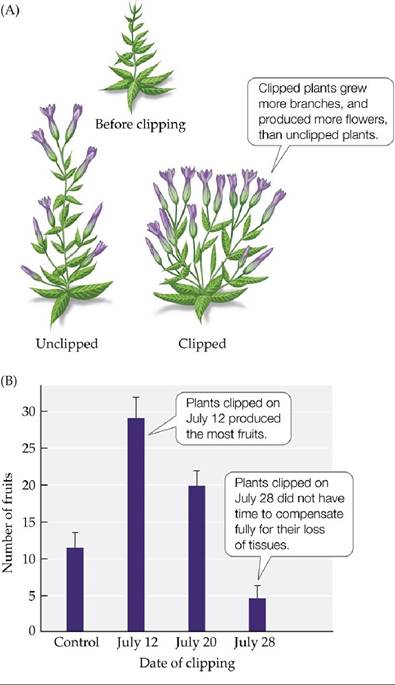
FIGURE 12.11 Compensating for Herbivory Field gentians (Gentianella campestris) were clipped at different times during the growing season to simulate herbivory. (A) The shape and production of flowers in unclipped (control) and clipped plants. (B) Numbers of fruits produced by control plants and plants clipped on different dates. Error bars show one standard error of the mean.
How many fruits would you expect to be produced by a field gentian that compensates fully for clipping? Explain your reasoning.
(After T. Lennartsson et al. 1998. Ecology 79: 1061-1072.) View larger image
Finally, plants use an enormous array of structural and chemical defenses to ward off herbivores (Pellmyr et al. 2002; Agrawal and Fishbein 2006). A stroll through many plant communities makes this readily apparent: the leaves of many plants are tough, and many plant bodies are covered with spines, thorns, sawlike edges, or pernicious (nearly invisible) hairs that can pierce the skin like miniature porcupine quills. In some cases, such structures are an induced
defense (stimulated by herbivore attack), as illustrated by individual cacti that increase their production of spines only after they have been grazed (Myers and Bazely 1991).
Plants also produce a wide variety of chemicals, called secondary compounds, that function to reduce herbivory. Some secondary compounds are toxic, protecting the plant from all but the relatively small number of herbivore species that can tolerate them. Others serve as chemical cues that attract predators or parasitoids to the plant, where they attack herbivores (Schnee et al. 2006).
Some plant species, such as oak trees, produce secondary compounds constantly, regardless of whether herbivores have attacked the plant.
In other species, the production of secondary compounds is an induced defense. For example, when attacked by herbivores, a North American tobacco species, Nicotiana attenuata, produces two induced defenses: toxic secondary compounds that deter herbivores directly, and volatile compounds that deter herbivores indirectly by attracting predators and parasitoids. Acting together, these defenses are very effective in reducing losses of tissue to herbivores. In one experiment, the application of compounds that are normally induced by herbivory to the stems of N. attenuata caused the numbers of a leaf-feeding herbivore on the plants to drop by more than 90% (Kessler and Baldwin 2001).Overcoming Plant Defenses: Structural, Chemical, and Behavioral Adaptations
The defenses used by plants prevent most herbivores from eating most plants. But for any given plant species, there are some herbivores that can cope with its defensive mechanisms. A plant covered with spines may be attacked by an herbivore that can avoid or tolerate those spines. Many herbivores have evolved digestive enzymes that enable them to disarm or tolerate plant chemical defenses. Such herbivores may gain a considerable advantage: they can eat plants that other herbivores cannot and thereby have access to an abundant food resource.
Some herbivores use behavioral responses to circumvent an otherwise effective plant defense. For example, some beetles use a behavioral response to cope with the defenses of tropical plants in the genus Bursera. These plants combine the production of toxic secondary compounds with a high-pressure delivery system: they store a toxic, sticky resin in a network of canals that runs through their leaves and stems (FIGURE 12.12). If an insect herbivore chews through one of these canals, the resin squirts from the plant under high pressure and may repel or even kill the insect (the resin hardens after it is exposed to air, so if an insect is drenched in resin, it can be entombed). Yet some tropical beetles in the genus Blepharida have evolved an effective counterdefense (Becerra 2003). Their larvae chew slowly through the leaf veins where the resin canals are located, releasing the pressure so gradually that the resin does not squirt from the plant. It often takes a beetle larva more than an hour to “disarm” a leaf in this manner; once that job is done, the larva eats the leaf in 10-20 minutes.
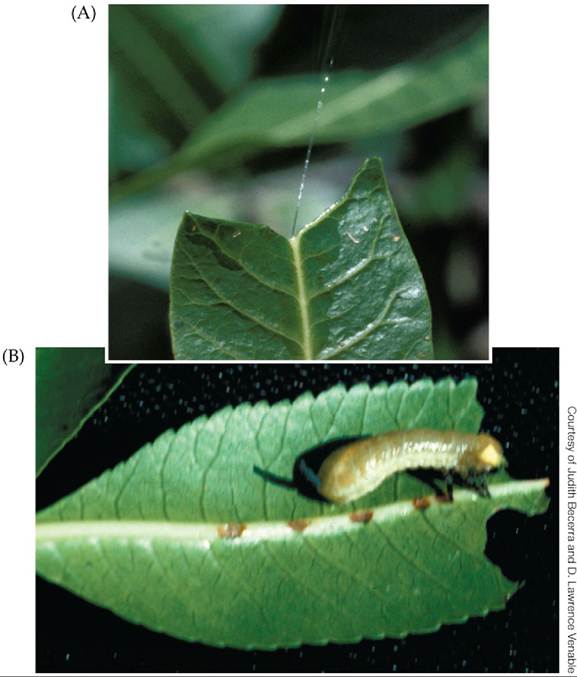
FIGURE 12.12 Plant Defense and Herbivore Counter-defense Someplantsinthegenus Bursera store toxic resin under high pressure in leaf canals. (A) When herbivores eat the leaves, they chew through these canals, causing the resin to be squirted up to 2 m from the leaf. (B) The larvae of some beetles in the genus Blepharida can disable this defense by chewing slowly through the canals, releasing the pressure in a gradual and harmless way. View larger image