Evolution can influence plant-herbivore interactions
The variety of antiherbivore defenses seen in plants suggests that herbivores represent a strong source of selection on plant populations. Several recent studies have tested this claim.
For example, in an experiment lasting five plant generations, Zust et al. (2012) tested the hypothesis that aphid herbivores cause evolution by natural selection in populations of the annual plant Arabidopsis thaliana, a small plant in the mustard family that is often used in laboratory experiments and genetic studies. They began their experiment with equal mixtures of 27 different Arabidopsis genotypes obtained from natural populations (FIGURE 12.13A). Typically, any one plant genotype expresses a subset of the full chemical arsenal of a species; collectively, however, the 27 genotypes used in this study were chosen to represent the full diversity of Arabidopsis chemical defenses.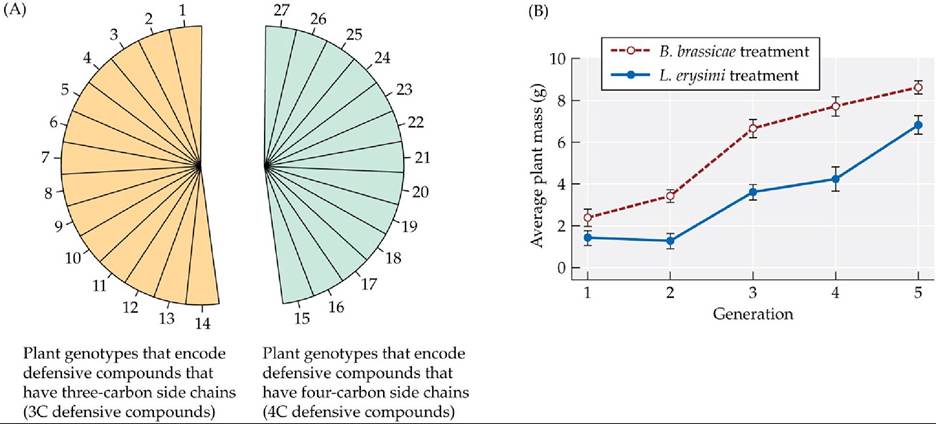
FIGURE 12.13 Does Herbivory Cause Evolution in Plant Populations? (A)Thispiechart shows the equal proportions of 27 Arabidopsis thaliana genotypes used at the start of an experiment testing the hypothesis that herbivory by aphids caused evolution in experimental plant populations. Yellow indicates plant genotypes that encode defensive compounds that have three- carbon side chains (3C defensive compounds), while blue indicates plant genotypes that encode defensive compounds that have four-carbon side chains (4C defensive compounds). (B) The herbivory by aphids (two species were used, Brevicoryne brassicae and Lipaphis erysimi) caused the average mass of A. thaliana plants to increase from generation to generation, indicating an evolutionary response by plant populations. Error bars show ± one standard error of the mean. (After T. Zust et al. 2012. Science 338: 116-119.) View larger image
Zust and colleagues found that feeding by aphids (two species were used, Brevicoryne brassicae and Lipaphis erysimi) reduced average plant size by up to 82% compared with a no-aphid (control) treatment, indicating that herbivory has a cost.
However, they also found that the average sizes of plants exposed to the two species of aphids rose steadily over the course of the experiment (FIGURE 12.13B), suggesting that rapid evolution may have occurred in these populations. These increases in average plant size were associated with considerable changes in the genotypic composition of the plant populations. For example, ten plant genotypes were lost completely, and different aphid species selected for different plant genotypes. You can explore the extent to which different aphid species caused different plant genotypes to be favored by natural selection in ANALYZING DATA 12.1. Overall, Zust et al.'s results provide clear experimental evidence that herbivores can cause evolution by natural selection in plant populations.ANALYZING DATA 12.1
Do Different Herbivore Species Select for Different Plant Genotypes?
As a graduate student, Tobias Zust (Zust et al. 2012)* examined how herbivory by aphids affected evolution by natural selection in plant populations. Six replicate populations of the annual plant Arabidopsis thaliana were established for each of three experimental treatments: a control (no aphids), herbivory by the aphid Brevicoryne brassicae, and herbivory by the aphid Lipaphis erysimi. Each replicate population was initiated from 27 natural genotypes, and plants were grown at high densities (over 8,000 plants/m2) in each of the three treatments.
At the start of the experiment, each replicate population contained equal proportions of the 27 plant genotypes (see Figure 12.13A). The experiment was conducted for five generations. At the end of the experiment, the frequencies of all surviving genotypes were determined.
The table shows the average plant genotype frequencies at the end of the selection experiment; in addition to the genotypes shown here, genotypes 12, 14, and 21 occurred at low frequencies (less than 1.5%) in one or two treatments. Other genotypes not shown in the table did not survive.
1. In total, how many plant populations were established in this experiment? In each of these populations, what was the initial frequency of each plant genotype?
2. Did evolution occur in the control populations? If so, what factor or factors may have caused evolution by natural selection in these populations? Explain your answers.
3. Did evolution occur in the populations exposed to aphid herbivores? If so, what factor or factors may have caused evolution by natural selection in these populations? Explain your answers.
4. Compare results for the B. brassicae treatment with those for the L. erysimi treatment, focusing on whether selection favored genotypes that code for 3C or 4C defensive compounds (see Figure 12.13A). To what extent do the plant genotypes favored by selection differ between these two treatments?
| Frequency (%) of surviving plant genotypes | |||||||||||||
| Treatment | 1 | 2 | 3 | 4 | 5 | 6 | 8 | 9 | 10 | 15 | 16 | 22 | 4 |
| Control | 0.7 | 4.9 | 0 | 2.8 | 0 | 42.3 | 2.8 | 8.5 | 6.3 | 0 | 1.4 | 1.4 | Z |
| B. brassicae | 2.8 | 3.5 | 0 | 0.7 | 0.7 | 0 | 0 | 9.9 | 3.5 | 1.4 | 2.1 | 1.4 | |
| L. erysimi | 0.7 | 0 | 5.6 | 0 | 9.7 | 0 | 0 | 63.2 | 4.2 | 9.7 | 0 | 0.7 | |
*Zust, T., C. Heichinger, U. Grossniklaus, R. Harrington, D. J. Kliebenstein, and L. A. Turnbull. 2012. Natural enemies drive geographical variation in plant defenses. Science 338: 116-119.