Most herbivores have relatively narrow diets
While most predators eat a broad range of prey species, the majority of herbivores feed on comparatively restricted sets of plant parts or plant species.
Specialization on Particular Plant Parts
As we saw in Figure 12.5, the tissues of plant parts differ in their nitrogen content and thus their nutritional value.
While some herbivores that are large relative to their food plant eat all parts of the plant, most herbivores tend to specialize on particular parts of plants. They can be grouped according to whether they eat leaves, stems, roots, seeds, or internal fluids (e.g., nutrientcontaining sap).More herbivores eat leaves than any other plant part. Leaves are abundant, and they are available year-round in many places; leaves are also more nutritious than other plant parts (except for seeds) (see Figure 12.5). Herbivores that eat leaves range from large browsers, such as deer or giraffes, to grasshoppers and herbivorous fishes, to tiny “leaf miners” such as fly larvae that enter a leaf and eat it from the inside. By removing photosynthetic tissues, leaf-eating herbivores can reduce the growth, survival, or reproduction of their food plants.
Belowground herbivory can also have major effects on plants, as illustrated by the 40% reduction in growth observed in bush lupine plants after 3 months of herbivory by caterpillars of the root-killing ghost moth (Hepialus californicus). Similarly, herbivores that eat seeds can have large effects on plant reproductive success, sometimes reducing it to zero. The effects of herbivores that feed on internal fluids are not always obvious (because visible plant parts are not removed), but they too can be considerable. For example, Dixon (1971) showed that although the lime aphid (Eucallipterus tiliae) did not reduce aboveground growth in lime trees during the year of infestation, the roots of trees infested with aphids did not grow that year, and a year later, their leaf production dropped by 40%.
Specialization on Plant Species
Most herbivores also specialize on particular plant species. This statement is true largely because of insects: there is an enormous number of herbivorous insect species, and most of them live on and eat only one (or a few) plant species. For example, most species of agromyzid flies, whose larvae are leaf miners, feed on only one or a few plant species (FIGURE 12.7). Similar results have been found for leaf-feeding beetles in the genus Blepharida: among 37 species of these beetles, 25 feed on a single plant species, 10 feed on 2-4 plant species, and only 2 feed on a relatively broad suite of plants (12-14 species) (Becerra 2007).
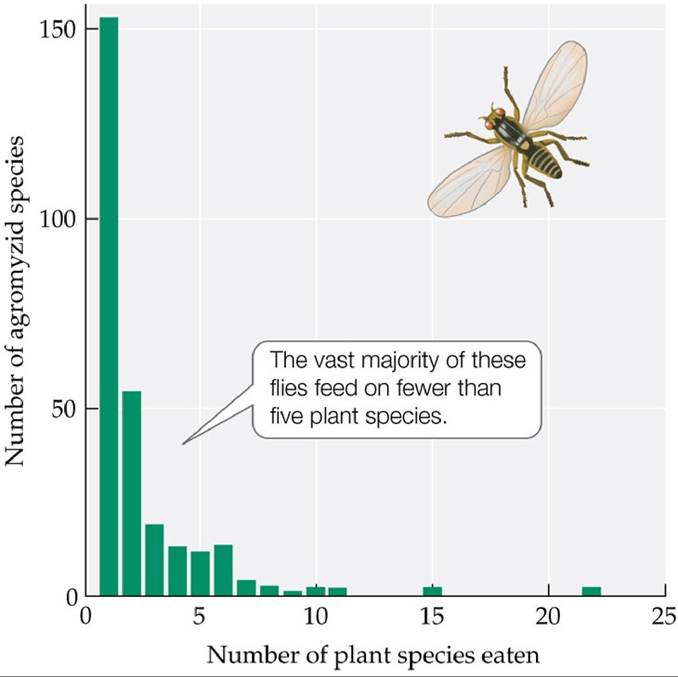
FIGURE 12.7 Most Agromyzid Flies Have Narrow Diets Thelarvaeofagromyzidfliesare leaf miners that live inside leaves and feed on leaf tissue.
Using the data in the graph, make a rough estimate of the percentage of agromyzid fly species that feed on fewer than five host plant species.
(After K. A. Spencer. 1972. Handbooks for the Identification of British Insects, Diptera, Agromyzidae, Vol.
X, Part 5G. Royal Entomological Society: London.) View larger image
There are numerous examples of herbivores that eat many plant species, however. Grasshoppers, for example, graze on a broad range of plant species, and even among the leaf miners in Figure 12.7, several species eat more than ten different plants. Large browsers, such as deer, often switch from one tree or shrub species to another; in addition, they eat all or most of the aboveground parts of many herbaceous plant species. The golden apple snail (Pomacea canaliculata) is a voracious generalist herbivore, capable of removing all the large plants from wetlands; the snail then survives by eating algae and detritus.
Now that we have considered diet preferences, we'll next focus on adaptations of predators and prey to either obtain food or avoid being eaten.