B. The actio publiciana and Defenses
Actio Publiciana
Si quem hominem Aulus Agerius (bona fide) emit
et is ei traditus est, anno possedisset, tum si eum hominem,
de quo agitur, eius ex iure Quiritium esse oporteret,
si is homo Aulo Agerio non restituetur,
quanti ea res erit, tantam pecuniam
iudex Numerium Negidium Aulo Agerio condemnato, si non paret absolvito.
Translation:
[Formula of] the Publician Action
If the plaintiff had possessed for a year the slave that he purchased in good faith, and that was delivered to him, then if this slave, about whom the action is, ought to be his [i.e., the plaintiff's] by Quiritian right [i.e., Roman civil law],
size=1 color=black face="Book Antiqua">if he is not restored to the plaintiff
the judge must condemn the defendant to pay as much money as the property is worth. If it does not so appear, he must acquit.
Defenses to the Publician Action:
Exceptiones [“affirmative defenses”] were introduced before the condemnatio of the formula (quanti ea res erit...) in the form of negative conditional clauses; replicationes [“replies to affirmative defenses”] took the form of positive conditional clauses (aut si...) and were attached to the pertinent defenses.
Exceptio rei venditae et traditae [“defense of property sold and delivered”]:
Si non Aulus Agerius fundum, quo de agitur, Numerio Negidio vendidit et tradidit.
(“If the plaintiff did not sell and deliver the land, which is the subject of this suit, to the defendant.”)Exceptio doli [“defense of fraud”]:
Si in ea re nihil dolo malo Auli Agerii factum sit neque fi at.
(“If in this matter nothing has been or is being done with fraudulent intent by the plaintiff.”)
Exceptio (iusti) dominii [“defense of valid ownership”]:
Si ea res Numerii Negidii non sit.
(“If this property is not owned by the defendant.”)
Replicatio rei venditae et traditae [plaintiff's “reply of property sold and delivered”]: Aut si Ns Ns fundum, quo de agitur, Ao Ao vendidit et tradidit.
(“Or if the defendant sold and delivered the land, which is the subject of this suit, to the plaintiff.”)
D 21.3.2 (Pomponius libro secundo ex Plautio)
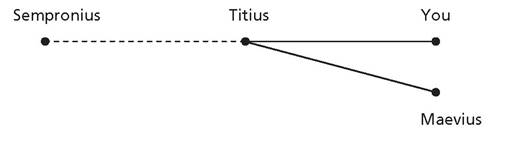
Si a Titio fundum emeris qui Sempronii erat isque tibi traditus fuerit, pretio autem soluto Titius Sempronio heres extiterit et eundem fundum Maevio vendiderit et tradiderit: lulianus ait aequius esse priorem[298] te tueri, quia et si ipse Titius fundum a te peteret, exceptione summoveretur et si ipse Titius eum possideret, Publiciana peteres.
Translation: (Pomponius in the second book of his Commentary on Plautius)[299]
If you have bought from Titius a farm that belonged to Sempronius, and this farm has been delivered to you, but after payment of the price Titius has inherited the farm from Sempronius and sold and delivered the same farm to Maevius, Julian says it would be fairer to protect you as the prior transferee, since even Titius himself, if he should wish to recover the farm from you, would be blocked by means of an exceptio, and you, even if Titius himself were in possession of the farm, could sue him with the actio publiciana.
Notes on the Text:
face="Book Antiqua">While bona fides defines a standard of behavior as well as an issue to be decided by the iudex, who is given that charge in the formula issued by the Praetor, aequitas (fairness, justice, equity) is a consideration by which the Praetor lets himself be guided in granting actions, defenses, and other legal remedies.
Aequitas thereby functions frequently as corrective of a ius civile that is perceived as rigid or imperfect.The jurists, however, also cite aequitas in other connections, if they wish to emphasize aspects like even-handedness, equal treatment, and balance.
Discussion Questions:
1) What is your legal position relative to the property of Sempronius that Titius has sold and delivered?
2) Did the subsequent inheritance of Titius have an effect on your legal position?
3) What action could Titius bring against you? Which defenses could you make effectively? Cf. Ulp. D 44.4.4.32 (Case 131).
4) What legal position does Maevius acquire in the land that Titius sold and delivered to him, although he had already sold and delivered the same land to you?
Literature:
Apathy, P. “Die actio Publiciana beim Doppelkauf vom Nichteigentümer,” ZRG 99 (1982) 158-187, at 176 ff.
Thielmann, Georg. “Nochmals : Doppelveräusserung durch Nichtberechtigte : D. 19, 1, 31, 2 und D. 6, 2, 9, 4,” ZRG 111 (1994) 197-241, 212 ff.
Ankum, Hans. ZRG 118 (2001) 442-462 (review of Potjewijd, G. H. Beschikkingsbevoegdheid, bekrachtiging en convalescentie: een romanistische Studie. Dordrecht; Boston: Kluwer, 1998.
D 44.4.4.32 (Ulpianus libro septuagensimo sexto ad edictum)
Si a Titio fundum emeris qui Sempronii erat isque tibi traditus fuerit pretio soluto, deinde Titius Sempronio heres extiterit et eundem fundum Maevio vendiderit et tradiderit: Iulianus ait aequius esse praetorem te tueri, quia et, si ipse Titius fundum a te peteret, exceptione in factum comparata vel doli mali summoveretur et, si ipse eum possideret et Publiciana peteres, adversus excipientem ‘si non suus est’ replicatione utereris, ac per hoc intellegeretur eum fundum rursum vendidisse, quem in bonis non haberet.
Translation: (Ulpian in the 76th book of his Commentary on the Praetor’s Edict)[300]
If you have bought from Titius a farm that belongs to Sempronius, and this farm has been delivered to you with payment of the price, and then Titius has inherited the farm from Sempronius and sold and delivered the same farm to Maevius, Julian says it would be fairer that the Praetor protect you, since even Titius himself, if he should wish to recover the farm from you, would be blocked by an exceptio in factum or doli.
And if he himself were in possession of the farm and you sued him with the actio Publiciana, you could meet his exceptio “if the land was not in my ownership” with a replicatio [of “fraud”]; and thereby it would be clear that he had resold a farm that he did not have in bonis [“among his goods”].color=black face="Book Antiqua">Discussion Questions:
Examine the relationship of this text from Title 44.4 of the Digest de doli mali et metus exceptione [“on the defenses of ‘fraud and fear'”] to D 21.3.2 (Case 130) from the Title entitled de exceptione rei venditae et traditae [“on the defense of ‘property sold and delivered'”].
Compare with this Text:
§ 366 Austrian Civil Code:
With the right of the owner to exclude anyone else from possession of his property is also attached the right to obtain, through the legal process of an ownership suit, repossession of formerly held property from anyone who is in possession of it. However, this right does not exist for anyone who alienated the property in his own name during the time when he was not yet the owner of it, but only acquired the ownership of it afterward.[301]
Literature:
Apathy (Case 130) 176 ff.
Thielmann (Case 130) 212 ff.
Wesener, Gunter. “Nichtediktale Einreden.” ZRG 112 (1995) 109-150, at 145 ff.
Ankum (Case 130) 451 ff.
D 6.2.9.4 (Ulpianus libro sexto decimo ad edictum)
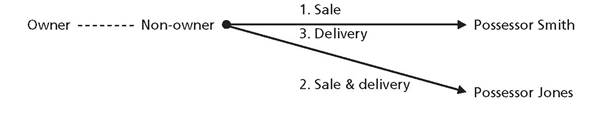
Si duobus quis separatim vendiderit bona fide ementibus, videamus, quis magis Publiciana uti possit, utrum is cui priori res tradita est an is qui [tantum] emit, et lulianus libro septimo digestorum scripsit, ut, si quidem ab eodem non domino emerint, potior sit cui priori res tradita est, quodsi a diversis non dominis, melior causa sit possidentis quam petentis.
quae sententia vera est.Translation: (Ulpian in the 16th book of his Commentary on the Praetor’s Edict)28
If someone has sold some property to two good faith purchasers separately, we must consider which of the two has a better claim to the actio Publiciana: the one to whom the property was transferred first, or the one who [only] bought it.[302] Julian writes in the seventh book of his Digesta: if both have bought from the same non-owner, the stronger claim belongs to the one to whom it was first delivered; but if they have bought from different non-owners, the position of the possessor is more favorable than that of the claimant. And that decision is correct.
Notes on the Text:
Someone who only purchased but did not take delivery of the property cannot obtain the actio Publiciana, because of the formula's requirement et is ei traditus est [“and it was delivered to him”]. Therefore the text must refer to the person “who first bought it” [rather than “who only bought it”].
1. First fact-situation:
Antiqua",serif;color:black'>[1] On author and work see Case 11 (D 18.6.1.2); on Julian see Case 70 (D 41.1.36).
2. Second fact-situation:
Non-owner Smith ·---------------------------------------------------- ► Possessor Brown
1.
Sale and deliveryNon-owner Jones ·--------------------------------------------------- k Possessor Green
1. Sale and delivery
In civil procedure generally the plaintiff must prove his right: actori incumbit probatio [“the burden of proof lies with the plaintiff1’], and also ei incumbit probatio, qui dicit, non qui negat (“the burden of proof lies with the party that asserts, not with the party that denies”)—Paul D 22.3.2. A plaintiff who demands the production of property will prevail only if his right is stronger than that of the defendant in possession: in pari causa melior est condicio possidentis (“in a case of equal claims, the position of the possessor is better”). On this point, see also the discussion under Cases 176 and 178a.
Discussion Questions:
Explain Julian's distinction and try to provide a justification for it.
Compare with this Case:
§ 372 Austrian Civil Code:
If the plaintiff does not succeed with the proof of having acquired ownership of property that is being withheld from him, but has established the valid title and the proper way by which he came into its possession, then he will be deemed the true owner as against any possessor who can produce no claim or only a weaker claim for possession.[303]
§ 374 Austrian Civil Code:
If the defendant and the plaintiff have equal claims to good possession, then the preference is owed to the defendant in virtue of the possession.[304]
Literature:
Apathy (Case 130) 161 ff.
Thielmann (Case 130) 199 ff.
D 19.1.31.2 (Neratius libro terio membranarum)
Uterque nostrum eandem rem emit a non domino, cum emptio venditioque sine dolo malo fieret, traditaque est: sive ab eodem emimus sive ab alio atque alio, is ex nobis tuendus est, qui prior ius eius adprehendit, hoc est, cui primum tradita est. si alter ex nobis a domino emisset, is omnimodo tuendus est.
Translation: (Neratius in the third book of his Legal Notes)[305]
Each of us two has bought the same thing from a non-owner. The purchase and sale took place without fraud, and the property was delivered. Whether we acquired from the same or different sellers, protection belongs to the one of us who first acquired a right in the property: that means the one to whom it was first delivered. If one of us bought from the owner, he should be protected in any case.[306]
Discussion Questions:
class=a6 style='margin-left:0cm;text-indent:18.0pt'>1) Annotate this case. What “right” is Neratius referring to?2) How might Neratius have argued against Julian D 6.2.9.4 (Case 132)?
Literature:
Apathy (Case 130) 160 ff.
Maifeld, Jan. Die aequitas bei L. Neratius Priscus. Trier: WVT Wissenschaftlicher Verlag, 1991, 32 ff., 48 ff.
Thielmann (Case 130) 199 ff.
C.
More on the topic B. The actio publiciana and Defenses:
- B. The actio publiciana and Defenses
- BEHAVIORAL DEFENSES OF VERTEBRATES
- Legis Actio
- Host defenses and parasite counterdefenses both have costs
- Immune systems, biochemical defenses, and symbionts can protect hosts against parasites
- Hausmaninger H., Gamauf R.. A Casebook on Roman Property Law. Oxford University Press,2013. — 371 p., 2013
- Parasites have mechanisms that circumvent host defenses
- Contents
- The actio negatoria[307]
- I CIVIL PROCEDURE IN THE CLASSICAL PERIOD