Immune systems, biochemical defenses, and symbionts can protect hosts against parasites
Host organisms have a wide range of defensive mechanisms that can prevent or limit the severity of parasite attacks. For example, a host may have a protective outer covering, such as the skin of a mammal or the hard exoskeleton of an insect, that can keep ectoparasites from piercing its body or make it difficult for endoparasites to enter.
Endoparasites that do manage to enter the host's body are often killed or rendered less effective by the host's immune system, biochemical defenses, or defensive symbionts.Immune Systems
The vertebrate immune system includes specialized cells that allow the host to recognize microparasites to which it has been previously exposed; in many instances, the “memory cells” of the immune system are so effective that the host has lifelong immunity against future attack by the same microparasite species. Other immune system cells engulf and destroy parasites or mark them with chemicals that target them for later destruction.
Plants can also mount highly effective responses to invasion by parasites. Some plants have resistance genes, the different alleles of which provide protection against microparasites with particular genotypes; we will describe this defense system in more detail in Concept 13.3. Plants are not helpless, however, even when they lack alleles that provide resistance to a specific attacker. In such a case, the plant relies on a nonspecific immune system that produces antimicrobial compounds, including some that attack the cell walls of bacteria and others that are toxic to fungal parasites (FIGURE 13.7). The plant may also produce chemical signals that “warn” nearby cells of imminent attack, and still other chemicals that stimulate the deposition of lignin, a hard substance that
provides a barricade against the invader's spread.
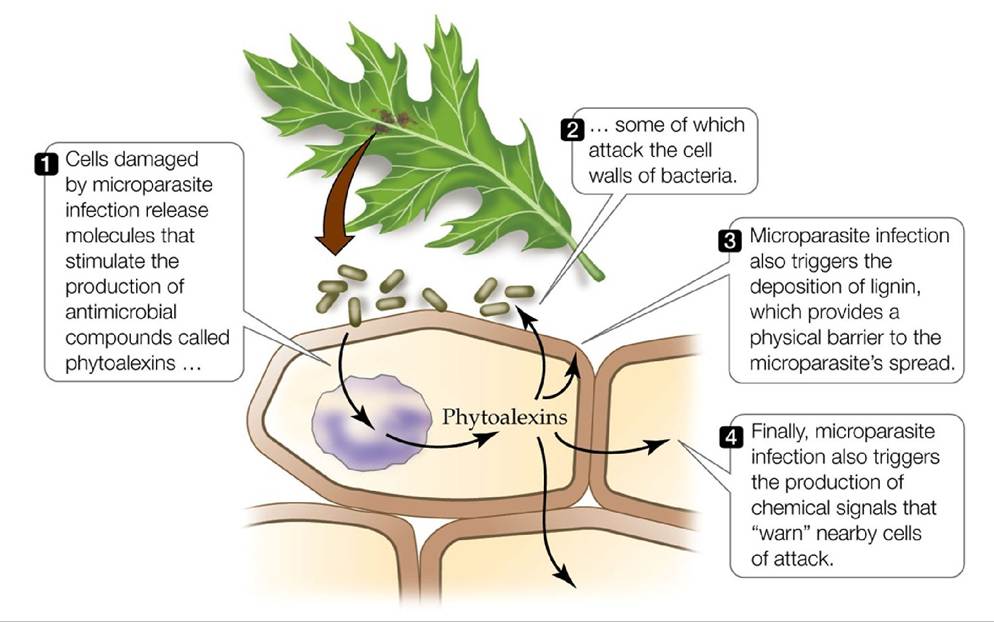
FIGURE 13.7 NonspecificPlantDefenses Plantscanmountanonspecificdefensive response that is effective against a broad range of fungal and bacterial microparasites.
View larger imageBiochemical Defenses
Hosts have ways of regulating their biochemistry to limit parasite growth. Bacterial and fungal endoparasites, for example, require iron to grow. Vertebrate hosts—including mammals, birds, amphibians, and fishes—have a protein called transferrin that removes iron from their blood serum (where parasites could use it) and stores it in intracellular compartments (where parasites cannot get to it). Transferrins are so efficient that the concentration of free iron in mammalian blood serum is only 10-26 M—so low that parasites cannot grow in vertebrate blood unless they can somehow outmaneuver the host. To do this, some parasites steal iron from the transferrin itself and use it to support their own growth.
Similar biochemical battles occur between plants and their parasites. As we saw in Concept 12.2, plants use a rich variety of chemical weapons to kill or deter the organisms that eat them. Plant defensive secondary compounds are so effective that some animals eat specific plants in order to treat or prevent parasite infections. For example, when parasitic flies lay eggs on the bodies of woolly bear caterpillars, the caterpillars switch from their usual food plant (lupines) to a diet of poisonous hemlock (Karban and English-Loeb 1997). The new diet does not kill the parasites, but it does increase the chance that the caterpillar will survive the attack and metamorphose into an adult tiger moth (Platyprepia virginalis). Chimpanzees infected with the nematode Oesophagostomum Stephanostomum specifically seek out and eat a bitter plant that scientists have learned contains compounds that kill or paralyze the nematodes and can also deter many other parasites (Huffman 1997). Humans do essentially the same thing: we spend billions of dollars each year on pharmaceuticals that are based on compounds originally obtained from plants.
Defensive Symbionts
Some organisms are aided in their defense against parasites by mutualistic symbionts such as bacteria and fungi.
For example, fungal symbionts living within leaves protect grasses and plants such as cacao trees (the source of the beans used to make chocolate) from attack by pathogens. Growing evidence also indicates that bacterial symbionts living within the human digestive tract can protect us against disease-causing organisms (Britton and Young 2012).Many such “defensive symbionts” are heritable, meaning the symbiont is reliably transmitted from a host to its offspring. We might expect that hosts harboring heritable defensive symbionts should increase in frequency in a population when parasites are common—and indeed, that frequently happens. For example, in a laboratory experiment, the frequency of pea aphids (Acyrthosiphon pisum) harboring the bacterial symbiont Hamiltonella defensa increased rapidly in the presence of a lethal wasp parasite (Oliver et al. 2008). This was expected, because the symbiont is heritable and because pea aphids harboring the symbiont survived at higher rates than did pea aphids lacking the symbiont. In another study on pea aphids, the bacterial symbiont Regiella insecticola was found to protect against attack by a deadly fungal parasite (FIGURE 13.8). Defensive symbionts have also been shown to protect against attack by nematode parasites, as you can explore in ANALYZING DATA 13.1.
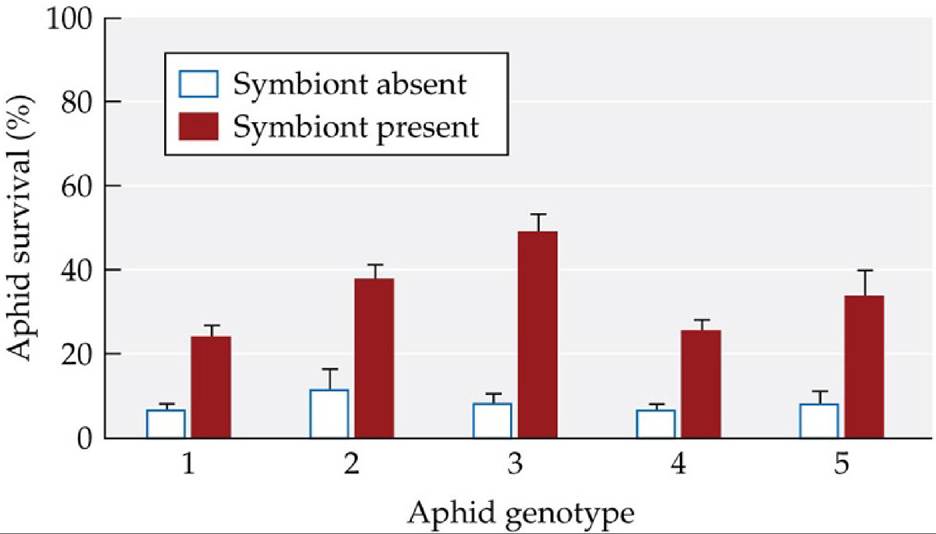
FIGURE 13.8 Protected by a Symbiont Pea aphids (Acyrthosiphon pisum) of five different genotypes were exposed to the pathogenic fungus Pandora neoaphidis. For each of these genotypes, some aphids were inoculated with the bacterial symbiont Regiella insecticola, while other aphids lacked the symbiont. Aphids harboring the symbiont survived at higher rates than did aphids lacking the symbiont. Error bars show one standard error of the mean. (After C. L. Scarborough et al. 2005. Science 310: 1781.) View larger image
ANALYZING DATA 13.1
Will a Defensive Symbiont Increase in Frequency in a Host Population Subjected to Parasitism?
Although we would expect heritable defensive symbionts to increase in frequency in host populations subjected to parasitism, few studies have tested this hypothesis.
Jaenike and Brekke (2011)* performed such a test, using laboratory populations of the fruit fly Drosophila neotestacea. These flies harbor a bacterial symbiont of the genus Spiroplasma, which protects flies from the nematode parasite Howardula aoronymphium. Howardula can sterilize female flies and reduce the mating success of male flies.Jaenike and Brekke established five replicate populations in which flies were exposed every generation to the nematode parasite and five replicate populations in which the parasite was absent. Initially, each population had a 50:50 mixture of Spiroplasma- infected and uninfected adult flies. In a second experiment, the researchers established five replicate populations in which all flies were infected with Spiroplasma and five replicate populations in which all flies were uninfected. All populations in this second experiment were exposed to Howardula parasites (but not necessarily infected by Howardula) in the first generation only. Both experiments were run for seven fly generations. The results for each experiment are shown in the tables.
Experiment 1 Percentage of Fruit Fly Individuals
Harboring Spiroplasma Symbionts
| Treatment | Generation | ||||||
| 1 | 2 | 3 | 4 | 5 | 6 | 7 | |
| Howardula absent | 54 | 65 | 52 | 65 | 59 | 65 | 39 |
| Howardula present | 49 | 52 | 86 | 92 | 97 | 99 | 96 |
Experiment 2 Percentage of Fruit Fly Individuals Infected by the Nematode Parasite Howαrdulα
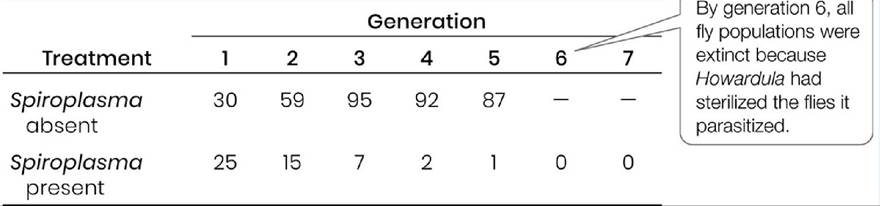
1. Plot the percentage of flies harboring Spiroplasma (y-axis) versus generation (x-axis) for both treatments in Experiment
1. Describe the hypothesis tested by this experiment. Which treatment represents the control? Do the results support the hypothesis?
2. Plot the percentage of flies infected by Howardula (y-axis) versus generation (x-axis) for both treatments in Experiment
2. Describe the hypothesis tested by this experiment. Which treatment represents the control? Do the results support the hypothesis?
3. Examine the graphs you made for Questions 1 and 2. Do the results indicate that there is a cost to flies for harboring Spiroplasma? Explain.
*Jaenike, J., and T. D. Brekke. 2011. Defensive endosymbionts: A cryptic trophic level in community ecology. Ecology Letters 14: 150-155.