As we have just seen, Plasmodium has specific mechanisms that enable it to live inside a red blood cell. When both a parasite and its host possess such specific mechanisms, that observation suggests that the strong selection pressure that hosts and parasites impose on each other has caused their populations to evolve.
Such changes have been directly observed in Australia, where the myxoma virus was introduced to control populations of the European rabbit (Oryctolagus cuniculus).
European rabbits were introduced to Australia in 1859, when 24 wild rabbits were released at a ranch in Victoria.
Within a decade, rabbit populations had grown so large, and were consuming so much plant material, that they posed a threat to cattle and sheep pasturelands and wool production. Several control measures were enacted, including introductions of predators, shooting and poisoning of rabbits, and the building of fences to limit the spread of rabbits from one region to another (Fenner and Ratcliffe 1965). None of these methods worked: by the 1900s, hundreds of millions of rabbits had spread throughout much of the continent.After years of investigation, Australian government officials settled on a new control measure: introduction of the myxoma virus. A rabbit infected with this virus may suffer from skin lesions and severe swellings, which can lead to blindness, difficulty with feeding and drinking, and death (usually within 2 weeks of infection). The virus is transmitted from rabbit to rabbit by mosquitoes. In 1950, when the virus was first used to control rabbit populations, 99.8% of infected rabbits died. In the ensuing decades, millions of rabbits were killed by the virus and the sizes of rabbit populations dropped dramatically throughout the Australian continent. Over time, however, rabbit populations evolved resistance to the virus, and the virus evolved to become less lethal (FIGURE 13.10). The myxoma virus is still used to control rabbit populations, but doing so requires a constant search for new, lethal virus strains to which the rabbit has not evolved resistance.
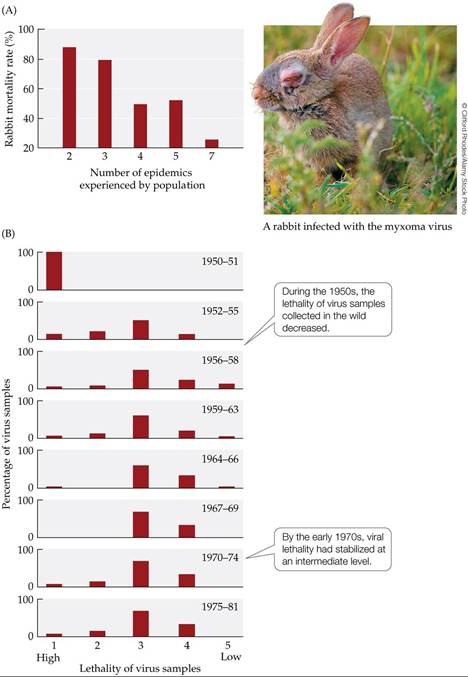
FIGURE 13.10 Coevolution of the European Rabbit and the Myxoma Virus (A) After the introduction of the myxoma virus to Australia, researchers periodically tested its lethality by collecting rabbits from a wild population and exposing them to a standard strain of the virus that killed 90% of naive (unselected) laboratory rabbits. Over time, mortality in those wild rabbits declined as the number of epidemics increased and the population evolved resistance to the virus.
(B) The lethality of virus samples collected in rabbits in the wild also declined, as was determined when they were tested against a standard (unselected) line of rabbits. (A, extracted from P, J. Kerr and S. M. Best. 1998. Myxoma virus in rabbits. In Genetic resistance to animal diseases. M. Muller and G. Brem (Eds.). Rev Sci Tech Off Int Epiz 17(1): 256-268. Available at: http://dx.doi.Org/10.20506/rst.17.1.1081. World Organisation for Animal Health at ⅜⅜ www.oie.int: B after R. M. May and R. M. Anderson. 1983. Proc R Soc London 219B: 281-313.) View larger imageThe increased resistance of the rabbit and the reduced lethality of the virus illustrate coevolution, which occurs when populations of two interacting species evolve together, each in response to selection pressure imposed by the other. The outcome of coevolution can vary greatly depending on the biology of the interacting species. In the European rabbit, selection favored the evolution of increased resistance to viral attack, as you might expect. In addition, viral strains of intermediate lethality predominated, perhaps because such strains allowed rabbits to live long enough for one or more mosquitoes to bite them and transmit the virus to another host (mosquitoes do not bite dead rabbits). In other cases of host-parasite coevolution, the parasite evolves counterdefenses to overcome host resistance mechanisms, as the following examples illustrate.