Selection can favor a diversity of host and parasite genotypes
As mentioned earlier, plant defense systems include a specific response that makes particular plant genotypes resistant to particular parasite genotypes. Such gene-for-gene interactions are well documented in a number of plant species, including wheat, flax, and Arabidopsis thaliana.
Wheat has dozens of different genes for resistance to fungi such as wheat rusts (Puccinia). Different wheat rust genotypes can overcome different wheat resistance genes, however, and periodically, mutations occur in wheat rusts that produce new genotypes to which wheat is not resistant. Studies have shown that the frequencies of wheat rust genotypes vary considerably over time as farmers use different resistant varieties of wheat. For example, a rust variety may be abundant in one year because it can overcome the resistance genes of the wheat varieties planted that year, yet less abundant the following year because it cannot overcome the resistance genes of the different wheat varieties planted that year.Changes in the frequencies of host and parasite genotypes also occur in natural systems. In the lakes of New Zealand, a trematode worm (Microphallus sp.) parasitizes the snail Potamopyrgus antipodarum. The worm has serious negative effects on its snail hosts: it castrates the males and sterilizes the females. The parasite has a much shorter generation time than its host, and hence we might expect that it would rapidly evolve the ability to cope with the snail's defensive mechanisms. Lively (1989) tested this idea in an experiment that pitted parasites from each of three lakes against snails from the same three lakes. He found that parasites infected snails from their home lake more effectively than they infected snails from the other two lakes (FIGURE 13.11). This observation suggests that the parasite genotypes in each lake had evolved rapidly enough to overcome the defenses of the snail genotypes found in that lake.
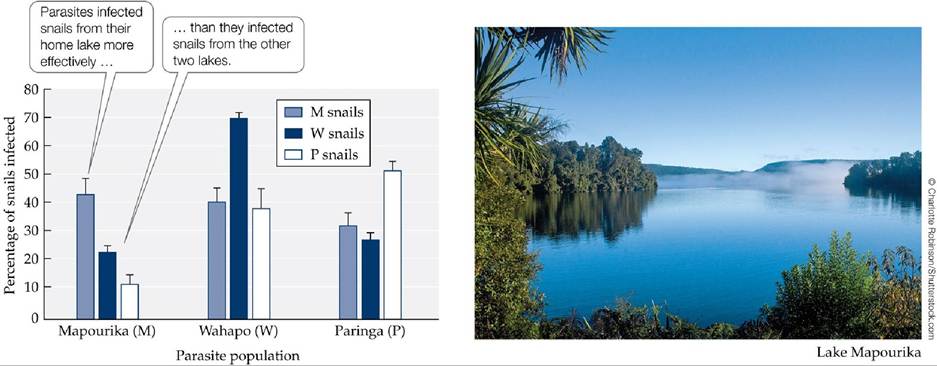
FIGURE 13.11 Adaptation by Parasites to Local Host Populations Thegraphshowsthe frequencies with which Microphallus parasites from three lakes in New Zealand (Lake Mapourika, Lake Wahapo, and Lake Paringa) were able to infect snails (Potamopyrgus antipodarum) from the same three lakes. Error bars show one standard error of the mean.
Do snails with poor defenses against parasites from their own lake also have poor defenses against parasites from other lakes? Explain.
(After C. M. Lively. 1989. Evolution 43: 1663-1671.) View larger image
The snails also evolved in response to the parasites, albeit more slowly. Dybdahl and Lively (1998) documented the abundances of different snail genotypes over a 5-year period in another New Zealand lake. The snail genotype that was most abundant changed from one year to the next. Moreover, roughly a year after a snail genotype was the most abundant one in the population, snails of that genotype had a higher-than-typical number of parasites. Together with Lively's earlier study (1989), these results suggest that parasite populations evolve to exploit the snail genotypes found in their local environment. Refining this idea further, Dybdahl and Lively hypothesized that as a result of evolution by natural selection, parasites would be able to infect snails with a common genotype at a higher rate than they could infect snails with a rare genotype. That is exactly what they found in a laboratory experiment (FIGURE 13.12). Hence, snail genotype frequencies may change from year to year because common genotypes are attacked by many parasites, placing them at a disadvantage and driving down their numbers in future years.
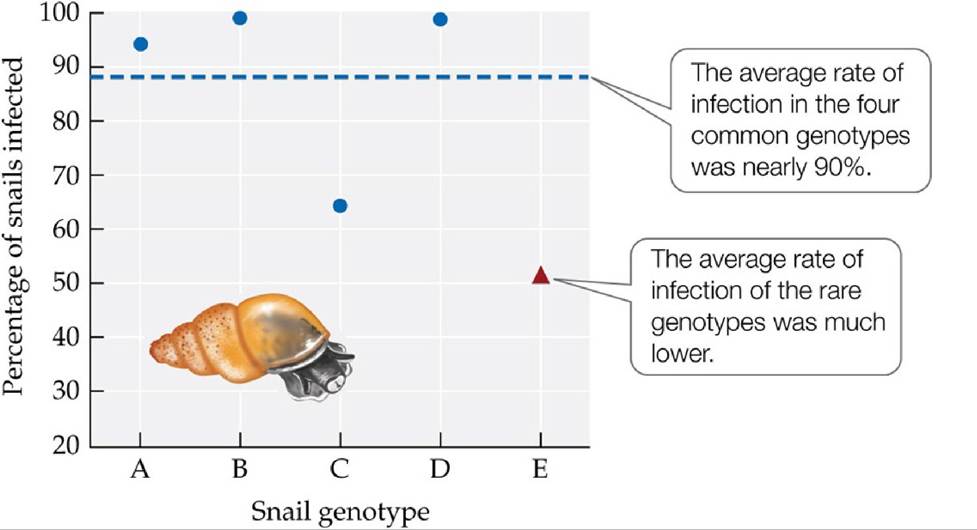
FIGURE 13.12 Parasites Infect Common Host Genotypes More Easily Than Rare Genotypes In a laboratory experiment, Dybdahl and Lively compared rates of Microphallus infection in four common snail genotypes (A-D, represented by blue dots) and in a group of 40 rare snail genotypes (E, represented by a red triangle). The parasites and snails in this experiment were all taken from the same lake. (After M. F. Dybdahl and C. M. Lively. 1998. Evolution 52: 1057-1066.) View larger image
More on the topic Selection can favor a diversity of host and parasite genotypes:
- CONCEPT 13.3 Host and parasite populations can evolve together, each in response to selection pressure imposed by the other.
- As we have just seen, Plasmodium has specific mechanisms that enable it to live inside a red blood cell. When both a parasite and its host possess such specific mechanisms, that observation suggests that the strong selection pressure that hosts and parasites impose on each other has caused their populations to evolve.
- Host defenses and parasite counterdefenses both have costs
- CONCEPT 13.1 Parasites typically feed on only one or a few host species, but host species have multiple parasite species.
- Parasite-Host Coevolution
- Host-Parasite Population Dynamics
- OEDIPUS'S ARGUMENT THAT HE DESERVES DIVINE FAVOR
- In the Case Study at the opening of this chapter, we saw lower hantavirus prevalence in small-mammal communities with higher species diversity than in those with lower species diversity (see Figure 19.2).
- Natural selection shapes animal behaviors over time
- Parasite Natural History
- Adaptations are the result of natural selection
- THYMIC SELECTION AND T CELL MATURATION
- Differences between males and females can result from sexual selection
- Personnel Selection
- Personnel Selection
- Simple models of host-pathogen dynamicssuggest ways to control the establishment and spread of diseases
- Parasites have mechanisms that circumvent host defenses