Differences between males and females can result from sexual selection
Charles Darwin (1859, 1871) concluded that the often-extravagant features of males did not provide a general advantage to members of a species, reasoning that if they did, both sexes would have them.
He proposed instead that such features resulted from sexual selection, a process in which individuals with certain characteristics gain an advantage over others of the same sex solely with respect to mating success. We'll focus initially on sexual selection among males.Evidence for Sexual Selection
Darwin pointed out that when individuals compete against others of their gender for mates, they typically use either force or displays. A male lion, for example, tries to repel his rivals by force, while a male pheasant or peacock tries to attract females to him (and away from other males) by displaying his beautiful tail feathers.
In species in which males fight over the right to mate with females, Darwin (1871) argued, the large size, strength, or special weapons of such males could have evolved by sexual selection. To make his case, Darwin began by pointing out that males often fought ferociously over females. He then described how males with the largest size, strength, and weaponry typically won such battles and therefore sired more offspring than other males. The large size, strength, or weaponry of the victors would then be passed on to their male descendants— causing these traits to become increasingly common over time. Multiple studies corroborate Darwin's argument. For example, in bighorn sheep, large rams with a long horn length typically defeat other males in battles over the right to mate with females and therefore sire more offspring than other rams (see the Case Study in Chapter 6). Since body size and horn length are heritable traits (Coltman et al. 2003; body size and horn length are also related to the age of the animal), the male offspring of the victors also tend to be large and strong.
Over time, this process causes the body and horn growth rates of males to increase.Darwin also thought that extravagant traits used by males to lure females could have arisen by sexual selection. For example, he wrote of his “conviction that the male Argus pheasant acquired his beauty gradually, through the preference of the females during many generations for the more highly ornamented males.” But Darwin's hypothesis that female mating preferences could lead to the evolution of more highly ornamented or brightly colored males was experimentally tested by few researchers prior to Malte Andersson's classic 1982 study on the long-tailed widowbird (Euplectes progne).
Male long-tailed widowbirds are mostly black and have extremely long tail feathers, the longest of which reach 50 cm. In contrast, females are mottled brown and have short tails (approximately 7 cm). Like many other animals, male widowbirds establish territories, areas that they defend against other males. In the grasslands of Kenya, where Andersson studied these birds, male widowbirds establish and defend territories in which females can feed and build their nests.
To test whether female mating preferences could have driven the evolution of the long tails found in males, Andersson captured birds and subjected them to four treatments: (1) a control treatment in which the tails of the birds were not altered; (2) a second control treatment, in which the birds' tails were first cut at the midpoint and then glued back on; (3) a treatment in which the birds' tail lengths were shortened (cut to approximately 14 cm); and (4) a treatment in which the birds' tail lengths were increased (feathers cut from birds in treatment 3 were glued to the tails of these birds).
Andersson found that males with lengthened tails had higher mating success than control males or males with shortened tails (FIGURE 8.15). There were no differences among treatments in the courtship behavior of the males or the vigor with which they defended their territories.
Overall, Andersson's results support the hypothesis that female mating preferences affect male mating success and hence may have selected for the extremely long tails of male widowbirds. Many other studies since have found similar results.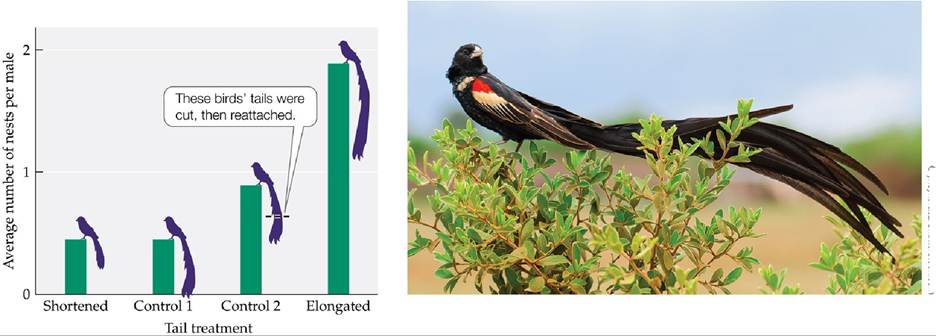
© jirisykoracz/Shutterstock.com
FIGURE 8.15 Males with Long Tails Get the Most Mates Thematingsuccessofmale long-tailed widowbirds (Euplectes progne) depends on the length of their tails, as Malte Andersson discovered by experimentally altering the tails of wild birds.
Explain why Malte Andersson used the two types of controls described in the text.
(After M. Andersson. 1982. Nature 299: 818-820.) View larger image
Benefits to Choosy Females
In some species, a male that attempts to convince a choosy female into mating with him may provide direct benefits to the female, such as gifts of food, help in rearing the young, or access to a territory that has good nesting sites, abundant food, or few predators. Nuptial gifts, usually offerings of food, are common in nature, and serve to enhance the chances that a female will select a male for mating. A bizarre form of nuptial gifts, which occurs in some spiders and mantid insects, involves sexual cannibalism or sexual suicide in which the male is consumed by the female after transferring his sperm to her. In redback spiders (Latrodectus hasselti) the male actually flips himself into the female's mandibles after successfully transferring sperm to her sperm receptacles (FIGURE 8.16). Why would the male do this, ending all future potential reproductive opportunities? Andrade (1996) discovered that a female redback spider was less likely to mate again if she had consumed her first mate, increasing the chances
that the suicidal males would pass on their genes. Furthermore, the male's chances of survival and locating a female are very low (8.16 Theultimategiftforcopulation (A) A female redback spider (Latrodectus hasselti).
(B) A much smaller male spider aligns himself on the female's abdomen and inserts sperm into her reproductive tract. (C) The male spider then raises up and flips his body over into the jaws of the female (D) who consumes him, lowering the potential she will mate with another male. (B-D after L. M. Forster. 1992. Australian J Zool 40: 1-11.) View larger imageIn some cases there are few or no apparent direct benefits provided to choosy females in mate selection. Why do females prefer to mate with males that have certain features, such as the long tail of the widowbird in the example described above, variation in color, or a loud mating call? Several hypotheses suggest that the female receives indirect genetic benefits when she chooses such a male. This may occur when her choosiness enhances the probability that her sons will mate due to some associated trait that confers higher fitness, or simply that the male's greater attractiveness to females will be inherited by her sons, enhancing their reproductive success. Evidence in support of the link between sexual signals in males and associated fitness benefits comes from studies of the associations of male coloration and parasitic infections. For example, Molnar et al. (2013) studied how variation in throat and belly color of the European green lizard (Lacerta viridis) was associated with the degree of infection by blood parasites. Previous studies had shown that experimental alteration of the belly and throat coloration of European green lizards influences both female choice for mating and the outcome of fights between males, with brighter colors favored. The researchers selected male European green lizards from populations in the wild and collected blood for assessment of protist parasitic infections. They also measured the coloration and brightness of the throat and belly using a spectrophotometer. The researchers found that nearly all (96%) of the male European green lizards they sampled were infected with blood parasites.
However, the degree of infection varied among the lizards and was negatively correlated with the brightness of both the throat and belly (FIGURE 8.17). Since the immunological defense response to parasites has a genetic basis, female selection of mates with brighter throats and bellies would benefit her offspring, supporting the hypothesis of an indirect benefit to the females' choosiness.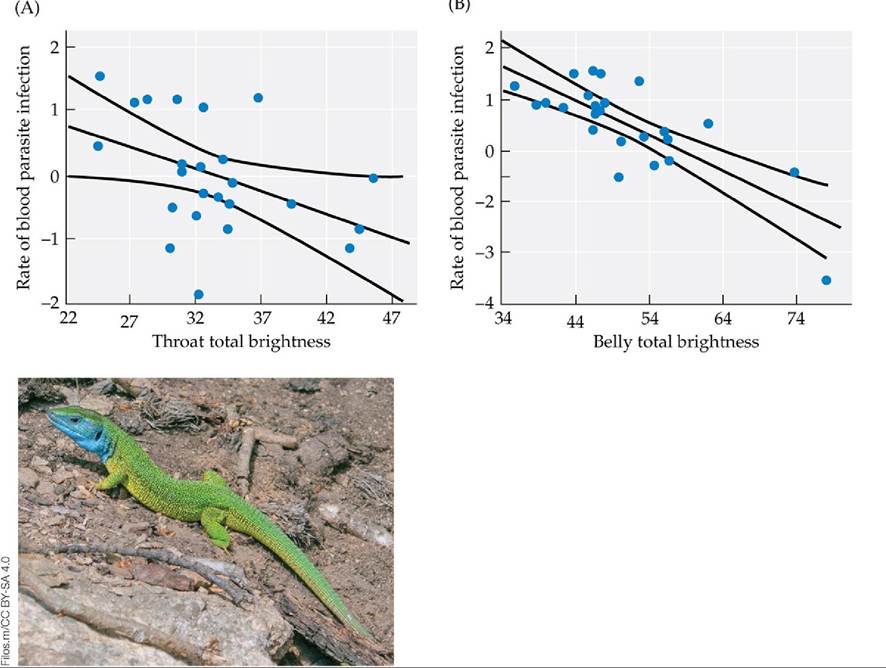
FIGURE 8.17 Skin Color Brightness Indicates Blood Parasites MaleEuropeangreen lizards (Lacerta viridis) collected from natural populations exhibit significant negative correlations between throat (A) and belly (B) brightness (reflection of light in visible wavelengths from 320 to 700 nm) and the amount of blood parasites (expressed as the residuals in the statistical model after accounting for other factors influencing infection rate). Center line is the correlation average, lines on either side are 95% confidence intervals. (After Molnar et al. 2013. Naturwissenschaften 100: 551-558.) View larger image
Numerous studies indicate that choosy females receive a variety of direct and indirect benefits when they select their mates. Next, we'll examine a question raised in the opening pages of this chapter: Why are females usually more choosy than males about who they will mate with?
More on the topic Differences between males and females can result from sexual selection:
- Males and females differ in their sexual organs and in other ways that are directly related to reproduction.
- Adaptations are the result of natural selection
- Complex cycles may result from stagespecific selection pressures
- Sexual History and Gender-Affirming Care Taking a Sexual History
- Limits of male maintenance: females as breadwinners
- THYMIC SELECTION AND T CELL MATURATION
- Sectorial differences in TFP
- Natural selection shapes animal behaviors over time
- 7. Non-neutral differences in technology
- Personnel Selection
- Personnel Selection
- What Is ‘Sexual Violence'?
- The result
- Sexual Violence
- Sexual Harassment
- Eradicating Sexual Violence