Gamete size, parental care, and ecological factors affect mating behavior
In addition to the differences we have discussed, females and males often differ in how much energy and resources they invest in their offspring. Such investments begin with the production of gametes and may continue in species in which the parents care for their offspring as they develop into young adults.
As we'll see, parental investments in offspring, along with ecological factors, can help us to understand the wide range of mating behaviors found in animal populations.Why are Females Usually Choosier than Males?
One potential explanation for female choosiness comes from anisogamy: when there are large differences in size between the egg cells of a female and the sperm cells of a male (see Figure 7.8B). Because female gametes are so much larger than male gametes, a female typically invests more resources in producing a single gamete than does a male, including the nutritive material to support the developing embryo, and hence she has more at stake in each one. However, it should be noted that producing sperm also requires energy expenditure and can compromise fitness in males, and a comparison of single gametes may not provide an accurate view of the differential investment of males and females (Wedell et al. 2002).
In many species, females invest large amounts of resources as their offspring develop. For example, under natural conditions, a chicken hen incubates her eggs to keep them warm, and then cares for her chicks for several weeks after they hatch. The rooster does not provide any care for the young chicks. What is true for chickens is true for many other species as well: females spend more of their time and energy caring for their offspring than males do.
How do differences in gamete size and parental care relate to mating behavior? Since reproduction is costly, we would expect that in species in which females invest more time and energy in their offspring than males do, females will be choosy and males will compete for the right to mate with females.
Moreover, where males invest relatively little per offspring produced, we would expect that males could produce more offspring during their lifetime than females could. This expectation often holds (TABLE 8.1). When the reproductive potential of males is higher than that of females, selection should favor different mating behaviors in males and females: it should be advantageous for a male to mate with as many females as possible, whereas a female should “protect” her investment by choosing to mate only with males that provide ample resources or that appear to be of high genetic quality.TABLE 8.1 Examples of the Reproductive Potential of Males and Females
| Maximum number of offspring produced during lifetime | ||
| Species | Male | Female |
| Elephant seal | 100 | 8 |
| Red deer | 24 | 14 |
| Human | 888 | 69 |
Source: N. B. Davies et al. 2012. An Introduction to Behavioral Ecology, 4th ed. Wiley-Blackwell: Oxford. Data from B. J. Le Boeuf and J. Reiter. 1988. In Reproductive Success, T. H. Clutton-Brock (Ed.), pp. 344362. Chicago University Press: Chicago, IL; T. H. Clutton-Brock et al. 1982. Red Deer: The Behavior and Ecology of Two Sexes. Chicago University Press: Chicago, IL.
As we've seen, observations in nature are often consistent with these predictions. But what about the exceptions, species in which females compete with one another to mate with males? Assuming that the mating behavior of such species has been shaped by natural selection, we would expect that where males provide more parental care than females, the males would be choosy in mate selection, leading to competition among females for the right to mate.
Field observations generally support this. For example, in the red phalarope (Phalaropus fulicarius, a shorebird; see Figure 8.2), females are larger and more brightly colored than males and compete with other females to mate, aggressively pursuing males with circular flight patterns or swimming after them. After successful mating the female lays her eggs, then abandons the nest in search of another mate, leaving the male to incubate the eggs. Another example of male parental care leading to greater competition among females to mate is found in the pipefish Syngnathus typhle. Male pipefish select as their mates the largest, most highly ornamented females, as they generally produce more eggs than other females do. The male pipefish carries the developing fertilized eggs in a special pouch that protects, aerates, and nourishes the fertilized eggs (Berglund and Rosenqvist 1993). A male does not mate while he is carrying the fertilized eggs, but during that time a female can produce additional eggs and mate with several other males. Thus, females have higher reproductive potential than males do, and (as predicted) they compete for the right to mate with males.Ecological Factors and Mating Behavior
As we saw in Concept 8.2, the foraging decisions of individuals are affected by ecological factors, such as a heterogeneous environment or the presence of predators. Not surprisingly, ecological factors can also affect decisions about mating. Female guppies, for example, mate less often and become less particular in their choice of mates (settling for less brightly colored males) when predators are present (Godin and Briggs 1996). Similar results have been found for many other species. Overall, the evidence shows that in fishes, birds, mammals, and other animals, an individual's decision to mate and its “choosiness” can be altered by such ecological factors as the number and spatial locations of potential mates, the quality of those mates, the availability of food, and the presence of predators or competitors.
Ecological factors can also influence the mating system, a term that refers to the number of mating partners that males or females have and the pattern of parental care. A rich variety of mating systems occur in nature (TABLE 8.2), and mating systems can vary not only among closely related species, but even among individuals within a population of a single species. How can we make sense of this variation? In a groundbreaking paper, Emlen and Oring (1977) argued that the diverse mating systems seen in nature result from the behaviors of individuals striving to maximize their reproductive success, or fitness.
TABLE 8.2 MatingSystems
| Mating system | Description |
| Monogamy | A male mates with only one female, and she with him. This pairing may last for one or more breeding seasons. In many cases, both parents care for the young. |
| Polygyny | One male mates with multiple females in a breeding season. The male may control access to these females directly (by fighting with other males) or indirectly (by controlling access to resources that females seek, such as food or good nesting sites). The female usually provides most or all of the parental care. |
| Polyandry | One female mates with multiple males in a breeding season. The female may defend these males directly (by fighting with other females) or indirectly (by controlling access to food or other resources). The male usually provides most or all of the parental care. |
| Promiscuity | Both males and females mate with multiple partners in a breeding season. |
Let's consider the logic of Emlen and Oring's approach from a male perspective. As mentioned earlier, males typically have greater reproductive potential than females; hence, the reproductive success of males will often be limited by access to potential female mates.
Under certain conditions, this imbalance can lead to polygyny, a mating system in which one male mates with multiple females in a breeding season. As Emlen and Oring (1977) wrote, “Polygyny occurs if environmental or behavioral conditions bring about the clumping of females, and males have the capacity to monopolize them.” For example, the availability of food or nest sites may affect where females are found. Whether females settle close to or far away from one another may determine whether a male can acquire and defend more than one mate (FIGURE 8.18).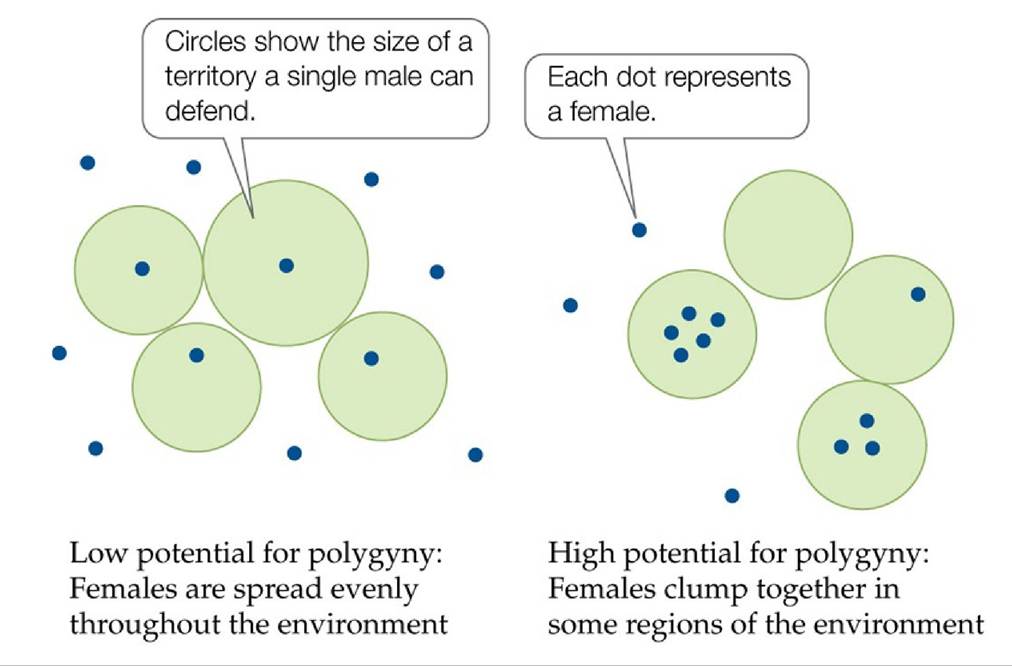
FIGURE 8.18 Ecological Factors Can Affect the Potential for Polygyny Inthisdiagram, dots represent the locations of females and circles show the size of a territory that a male can defend. View larger image
Experimental studies in birds, fishes, and mammals have illustrated particular cases in which females clump together in high-resource areas—and the males then follow the females to those same areas. Moreover, in some cases, field observations indicate that the availability of resources is correlated with both the locations of females and the mating system. For example, Martin and Martin (2007) found that the brushtail possum (Trichosurus cunninghami) was monogamous in a habitat where food and nest sites (and hence females) were widely separated, but polygynous in a habitat where food and nest sites (and hence females) were located closer to one another. Similarly, Lukas and Clutton- Brock (2013) found that monogamy usually occurs in mammalian species where it is difficult for males to defend access to more than one breeding female—as hypothesized by Emlen and Oring's original paper.
More on the topic Gamete size, parental care, and ecological factors affect mating behavior:
- CONCEPT 8.3 Mating behaviors reflect the costs and benefits of parental investment and mate defense.
- Mating Behavior
- Landscape patterns affect ecological processes
- CONCEPT 15.3 Positive interactions affect the abundances and distributions of populations as well as the structure of ecological communities.
- Density-dependent factors regulate population size
- Density-independent factors can determine population size
- A general theme that runs through this book is that ecological interactions can affect the distributions and abundances of species, affecting communities and ecosystems.
- CONCEPT 11.2 Population size is determined by a combination of density-dependent and density-independent factors.
- Researchers studying animal behavior can seek to answer questions using a variety of approaches focusing on different aspects of the behavior under study.
- Primary care for children with special health care needs may include consideration for palliative care services
- Patient- and family-centered care (PFCC) is a philosophy of care that recognizes and respects the pivotal role of both the patient and the family in the delivery of medical care.
- Patient- and family-centered care (PFCC) is a philosophy of care that recognizes and respects the pivotal role of both the patient and the family in the delivery of medical care.
- CONCEPT 11.4 Life tables show how survival and reproduction vary with age or size structure, influencing population growth and size.
- Some populations exhibit logistic growth, a pattern in which abundance increases rapidly at first and then stabilizes at a population size known as the carrying capacity, the maximum population size that canbe supported indefinitely by the environment
- Olinaltecan Parental Protection and Distrust