Density-independent factors can determine population size
In many species, year-to-year variation in weather leads to dramatic changes in abundance and hence in population growth rates. For example, Davidson and Andrewartha (1948) studied how weather in Adelaide, Australia, affected populations of the insect Thrips imaginis, a pest of roses.
By correlating weather conditions with thrips population sizes over a 14-year period, they showed that yearly fluctuations in population size could be predicted accurately by an equation that used temperature and rainfall data (FIGURE 11.8).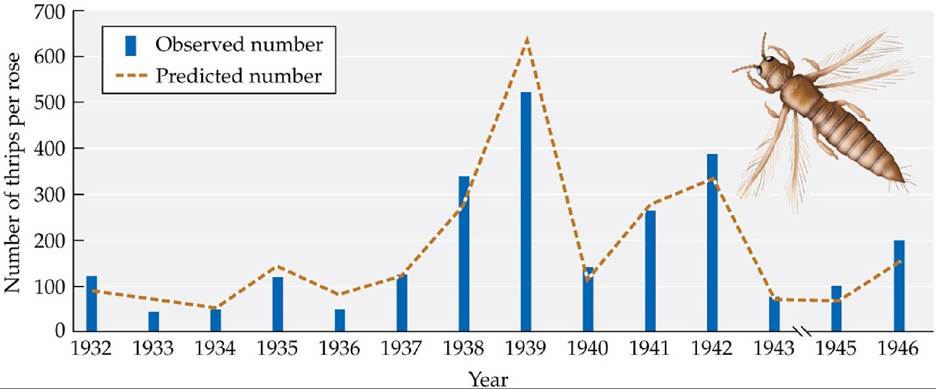
FIGURE 11.8 Weather Can Influence Population Size DavidsonandAndrewartha accurately predicted the mean number of thrips per rose observed in Adelaide, Australia, using an equation based on four weather-related variables. (After J. Davidson and H. Andrewartha. 1948. J Anim Ecoi 17: 200-222.) View larger image
The effects of climate can also change the birth or death rates of species more gradually over time, as is the case for forests across broad regions of the western United States.
Climate Change Connection
Effects of Climate Change on Tree Mortality Rates
Over the course of several decades, mortality rates increased gradually in populations of coniferous forest trees across the western United States (FIGURE 11.9). These increases occurred in stands of seemingly healthy forest that had not been cut for more than 200 years, leading researchers to ask, “What is killing the trees?”
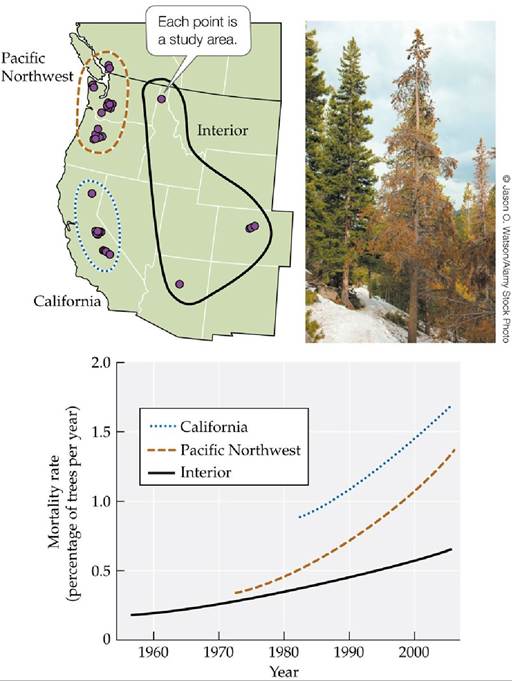
FIGURE 11.9 Rising Tree Mortality Rates Trends in coniferous tree mortality rates for 76 study plots located in the three regions of the western United States shown on the
map. (After P. J. van Mantgem et al. 2009. Science 323: 521-524.) View larger image
In seeking an answer to this question, Van Mantgem et al.
(2009) ruled out several possible causes, including air pollution, forest fragmentation, changes in fire frequency, and within-stand increases in the intensity of competition. The researchers went on to note that during the time period covered by their study, regional temperatures in the western United States had increased at rates of 0.3°C to 0.5°C per decade. These rapid temperature increases were associated with declines in the snowpack, earlier spring snowmelt, and a lengthening of the summer dry period. These changes caused an increase in the trees' climatic water deficit (the amount by which a plant's annual evaporative demand for water exceeds available water). Previous studies had shown that tree mortality rates tend to increase when climatic water deficit increases (Bigler et al. 2007). Overall, van Mantgem et al.'s study suggests that the rise in tree mortality rates was driven by regional warming and the ensuing drought stress. Similarly, in the southwestern United States, warmer temperatures in the summer and reduced snowfall in the winter have produced “hotter droughts” that are associated with increases in the area burned by wildfires and the area affected by insect outbreaks— again causing tree mortality rates to rise (Williams et al. 2013).4_______________________________________________________________________________________________________________________________________________________________________________________________________________________________
Population size can also fluctuate as a consequence of biotic factors, such as hunting. For example, in 2002, a system for recording the cause of death of elephants was established in 45 sites across Africa. Wittemyer et al. (2014) combined that information with other demographic data to estimate how elephant population growth rates have changed over time (FIGURE 11.10).
Their analyses indicated that across the African continent, elephant population growth rates have dropped below λ = 1.0, primarily because of a rapid increase in illegal poaching (for tusk ivory) after 2009.
For example, 100,000 elephants were killed for ivory over a 3-year period (2010-2012)—a level of illegal killing that cannot be sustained. To prevent elephants from becoming extinct in the wild, elephant population growth rates must increase and remain above λ = 1.0. For this to occur, new efforts must be taken to curb the rate of illegal killing and reduce the global demand for illegal ivory.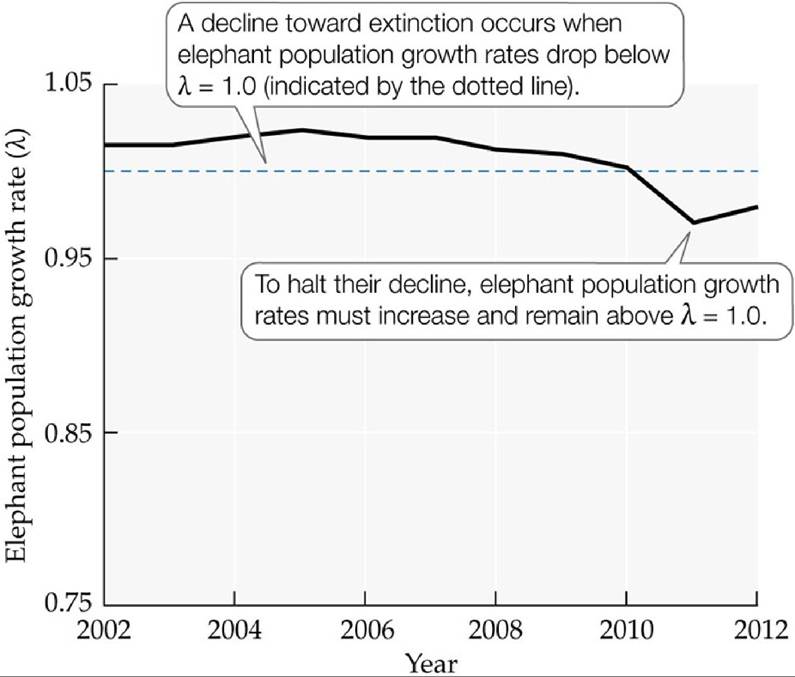
FIGURE 11.10 Will Elephants Become Extinct in the Wild? Populationgrowthrates(A) for 306 elephant populations show that elephants have been in decline across the African continent since 2010. (After G. Wittemyer et al. 2014. Proc NatlAcad Sci USA 111: 13117-13121.) View larger image
As these examples suggest, density-independent factors can have major effects on population size from one year to the next. In principle, such factors could account entirely for year-to-year fluctuations in the size of a population. But density-independent factors do not tend to increase the size of populations when they are small and decrease the size of populations when they are large. A factor that did consistently lead to such changes would cause the population growth rate to change as a function of density—that is, to be density dependent, not density independent.
More on the topic Density-independent factors can determine population size:
- CONCEPT 11.2 Population size is determined by a combination of density-dependent and density-independent factors.
- Density-dependent factors regulate population size
- Some populations exhibit logistic growth, a pattern in which abundance increases rapidly at first and then stabilizes at a population size known as the carrying capacity, the maximum population size that canbe supported indefinitely by the environment
- CONCEPT 11.4 Life tables show how survival and reproduction vary with age or size structure, influencing population growth and size.
- The logistic equation models densitydependent population growth
- Life histories can be classified independent of size and time
- Fluctuations in population size can increase the risk of extinction
- Gamete size, parental care, and ecological factors affect mating behavior
- CONCEPT 11.3 The logistic equation incorporates limits to growth and shows how a population may stabilize at a maximum size, the carrying capacity.
- The European Neolithic was a period of enormous cultural, social and economic change affecting subsistence strategies, settlement patterns, technology and population size, as well as ideologies and world views.
- Density dependence has been observed in many populations
- General laws of environmental factors effect on organisms. Limiting factors. Minimum law of Liebig, tolerance law of Shelford
- Bone and Mineral Density Disorders
- Effects of Density
- Seasonal changes in aquatic environments are associated with changes in water temperature and density
- Biological and geochemical fluxes both determine the global sulfur cycle
- The goal of analyzing an income statement is essentially to determine whether the story it tells is good, bad, or indifferent.