Seasonal changes in aquatic environments are associated with changes in water temperature and density
Aquatic environments in the temperate and polar zones also experience seasonal changes in temperature, but as we have seen, they are not as extreme as those on land. Liquid water becomes denser as it gets colder, and it has the unique property of being most dense at 4°C.
Ice is less dense than liquid water and therefore forms on the surfaces of water bodies in winter. Because it has a higher albedo than open water, ice on the surface of lakes or polar oceans effectively prevents warming of the water below it.Differences in water temperature (and thus water density) with depth result in the stratification, or layering, of water in oceans and lakes. Stratification has important implications for aquatic organisms because it determines the movement of nutrients and oxygen. Surface waters in lakes and oceans mix freely, but they are underlain by colder, denser layers of water that do not mix easily with the surface waters. In oceans, the surface waters mix with the subsurface layers only rarely—for example, in upwelling zones.
In temperate-zone lakes, seasonal changes in water temperature and density result in seasonal changes in stratification (FIGURE 2.22). In summer, the surface layer, or epilimnion, is the warmest and contains active populations of phytoplankton and zooplankton. The epilimnion is underlain by a zone of rapid temperature decline, called the thermocline. Below the thermocline is a stable layer of the densest, coldest water in the lake, known as the hypolimnion. In summer, dead organisms from the epilimnion will drop to the hypolimnion and bottom (benthic) zone, carrying nutrients and energy away from the surface layers.
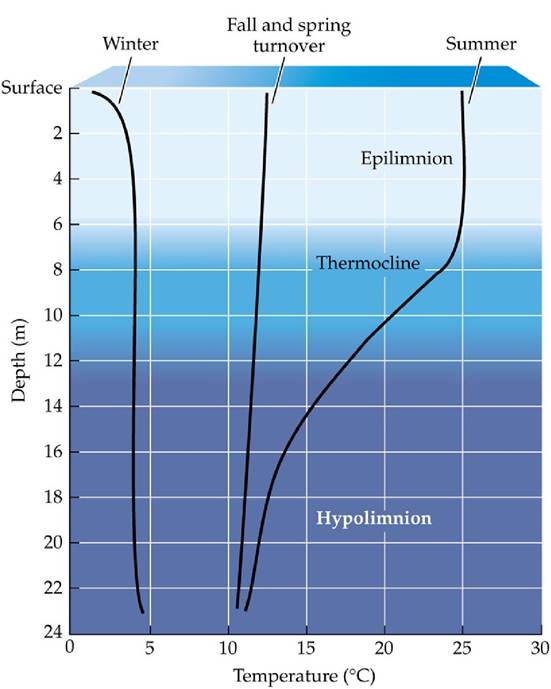
FIGURE 2.22 Lake Stratification Lake stratification, which occurs primarily in summer in temperate and polar regions, results from the effects of temperature on water density.
Seasonal changes in water temperature result in the turnover of water that mixes little during summer and winter.Why would seasonal changes in lake stratification be unlikely to occur in tropical lakes?
(After S. Dodson. 2004. Introduction to Limnology. McGraw Hill: New York.) View larger image
During the fall, the air above the water surface cools, and the lake loses heat to the atmosphere. As the epilimnion cools, its density increases until it is the same as that of the layers below it. Eventually, the water at all depths of the lake has the same temperature and density, and winds blowing on the surface lead to a mixing of surface and deep layers, known as lake turnover. This mixing is important for recycling of the nutrients that are lost from the epilimnion during
summer. In addition, lake turnover moves oxygen into the hypolimnion and the sediments at the lake bottom. The replenishment of nutrients at the surface and of oxygen at the bottom, where it is used up by the respiration of aerobic bacteria during summer, increases biological activity throughout the lake. Turnover occurs again in spring when the surface ice melts and the lake water has a uniform density once again.
More on the topic Seasonal changes in aquatic environments are associated with changes in water temperature and density:
- Competition in seasonal environments: temporal overlap
- 4 Coping with Environmental Variation: Temperature and Water
- CONCEPT 3.2 Biological zones in freshwater ecosystems are associated with the velocity, depth, temperature, clarity, and chemistry of the water.
- CONCEPT 11.2 Population size is determined by a combination of density-dependent and density-independent factors.
- Water is essential for life. Water is the medium in which all biochemical reactions necessary for physiological functioning occur.
- CONCEPT 4.3 The water balance of an organism is determined by exchanges of water and solutes with the external environment.
- MORBILLIVIRUS INFECTIONS IN AQUATIC MAMMALS
- Temperature
- Density dependence has been observed in many populations
- Seasonal Patterns of Trading Activity
- A modelling framework and a seasonal MacArthur system
- Density-dependent factors regulate population size
- Temperature controls physiological activity
- INFLUENZA IN AQUATIC MAMMALS
- Nutrients in Aquatic Ecosystems
- Bone and Mineral Density Disorders