Climate variation over years and decades results from changes in atmospheric pressure cells
Peruvian fishermen have long been aware of times when the normally productive ocean waters hold few fish and the weather becomes extremely wet. They named these climate episodes El Nino, for the Christ child, because they usually started around Christmas.
El Nino events are associated with a switch (or oscillation) in the positions of high-pressure and low-pressure cells over the equatorial Pacific, which leads to a weakening of the easterly trade winds that normally push warm water toward Southeast Asia. Climatologists refer to this oscillation and the climate changes associated with it as El Nino Southern Oscillation, or ENSO. Its underlying causes are still not well understood. The frequency of ENSO is somewhat irregular, but it occurs at intervals of 3-8 years and generally lasts for about 18 months. During El Nino events, the upwelling of deep ocean water off the coast of South America ceases as the easterly winds weaken or, in some events, shift to westerly winds. ENSO also includes La Nina events, which are stronger-than-average phases of the normal pattern, with high pressure off the coast of South America and low pressure in the western Pacific. La Nina events usually follow El Nino events but tend to be less frequent.ENSO is associated with unusual climate conditions, even at localities distant from the tropical Pacific, through its complex interactions with atmospheric circulation patterns (FIGURE 2.23). El Nino events are associated with unusually dry conditions in the Malay Archipelago, other parts of Southeast Asia, and Australia. The likelihood of fires in the grasslands, shrublands, and forests of these areas increases as precipitation decreases and vegetation dries out. In contrast, in the southern United States and northern Mexico, El Nino events may increase precipitation, while the ensuing La Nina events bring drought conditions. The increased plant growth associated with an El Nino event, followed by dry La Nina conditions, intensifies fires in the southwestern United States (Veblen et al.
2000).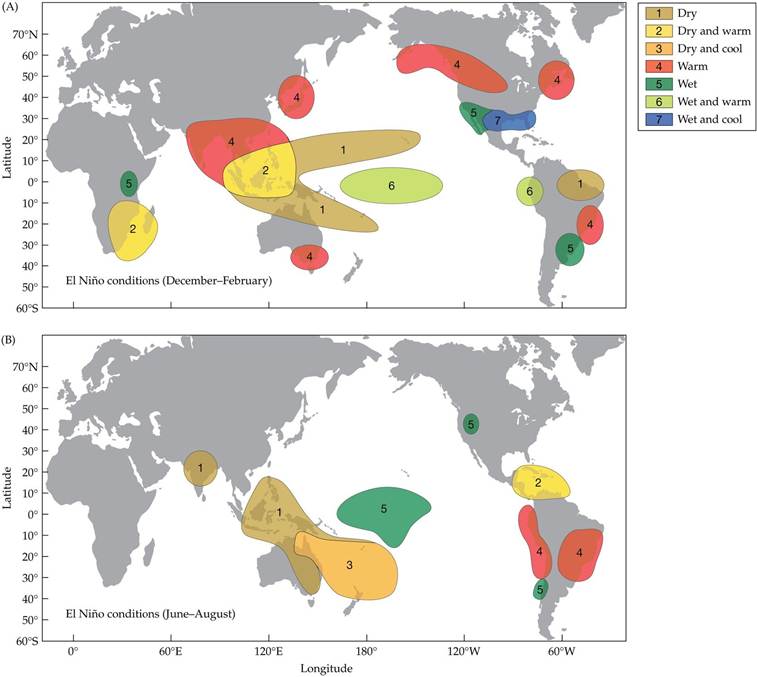
FIGURE 2.23 El Nino Southern Oscillation (ENSO) El Nino events have widespread
climate effects that vary seasonally, altering temperature and precipitation patterns at a global scale. (Courtesy of NOAA Tropical Atmosphere Ocean Project.) View larger image
Similar atmospheric pressure-ocean current oscillations occur in the North Atlantic Ocean. The North Atlantic Oscillation affects climate variation in Europe, in northern Asia, and on the east coast of North America. Another longterm oscillation in sea surface temperature and atmospheric pressure, known as the Pacific Decadal Oscillation, or PDO, was described for the North Pacific after its influence on salmon numbers was discovered, as described in the Case Study earlier in this chapter. The PDO affects climate in ways similar to ENSO and can moderate or intensify the effects of ENSO. The effects of the PDO are felt primarily in northwestern North America, although southern parts of North America, Central America, Asia, and Australia may also be affected. The PDO and the North Atlantic Oscillation have been linked to long-term droughts in the United States (e.g., the U.S. Dust Bowl in the 1930s; see the Case Study for Chapter 25). We will return to the PDO in the Case Study Revisited.
Long-term changes in climate have occurred throughout Earth's history, including glacial-interglacial cycles and extended periods of much warmer climate than what is occurring now. These long-term climate fluctuations are associated with differences in the amount of solar radiation received and the concentrations of greenhouse gases.