Seasonality results from the tilt of Earth's axis
The amount of sunlight striking any point on Earth's surface varies as Earth makes its 365.25-day journey around the sun. Earth's axis is tilted at an angle of 23.5° relative to the sun's direct rays (FIGURE 2.20).
Thus, the angle and intensity of the rays striking any point on Earth change as Earth orbits the sun. This influence of the tilt of Earth's axis overrides the variation associated with seasonal changes in the distance between Earth and the sun due to Earth's slightly elliptical orbit. Earth is closest to the sun in January (at a point called the perihelion: 237 million km or 147 million miles) and farthest away in July (at the aphelion: 245 million km or 152 million miles).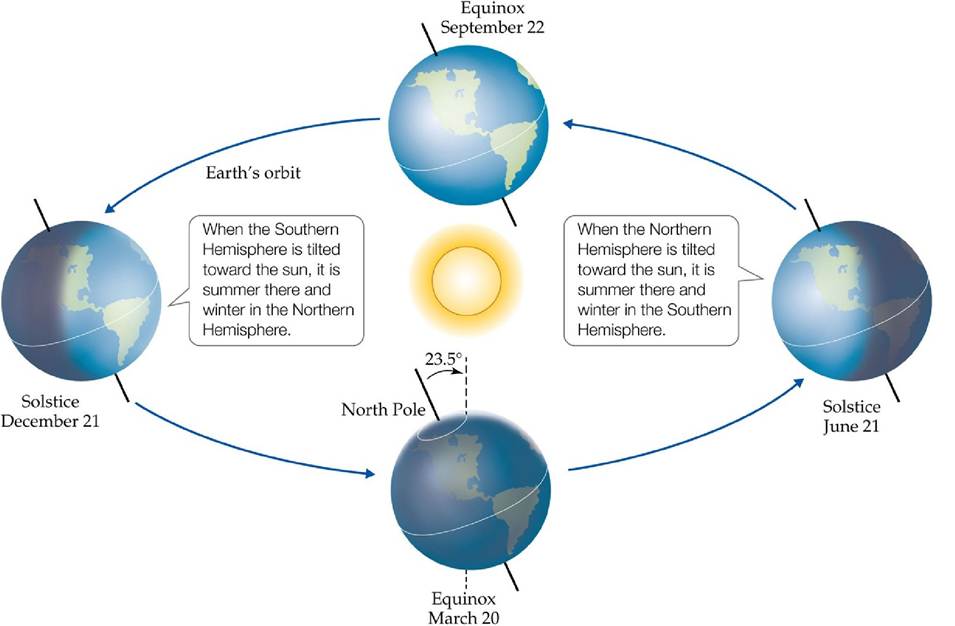
FIGURE 2.20 The Tilt of Earth's Axis Causes Seasonal Changes As Earth orbits the sun over the course of a year, its orientation relative to the sun changes because of the tilt of its axis of rotation. The resulting changes in the intensity of solar radiation create seasonal climate variation. (After C. D. Ahrens. 2005. Essentials of Meteorology. Thomson Brooks/Cole: Boston, MA.) View larger image
The temperate and polar zones experience pronounced changes in temperature associated with variation in solar radiation over the year. Summer occurs in the Northern Hemisphere from June to September, when that hemisphere is tilted toward the sun; at the same time, the Southern Hemisphere is oriented away from the sun and experiences its winter. The difference in solar radiation, and thus the temperature variation, between summer and winter increases from the tropics toward the poles. The seasonal changes in the angle of the sun affect not only the intensity of solar radiation, but also the length of the day. Above 66.5°N and S, the sun does not set for several days, weeks, or even months in summer.
During the winter at these same latitudes, the sun does not rise high enough to warm the surface. Because air temperatures regularly drop below freezing during winter in the temperate and polar zones, seasonality in these zones is an important determinant of biological activity and strongly influences the distributions of organisms.
Seasonal changes in solar radiation are relatively small in the tropics compared with those in the temperate and polar zones. As a result, seasonality in the tropics is marked primarily by changes in precipitation rather than by changes in temperature. These seasonal changes are associated with the movement of the zone of maximum air uplift and precipitation in the Hadley cells, known as the intertropical convergence zone, or ITCZ. This zone of maximum uplift corresponds with the part of the tropics where the sun strikes Earth most directly. Thus, the ITCZ moves from 23.5°N in June to 23.5°S in December, bringing the wet season with it (FIGURE 2.21).
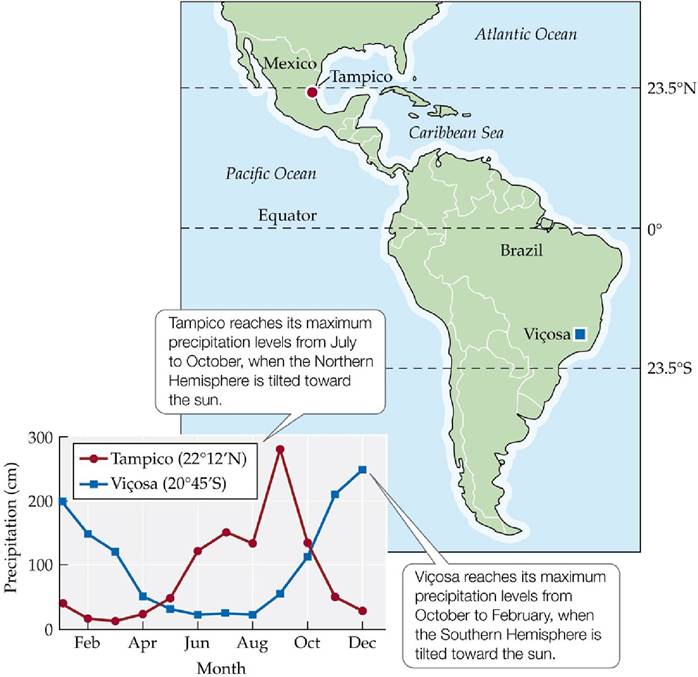
FIGURE 2.21 Wet and Dry Seasons and the ITCZ Seasonalityofprecipitationinthe tropics is associated with movement of the intertropical convergence zone (ITCZ) between the tropics of the Northern and Southern Hemispheres. Thus, Tampico, Mexico, reaches its maximum precipitation levels from July to October and has a dry season from November to April, whereas Viposa, Brazil, has a wet season from October to February and a dry season from April to August. (Data from NOAA GHCN-Monthly, version 2; T. C. Peterson and R. S. Vose. 1997. Bull Am Meteorol Soc 78: 2837-2849.) View larger image