The logistic equation models densitydependent population growth
To see how the idea of a carrying capacity can be represented in a mathematical model of population growth, let's reconsider Figure 11.12. The data in both graphs show that population growth rates (r or λ) decreased approximately as a straight line as population densities increased.
But r is assumed to be constant in the exponential growth equation, dN/dt = rN. As we've seen, a constant value of r > 0 allows for unlimited growth in population size. Thus, to modify the exponential growth equation to make it more realistic, we replace the assumption that r is constant with the assumption that r declines in a straight line as density (N) increases. When we do this, we obtain the logistic equation: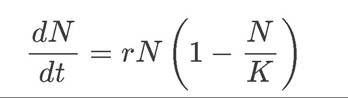
(11.6)
where dN/dt is the rate of change in population size at time t, N is population density (also at time t), r is the (per capita) intrinsic rate of increase under ideal conditions, and K is the density at which the population stops increasing in size. K can be interpreted as the carrying capacity of the environment, and the term (1 - N/K) can be viewed as the fraction of the carrying capacity that is available for population growth. As long as the population size is less than the carrying capacity (i.e., N < K), only a fraction of the available resources are being used and the population will continue to grow. As the population size approaches the carrying capacity, however, the fraction of resources available for individuals becomes smaller and the population growth slows and ultimately stops at K.
Just as you saw with Equation 11.4, we can rearrange Equation 11.6 to allow us to predict the population size at some later time, assuming logistic growth. When we do this, we get

(11.7)
Logistic growth is similar to, but slightly slower than, exponential growth when densities are low (FIGURE 11.14).
This occurs because when N is small, the term (1 - N/K) is close to 1, and hence a population that grows logistically grows at a rate close to r. As the population density increases, however, logistic growth and exponential growth differ greatly. In logistic growth, the rate at which the population changes in size (dN/dt) approaches zero as the population size nears the carrying capacity, K. As a result, over time, the population size approaches K gradually, eventually remaining constant with K individuals in the population.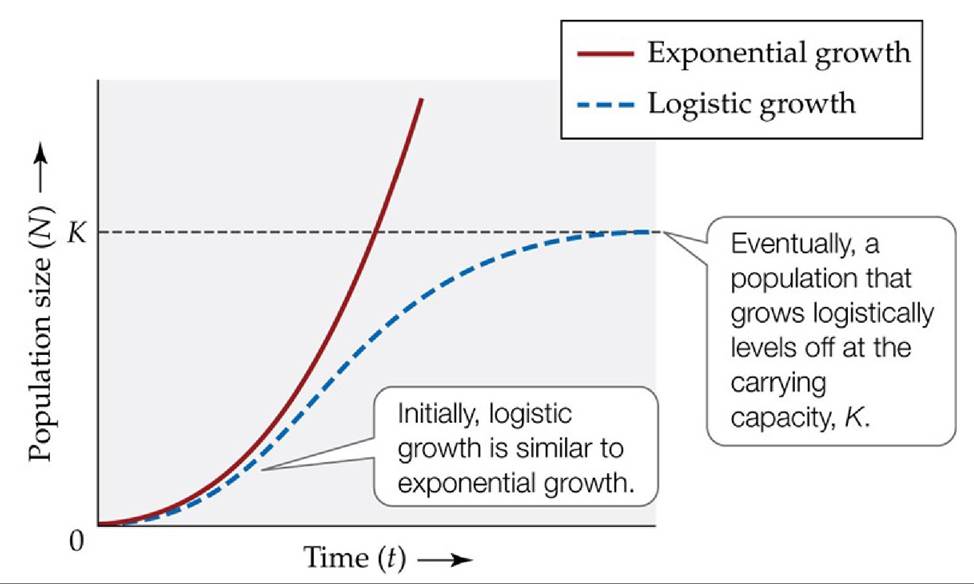
FIGURE 11.14 Comparison of Logistic and Exponential Growth Over time, logistic growth differs greatly from the unlimited growth of a population that increases exponentially. In the logistic equation, as the population size (N) becomes increasingly close to the carrying capacity, K, how does that affect the term (1 - N/K)? Why does this cause N to stop increasing in size?
View larger image
In Concept 10.1, we discussed the extent to which the growth of natural populations can be described by the S-shaped curve that results from the logistic equation; here, we examine efforts to fit the logistic equation to U.S. census data.
More on the topic The logistic equation models densitydependent population growth:
- CONCEPT 11.3 The logistic equation incorporates limits to growth and shows how a population may stabilize at a maximum size, the carrying capacity.
- CONCEPT 11.2 Population size is determined by a combination of density-dependent and density-independent factors.
- Density-dependent factors regulate population size
- Can logistic growth predict the carrying capacity of the U.S. population?
- In logistic growth, the population approaches an equilibrium
- Some populations exhibit logistic growth, a pattern in which abundance increases rapidly at first and then stabilizes at a population size known as the carrying capacity, the maximum population size that canbe supported indefinitely by the environment
- Working independently of each other, A. J. Lotka (1932) and Vito Volterra (1926) both modeled competition by modifying the logistic equation.
- CONCEPT 14.3 Competitive interactions can be modeled using the logistic equation.
- Density-independent factors can determine population size
- Consequences of non-logistic resource growth
- Logistic Growth