Some populations exhibit logistic growth, a pattern in which abundance increases rapidly at first and then stabilizes at a population size known as the carrying capacity, the maximum population size that canbe supported indefinitely by the environment
The growth of such a population can be represented by an S-shaped curve (FIGURE 11.13). The growth rate of the population decreases as the population size nears the carrying capacity because resources such as food, water, or space begin to be in short supply.
At the carrying capacity, the growth rate is zero, and hence the population size does not change.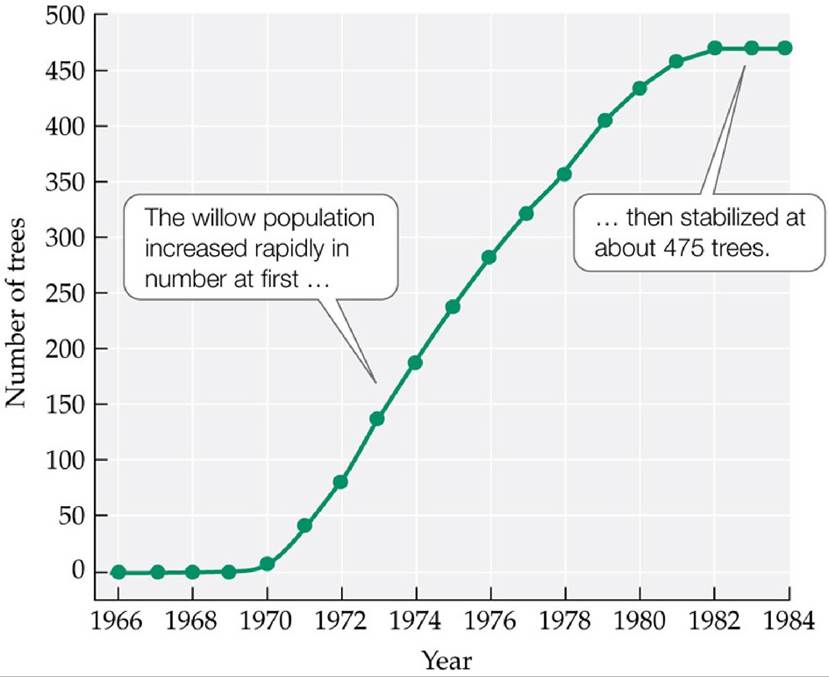
FIGURE 11.13 An S-Shaped Growth Curve in a Natural Population AtasiteinAustralia, heavy grazing by rabbits had prevented willows from colonizing the area. The rabbits were removed in 1954, opening up new habitat for willows. When willows colonized the area in 1966, ecologists tracked the growth of their population. (After M. C. Alliende and J. L. Harper. 1989. JEcol 77: 1029-1047.) View larger image
More on the topic Some populations exhibit logistic growth, a pattern in which abundance increases rapidly at first and then stabilizes at a population size known as the carrying capacity, the maximum population size that canbe supported indefinitely by the environment:
-
General ecology -
-
Conflictology -
Ecology -
Economy -
Finance -
History -
Law -
Medicine -
Philosophy -
Religious studies -