Working independently of each other, A. J. Lotka (1932) and Vito Volterra (1926) both modeled competition by modifying the logistic equation.
Recall from the discussion under Concept 11.3 that in the logistic equation, the rate at which a population changes in size (dN/dt) is 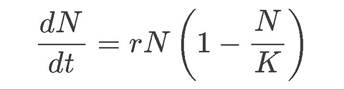
or, alternatively,
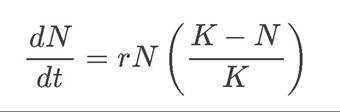
where N is the population size, r is the intrinsic rate of increase (the maximum possible growth rate for the species, achieved only under ideal conditions), and K is the number at which the population stops increasing in size (which can be interpreted as the carrying capacity of the population).
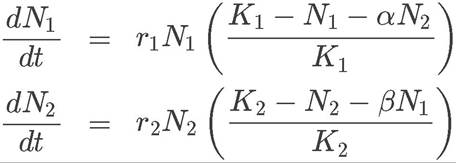
As we have seen in Concept 14.2, competition deprives species of resources and hence reduces population growth rates. Thus, the presence of a competitor should reduce the growth rate of the original population. To incorporate the effects of the competitor species on one another, we can modify the logistic equation of each species by subtracting a competition coefficient, which is a constant used to indicate how strong the competitive effect of one species is on another. The new equations, known as the Lotka-Volterra competition model, can be written as
(14.1)
In these equations, N1 is the population density of species 1, r1 is the intrinsic rate of increase of species 1, and K1 is the carrying capacity of species 1; N2, r2, and K2 are similarly defined for species 2. The competition coefficients (α and β) are constants that describe the effect of one species on the other: α is the effect of species 2 on species 1, and β is the effect of species 1 on species 2. For example, if α = 1, then individuals of the two species have the same effect in depressing the growth of species 1.
If α = 5, each individual of species 2 decreases the growth of species 1 by the same amount as five additional individuals of species1. Thus, the competition coefficient α is a measure of the effect, on a perindividual basis, of species 2 on the population growth of species 1, measured relative to the effect of species 1. Similar reasoning applies to β, which is the effect, on a per-individual basis, of species 1 on the population growth of species
2.
We can also think of α and β as “translation terms,” each of which converts the number of individuals of one species into the number of individuals of the other species that has an equivalent effect on population growth rates. For example, if α = 3, one individual of species 2 decreases the growth of species 1 by the same amount as would three individuals of species 1. Thus, if there are 100 individuals of species 2, it would take 300 individuals of species 1 to decrease the growth rate of species 1 by the same amount as do the 100 individuals of species 2 (i.e., α = 3 and N2 = 100, so it takes α N2 = 3 ? 100 = 300 individuals of species 1 to have an equivalent effect).
In the remainder of this section, we'll see how Equation 14.1 can be used to predict the outcome of competition; then we'll explore how competitive coexistence is affected by species interaction strength.
More on the topic Working independently of each other, A. J. Lotka (1932) and Vito Volterra (1926) both modeled competition by modifying the logistic equation.:
- CONCEPT 14.3 Competitive interactions can be modeled using the logistic equation.
- The Lotka-Volterra Competition Model
- The Lotka-Volterra model
- The logistic equation models densitydependent population growth
- Why the Lotka-Volterra and MacArthur models are insufficient
- CONCEPT 11.3 The logistic equation incorporates limits to growth and shows how a population may stabilize at a maximum size, the carrying capacity.
- Predator-prey cycles can be modeled mathematically
- Disease-Modifying Antirheumatic Drugs
- Population Losses, 1926-1939
- The Famine of 1932–33
- Can logistic growth predict the carrying capacity of the U.S. population?
- Consequences of non-logistic resource growth
- Organisms influence their temperature by modifying energy balance
- Intellectual humility has something important in common with trust: both, independently, help secure knowledge. But they also do so in tandem, and this chapter discusses how.